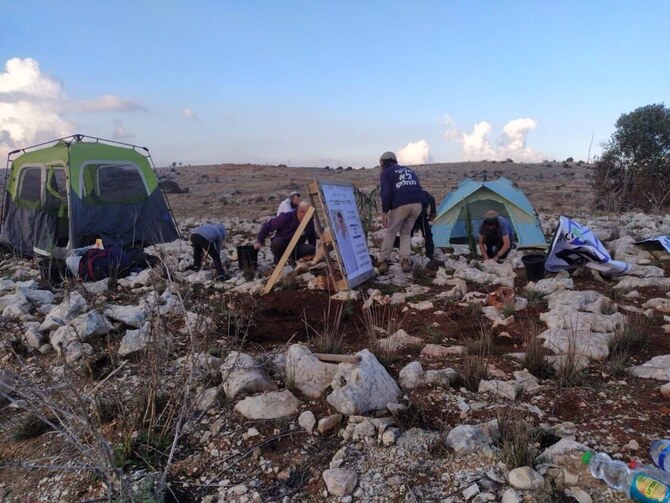

BEIRUT: Israeli settlers crossed into Lebanese territory on Wednesday, entering the border town of Maroun Al-Ras in a significant incident.
The group erected tents and took pictures of themselves in the area.
The Israeli army, which has been present in Lebanese territory since Oct. 1 and remains in the border area, said that the “serious matter” is being investigated.
Photos taken by the settlers showed two tents and a group of men accompanied by two children. The group raised banners featuring the Star of David, with the Lebanese cedar — symbolic of the Lebanese flag — prominently displayed in the center.
It was later discovered that one of the settlers had recently shared a video on social media in which he told his child, who accompanied him, that Lebanon belongs to Israel. The video had previously ignited widespread outrage in Lebanon.
The Israeli violations extended to areas near sites belonging to UNIFIL forces operating south of the Litani River.
A UNIFIL statement reported “activities by the Israeli army near one of our sites in Maroun Al-Ras,” describing the incident as “both dangerous and unacceptable, as it jeopardizes the safety of our personnel.”
The two incidents coincided with a meeting of the committee responsible for overseeing the implementation of the ceasefire agreement. Held at the headquarters of the Italian unit in Ras Al-Naqoura, the talks brought together military representatives from the US, France, Lebanon, Israel and UNIFIL.
For the third consecutive day, Israeli forces have continued demolishing and bulldozing homes, particularly in the town of Naqoura.
According to the town’s mayor, Ali Awada, “the extent of systematic destruction in the town has reached 70 percent since the ceasefire agreement took effect on Nov. 27.”
Awada added: “The Israeli forces are systematically demolishing the town, located just 3 km from the border. We have been unable to assess the full extent of the damage or losses firsthand, as the Israeli military has prohibited citizens from entering the town to inspect their properties. However, images and videos from the area clearly reveal Israeli machinery bulldozing homes, shops and civilian facilities in what seems to be a calculated act of retaliation against the town and its people.”
He expressed his surprise at “the failure of UNIFIL forces and those responsible for monitoring the ceasefire to prevent Israeli forces from demolishing infrastructure and civilian facilities in several towns, particularly in Naqoura, where the UNIFIL headquarters is located.”
The destruction extended to areas of Tyre Harfa, Al-Jabeen and Sheheen in the Tyre District, with residents of Tyre reporting the sound of explosions.
Israeli military reconnaissance aircraft were operating at low altitudes around the clock over the southern airspace as well as Beirut and its southern suburbs.
The Lebanese army, in coordination with UNIFIL forces, recovered several bodies of Hezbollah members who were killed in confrontations with the Israeli army during the extensive war launched by the Israeli military.
In the town of Adaisseh, located in the Marjeyoun district, the estimated number of bodies was about 30, all of which were retrieved by the Lebanese Red Cross.
The process of retrieving the bodies from the town of Taybeh is still awaiting approval from Israel, as requested by UNIFIL forces.
Civil defense teams continued their search for casualties in the northern neighborhood of Khiam following the withdrawal of the Israeli army from the area and the advance of the Lebanese army.
Caretaker Prime Minister Najib Mikati received a report from Tamara El-Zain, secretary-general of the National Council for Scientific Research in Lebanon, titled “Israeli Aggressions Against Lebanon and Sectoral Damages.”
It was prepared by the council in collaboration with the UN Development Program in Lebanon.
The headquarters of the Lebanese Press Syndicate in Beirut witnessed a rally by dozens of activists from the Shiite Muslim community opposing Hezbollah, hailing from the south and the Bekaa. Their objective was to launch a rescue plan under the slogan “The State Protects Us.”
Media activist Mohammed Barakat said: “It is necessary to take the Shiite sect into the state project, after it was proved that sects and weapons do not protect a group of Lebanese, and after the fall of sectarian dominance projects in all regions.
“We tried (using) weapons. It turned out that they do not protect us. True security can only be achieved through the state and international resolutions.”
Barakat added that Shiites in Lebanon want “a Lebanon with one army, without militias that want to liberate Palestine or loose groups with weapons in all the alleys and sects.”
He said that Lebanon should, ultimately, be a “democratic parliamentary system, based on electoral processes rather than dominated by weapons, assassinations and black shirts.”
The activists highlighted the “legitimacy of the state, its constitution, the Taif Agreement, Arab legitimacy and Resolution 1701.”
Abiding by these would safeguard the Lebanese population, “particularly those residing in the South, the Bekaa Valley and the southern suburbs of Beirut,” they said.
“Lebanon should serve as the ultimate homeland for all its citizens, embracing an Arab identity and affiliation, characterized by shared interests, prosperity, development and investment.”