

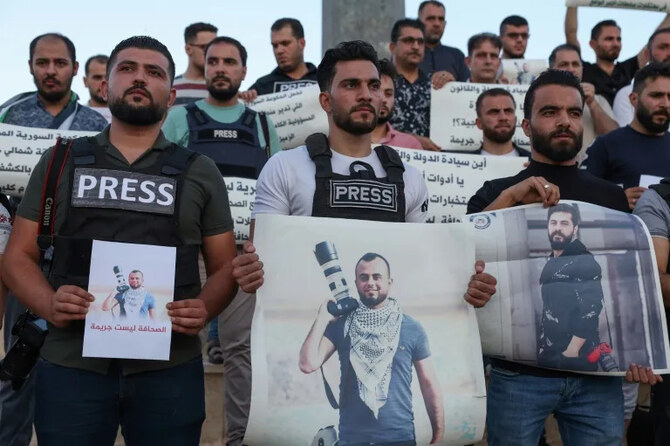
Media watchdog condemns Israel over killing of 4 Gaza journalists, demands accountability

According to CPJ, at least 133 journalists have been killed in Gaza since the outbreak of the conflict 15 months ago, making it the deadliest conflict for journalists since record-keeping began. (AFP/File)
Short Url
Updated 17 December 2024
Follow

Media watchdog condemns Israel over killing of 4 Gaza journalists, demands accountability

  • Iman Al-Shanti, Mohammed Al-Qrinawi, Mohammed Balousha, and Ahmed Al-Louh were killed between Dec. 11 and 15
  • At least in two cases, the attacks were described as ‘deliberate,’ Committee to Protect Journalists reported

LONDON: The Committee to Protect Journalists has condemned Israel’s recent attacks in Gaza, which have killed four journalists in the past week alone, and renewed calls for the international community to hold Tel Aviv accountable for its actions against media workers.

“At least 95 journalists and media workers have been killed worldwide in 2024,” CPJ’s CEO Jodie Ginsberg said in New York. “Israel is responsible for two-thirds of those deaths and yet continues to act with total impunity when it comes to the killing of journalists and its attacks on the media.”

Between Dec. 11 and 15, Israeli forces carried out multiple deadly strikes targeting media workers in Gaza, killing Iman Al-Shanti, Mohammed Al-Qrinawi, Mohammed Balousha, and Ahmed Al-Louh. Sources claim that at least two of the journalists were clearly identifiable by their press vests and accused the Israeli army of deliberately targeting civilians in the area.

On Wednesday, Al-Shanti, a 36-year-old journalist who worked for Al Aqsa Radio and contributed to Al Jazeera’s AJ+ platform, was killed alongside her family in an Israeli airstrike on Gaza’s Sheikh Radwan neighborhood.

On Friday, Al-Qrinawi, editor at the local Snd news agency, was killed with his wife and three children in an Israeli strike on Al-Bureij refugee camp in central Gaza.

That same day, Balousha, a 38-year-old journalist reporting for Dubai-based Al Mashhad Media, died in a direct Israeli drone strike while returning from a medical checkup in northern Gaza City. Al Mashhad described the attack as deliberate.

On Saturday, Al-Louh, a 39-year-old freelance journalist who contributed to multiple outlets, including Al Jazeera, was killed in an Israeli airstrike on Nuseirat camp in Gaza City. He became the seventh journalist from Al Jazeera to be killed during the war.

Following Al-Louh’s death, Israeli Defense Forces spokesperson for Arabic media Avichay Adraee accused him of being a member of the Palestinian Islamic Jihad. However, as in similar past claims, Adraee failed to provide evidence to support the allegation. Al Jazeera condemned the killing as a “war crime” and part of a “systematic targeting of journalists in Gaza aimed at intimidating and deterring them.”

According to CPJ, at least 133 journalists have been killed in Gaza since the outbreak of the conflict 15 months ago, making it the deadliest conflict for journalists since record-keeping began. The real toll is believed to be significantly higher.

Media watchdogs and international organizations have repeatedly called for Israel and its leaders to be held accountable for what some human rights groups describe as ethnic cleansing. However, these demands have so far failed to produce tangible results.

The CPJ reached out to the Israeli military’s North America Media Desk, asking whether the IDF was aware of civilian presence in the areas it bombed and if journalists had been targeted for their work. The IDF replied that it required more time to investigate but did not specify a timeline for its response.


Pioneering Asharq Al-Awsat journalist Mohammed al-Shafei dies at 74

Updated 08 January 2026
Follow

Pioneering Asharq Al-Awsat journalist Mohammed al-Shafei dies at 74

  • Egyptian was known for his fearless coverage of terrorist, extremist groups
  • One of handful of reporters to interview Taliban leader Mullah Omar in 1970s

LONDON: Mohammed al-Shafei, one of Asharq Al-Awsat’s most prominent journalists, has died at the age of 74 after a 40-year career tackling some of the region’s thorniest issues.

Born in Egypt in 1951, al-Shafei earned a bachelor’s degree from Cairo University in 1974 before moving to the UK, where he studied journalism and translation at the University of Westminster and the School of Oriental and African Studies.

He began his journalism career at London-based Arabic papers Al-Muslimoon and Al-Arab — both of which are published by Saudi Research & Publishing Co. which also owns Arab News — before joining Al-Zahira after Iraq’s 1990 invasion of Kuwait.

Al-Shafei joined Asharq Al-Awsat in 1991 and spent 15 years on the sports desk before shifting to reporting on terrorism. He went on to pioneer Arab press coverage in the field, writing about all aspects of it, including its ideologies and ties to states like Iran.

His colleagues knew him for his calm demeanor, humility and meticulous approach, marked by precise documentation, deep analysis and avoidance of sensationalism.

Al-Shafei ventured fearlessly into terrorist strongholds, meeting senior terrorist leaders and commanders. In the 1970s he was one of only a handful of journalists to interview Mullah Omar, the leader of the Taliban, and conducted exclusive interviews with senior figures within Al-Qaeda.

He also tracked post-Al-Qaeda groups like Daesh, Hay’at Tahrir al-Sham and Boko Haram, offering pioneering analysis of Sunni-Shiite extremism and how cultural contexts shaped movements across Asia and Africa.

During the war on Al-Qaeda, he visited US bases in Afghanistan, embedded with international forces, and filed investigative reports from active battlefields — rare feats in Arab journalism at the time.

He interviewed Osama bin Laden’s son, highlighting a humanitarian angle while maintaining objectivity, and was among the few Arab journalists to report from Guantanamo, where his interviews with Al-Qaeda detainees shed light on the group’s operations.

Al-Shafei married a Turkish woman in London in the late 1970s, with whom he had a son and daughter. He was still working just hours before he died in London on Dec. 31.