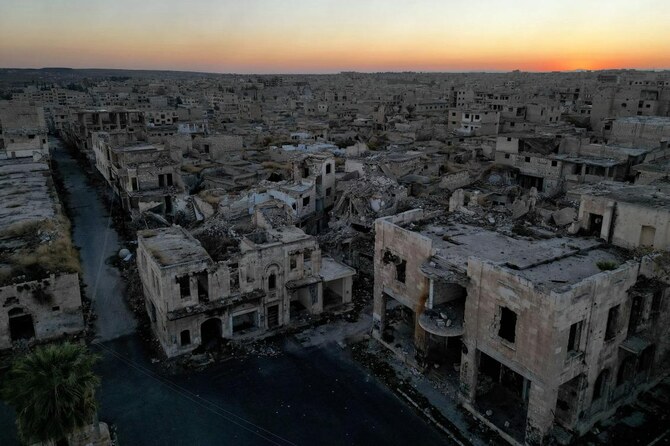
MAARET AL-NUMAN, Syria: Vegetation grows between crumbled walls and torn asphalt, and not a single street remains intact in Syria’s Maaret Al-Numan, a key war battleground town being brought back to life by returnees.
Bilal Al-Rihani reopened his pastry shop in the western town this week with his wife and 14-year-old son.
The 45-year-old baker couldn’t stay away after years of exile, even amid the devastation surrounding him.
Working without water or electricity, the shop bustles with customers as they prepare cinnamon pastries — a family speciality for 150 years.
Cars weave through the ruins, honking to announce their arrival. Like Rihani, his customers are former residents displaced by war, eager to rebuild their homes and lives.
“I’m doing better business here than in the (displacement) camp!” Rihani said, pointing to the cracked road outside. “This street was the town’s busiest, day and night.”
Once home to nearly 100,000 people, Maaret Al-Numan was devastated by years of war, turning it into a ghost town and a symbol of Syria’s destruction.
The town’s location on the strategic M5 highway, linking second city Aleppo to the capital Damascus, made it a key battleground from the outbreak of fighting in 2012.
Islamist rebel group Hayat Tahrir Al-Sham, the group now in power after ousting long-time president Bashar Assad over a week ago, seized it in 2017.
But in 2020, Assad’s forces backed by Russian air strikes retook the town after intense fighting, forcing the last remaining residents to flee to displacement camps in Idlib.
The war left Maaret Al-Numan littered with mines and unexploded ordinances, deterring large-scale returns.
Authorities have yet to encourage people to return, but the White Helmets, a volunteer rescue group active in rebel areas, were working to clear debris and recover bodies.
At one site, they placed four bodies in mortuary bags.
“Soldiers from Assad’s army, killed by his own people,” one White Helmet member said, declining to elaborate.
The Syrian civil war, which began in 2011 with the brutal crackdown on pro-democracy protests, resulted in more than half a million deaths and displaced millions of people.
At another intersection, a bulldozer clears collapsed stone walls from the streets.
“This neighborhood is cleaned up, and we’re here to protect the people and their belongings,” said Jihad Shahin, a 50-year-old police officer.
“Activity is returning to the city, and we’ll rebuild better than before.”
But it is an uphill battle, according to local official Kifah Jaafer.
“There are no schools, no basic services. We’re doing what we can to help, but the city lacks everything,” he said.
Jaafer, who previously managed an Idlib displacement camp, is now focused on addressing residents’ needs as they trickle back.
At the town’s edge, Ihab Al-Sayid, 30, and his brothers are clearing the collapsed roof of their family home.
In 2017, a Russian air strike left Sayid with severe brain injuries requiring multiple operations.
Now he’s back, brewing coffee on a stove while his four-year-old son plays nearby.
“People here are simple,” he said. “All we need is security. We came back five days ago to rebuild and start fresh.”
The bitter cold settles as the sun sets, but Sayid remains optimistic.
“We’ve gotten rid of Assad — that gives us courage.”


Syrians rebuild Maaret Al-Numan, symbol of war’s devastation


https://arab.news/gdnyj
Syrians rebuild Maaret Al-Numan, symbol of war’s devastation

- Once home 100,000 people, Maaret Al-Numan was devastated by years of war
- Residents fear returning due to mines and unexploded ordinances


Palestine, Egypt officials discuss Gaza safety, security
- Talks also on strategies for stability in Israeli-ravaged Occupied Territories
LONDON: Hussein Al-Sheikh, deputy president of the Palestinian Authority, discussed security and diplomatic issues during separate meetings in Cairo with Egypt’s Foreign Minister Badr Abdel Ati and Hassan Rashad, director of the Egyptian General Intelligence Service.
Al-Sheikh briefed Egyptian officials on the latest developments regarding the Occupied Territories, in the presence of Maj. Gen. Majed Faraj, head of the Palestinian General Intelligence Service.
The discussion on Sunday also focused on strategies for achieving stability and security for the Palestinian people, and progressing to the second phase of US President Donald Trump’s plan for Gaza, as reported by the Wafa news agency.
Officials aim to improve coordination and consultation to tackle the challenges facing the Israeli-ravaged Palestine and the wider region.
Al-Sheikh might become Palestine’s president in the event of a power vacuum in the Palestinian Authority, currently led by 90-year-old Mahmoud Abbas.