Pakistan calls for just solutions to global conflicts like Palestine for Asia’s enduring prosperity

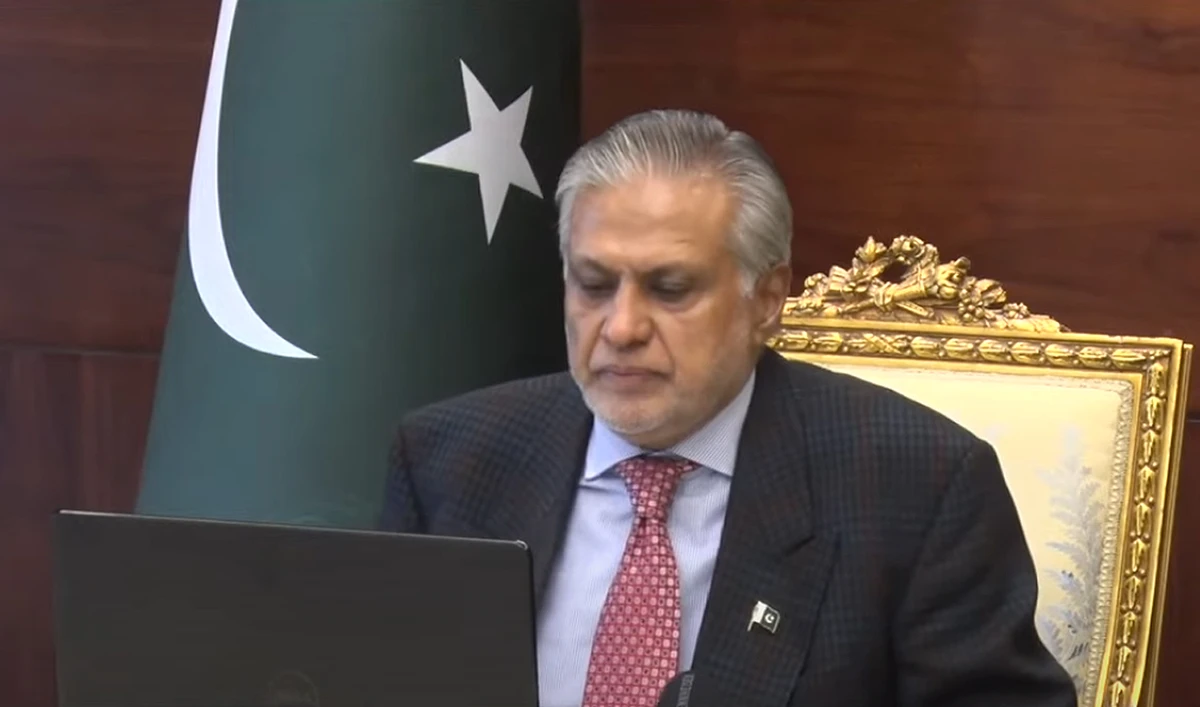
Pakistan’s Deputy Prime Minister and Foreign Minister Ishaq Dar virtually addresses the Conference on Interaction and Confidence Building Measures in Asia (CICA) being held in Baku, Azerbaijan, on December 17, 2024. (PTV News)
Short Url
Updated 17 December 2024
Follow

Pakistan calls for just solutions to global conflicts like Palestine for Asia’s enduring prosperity

  • Ishaq Dar virtually addresses CICA’s ministerial meeting, asks member states to address root causes of conflicts
  • The deputy PM also seeks strengthening regional connectivity for economic integration, sustainable development

ISLAMABAD: Pakistan on Tuesday called for just and inclusive political solutions to long-standing global disputes, such as Palestine and Kashmir, at the 7th Ministerial Meeting of the Conference on Interaction and Confidence Building Measures in Asia (CICA).
CICA, a 28-member forum established in 1992 and headquartered in Kazakhstan, began as a Central Asian initiative, though it now includes members from other region like the Middle East and Southeast Asia. As a founding member, Pakistan sees the platform as vital for addressing issues related to economic development and regional integration in its neighborhood.
The meeting, hosted by Azerbaijan, was addressed virtually by Pakistan’s Deputy Prime Minister Ishaq Dar, who participated from Egypt, where he is attending a summit of D-8 developing nations focused on Gaza and Lebanon.
Dar highlighted Pakistan was working to promote corporation and advance peace, stability and security in Asia, though he also noted the challenges hindering the shared economic and political objectives of the member states.
“Lasting progress cannot be achieved in isolation,” he told the gathering. “Persistent challenges, including political disputes, conflicts, foreign occupations and the denial of self-determination, along with poverty and illiteracy, undermine the collective development of Asia.”
He emphasized that sustainable peace and security depended on addressing the root causes of conflicts.
“A just resolution of the Palestine and Jammu and Kashmir issues and guaranteeing their right to self-determination is key to fostering lasting peace in the region,” Dar added.
The Pakistani deputy prime minister also highlighted the importance of strengthening regional connectivity to drive economic integration and sustainable development.
He noted that initiatives like the China-Pakistan Economic Corridor (CPEC) and the Belt and Road Initiative (BRI) could serve as “catalysts for regional economic cooperation and prosperity.”
“As the global economic center of gravity shifts, it is essential that we seize the moment of opportunity to ensure inclusive regional transformation,” he said, underscoring CICA’s role in fostering collaboration across Asia.
He also reaffirmed Pakistan’s commitment to CICA’s vision of advancing dialogue, mutual respect and adherence to international law to resolve disputes.
Dar urged member states to continue utilizing the platform for regional cooperation and collective progress.
Pakistan defense minister discusses regional, global developments with counterparts in Munich

Updated 5 sec ago
Follow

Pakistan defense minister discusses regional, global developments with counterparts in Munich

  • The high-powered meeting of government leaders, diplomats comes shortly before Russia’s war on Ukraine enters its fifth gruelling year
  • Bruised by President Donald Trump’s comments, European leaders at summit have pledged to shoulder more of the burden of shared defenses

ISLAMABAD: Pakistan’s Defense Minister Khawaja Asif on Friday met his Italian and Albanian counterparts to discuss bilateral cooperation and regional and global developments on the sidelines of the Munich Security Conference, the Pakistani embassy in Germany said.

The high-powered Munich meeting of government leaders, diplomats, defense and intelligence chiefs comes shortly before Russia’s full-scale war on Ukraine is set to enter its fifth gruelling year.

Bruised by President Donald Trump’s designs on Greenland and his often hostile comments about America’s traditional bedrock allies, European leaders at the conference have pledged to shoulder more of the burden of shared defenses.

Asif met his Italian counterpart Guido Crosetto during the conference, running from Feb. 13 till Feb. 15, with both sides agreeing to enhance bilateral ties, according to the Pakistani embassy.

“Asif met the Defense Minister of Republic of Albania, Mr. Pirro Vengu, on the sidelines of the 62nd Munich Security Conference,” the Pakistani embassy said on X.

“Discussed matters related to enhancing bilateral cooperation in the wake of recent regional and international developments.”

The development came as US Secretary of State Marco Rubio was set to address European leaders on Saturday as they try to step up their autonomy in defense while salvaging transatlantic ties badly strained under President Trump.

German Chancellor Friedrich Merz acknowledged a “rift” had opened up between Europe and the United States, fueled by culture wars, but issued an appeal to Washington: “Let’s repair and revive transatlantic trust together.”

“In the era of great power rivalry, even the United States will not be powerful enough to go it alone,” said the conservative leader, who has ramped up defense spending in the top EU economy.

Macron said a new framework was needed to deal with “an aggressive Russia” once the fighting in Ukraine ends.

Ukrainian President Volodymyr Zelensky, who has been in Munich since Friday and meeting multiple allies, was expected to address the meeting on Saturday. No Russian officials have been invited.

Kremlin critic Mikhail Khodorkovsky said he feared “a new cold war” between Europe and Russia in the coming decade, making reopening dialogue with Moscow essential.

“If it makes sense to talk, we are willing to talk,” said Merz, but he also charged that “Russia is not yet willing to talk seriously.”