

Pakistani, Saudi interior ministers discuss security, narcotics control cooperation in Riyadh

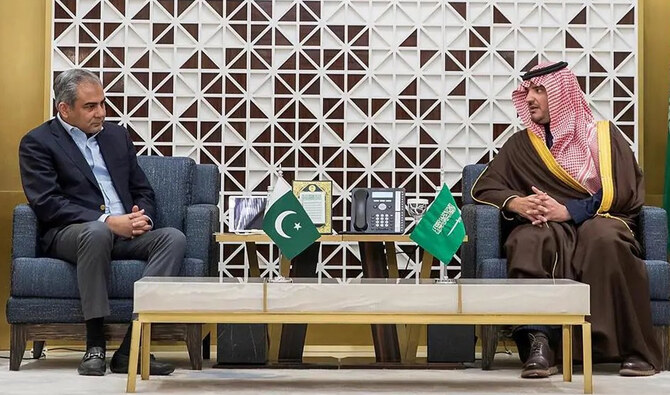
Pakistan’s Minister for Interior and Narcotics Control, Mohsin Naqvi meets Saudi Arabia’s Minister of Interior, Prince Abdulaziz bin Saud bin Naif (right), in Riyadh on December 16, 2024. (Photo Courtesy: X/@alekhbariyaEN)
Short Url
Updated 17 December 2024
Follow

Pakistani, Saudi interior ministers discuss security, narcotics control cooperation in Riyadh

  • Naqvi’s meeting with interior minister follows meeting with head of Saudi General Directorate of Narcotics Control
  • Naqvi arrived in Riyadh on Sunday as the longtime allies seek to forge closer economic, investment and security ties

ISLAMABAD: Pakistani Interior Minister Mohsin Naqvi met with Saudi Arabia’s Minister of Interior, Prince Abdulaziz bin Saud bin Naif, in Riyadh on Tuesday and discussed security cooperation and joint narcotics control measures. 

Naqvi’s meeting with the Saudi interior minister follows a meeting on Monday with Major General Mohammed bin Saeed Al-Qarni, the head of the Kingdom’s General Directorate of Narcotics Control (GDNC). 

Naqvi arrived in Riyadh on Sunday to discuss bilateral ties as both countries seek closer economic, investment and security ties.

“The ministers discussed security cooperation between Pakistan and Saudi Arabia,” the Pakistani interior ministry said in a statement. “Prince Abdulaziz and Mohsin Naqvi also discussed measures to combat drug smuggling and other issues of mutual interest. The meeting included discussions on enhancing cooperation in narcotics control.”

On Sunday, Naqvi also met with the Kingdom’s Director of Public Security, Lt. Gen. Mohammed bin Abdullah Al-Bassami, and inspected various departments of the state-of-the-art Directorate of Public Security and the Safe City Center.

“During the meeting, it was agreed to activate the joint task force [on public security] between Pakistan and Saudi Arabia soon,” the Pakistani interior ministry said in a statement, with Naqvi adding that he was glad to see “excellent” public security mechanisms in Saudi Arabia and both sides could benefit from each other’s experiences in the field of police training.


Pakistan reports decline in polio cases in 2025

Updated 4 sec ago
Follow

Pakistan reports decline in polio cases in 2025

  • Cases drop to 30 from 74 in 2024, with no new infections recorded since September
  • Authorities plan intensified targeted drives in 2026 to halt remaining transmission

ISLAMABAD: Pakistan reported a sharp decline in polio cases in 2025, with infections falling to 30 from 74 a year earlier, as intensified vaccination campaigns and improved surveillance helped curb the spread of the virus, health authorities said on Wednesday.

No new polio cases have been recorded anywhere in the country since September, said a statement, as Pakistan carried out six polio campaigns, including five nationwide drives, trying to reach children in high-risk areas and improve monitoring of virus circulation.

Despite the decline, the authorities cautioned that poliovirus continues to circulate in some districts, requiring sustained vigilance to prevent a resurgence.

“Targeted interventions, robust community engagement, and ongoing vaccination efforts remain essential to reach every missed child and prevent any resurgence,” the official statement said.

“Frontline health workers, security personnel, and local authorities continue to work in close coordination to maintain high immunity levels and ensure that Pakistan remains on course toward becoming polio-free,” it added.

The most recent nationwide campaign, conducted from Dec. 15 to 21, achieved more than 98 percent coverage across the country, including all four provinces, Azad Jammu and Kashmir, Gilgit-Baltistan and the capital, Islamabad.

Authorities reported an 18 percent reduction in the number of missed children compared with the previous round, with notable improvements in access and operations in southern Khyber Pakhtunkhwa, a longstanding challenge area.

Pakistan’s polio eradication drive relies on close coordination between health workers, security personnel and local authorities, amid ongoing resistance in some communities and access constraints in remote or insecure regions.

Officials said district-specific interventions, including improved microplanning, better deployment of vaccination teams and enhanced community outreach, were being used to address remaining gaps, particularly in parts of southern Khyber Pakhtunkhwa.

The statement said Pakistan plans to intensify targeted efforts in 2026 to interrupt the remaining transmission chains and move closer to eliminating the disease.