LONDON: The UK government unlawfully detained Sri Lankan migrants on a remote military base for more than two years, the British Indian Ocean Territory (BIOT) Supreme Court ruled on Monday.
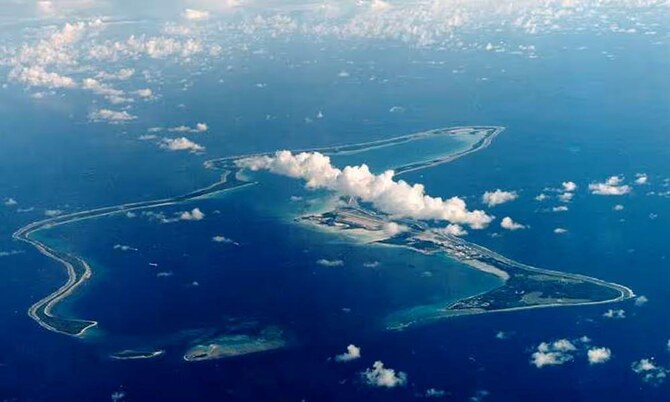
Sixty-four Sri Lankan Tamil asylum seekers were held in “prison-like” camps on Diego Garcia, a British-American military base which is part of the Chagos islands — renamed in 1965 by the UK as BIOT — after being rescued at sea, according to the ruling.
Many of them claimed they were fleeing persecution in Sri Lanka, where Tamils are a historically oppressed minority, and sought international protection once they arrived on Diego Garcia.
Earlier this month, most of the migrants were finally brought to the UK and given a chance to apply for asylum from London.
Successive British foreign secretaries had been reluctant to allow them into the UK, fearing it would open a new irregular immigration route via the islands.
In a ruling published on Monday, Margaret Obi, the acting judge of the BIOT supreme court, said that the migrants were “unlawfully detained” for an “extraordinarily long time” on the military base, with the UK government now potentially facing heavy damages.
The Sri Lankans were held in a camp the size of a football pitch and alleged that they faced “prison-like” conditions, including a lack of privacy and an infestation of rats.
The camp was also rife with cases of migrants attempting to self-harm due to poor mental health.
While the BIOT commissioner claimed they were “free to leave” and therefore not detained, Obi ruled that this was “not a genuine choice,” since the migrants had sought international protection and could not return to Sri Lanka.
“It is unsurprising that the claimants feel as if they are in a prison; that is exactly what it is, in all but name,” the judge said.
The camp was manned by security guards at all times and there were “punishments” imposed for leaving the camp without permission, according to the ruling.
The asylum seekers were only granted bail earlier this year by Obi to access a trail and the beaches on the island, after months of being barred from leaving the camp.
In the ruling, the judge also found that in July the UK Home Office “impeded” the progress of international protection claims fearing potential implications for the previous Conservative government’s Rwanda scheme, which since then has been scrapped.

UK unlawfully detained Sri Lankan migrants on Chagos island: court
Short Url
https://arab.news/cdzpu
UK unlawfully detained Sri Lankan migrants on Chagos island: court
- Sixty-four Sri Lankan Tamil asylum seekers were held in ‘prison-like’ camps on Diego Garcia
- Most of the migrants were finally brought to the UK, this month, and given a chance to apply for asylum
Taiwan to send team to assess US rare earth deposits
TAIPEI: Taiwan plans to send officials to assess US rare earths deposits with a goal to have such minerals refined on the island, Economy Minister Kung Ming-hsin said on Wednesday.
President Donald Trump’s administration has stepped up efforts to secure US supplies of critical minerals after China rattled senior officials and global markets last year by withholding rare earths required by American automakers and other industrial manufacturers.
Trump last week launched a US strategic stockpile of critical minerals, called Project Vault, backed by $10 billion in seed funding from the US Export-Import Bank and $2 billion in private funding.
While semiconductor powerhouse Taiwan is not formally part of that scheme, it has previously held talks with the United States on how it can help, given Taipei’s concerns about over-reliance on a China-centric supply chain.
China views Taiwan as its own territory and has stepped up its military threats.
Speaking to reporters in Taipei, Kung said the ministry’s Geological Survey and Mining Management Agency would go to the United States to assess rare earths deposits there.
“Specifically, what rare-earth elements they contain and whether they are suitable. In other words, whether those are the rare earths we actually need. So we still need to investigate,” he said.
Given Taiwan does not mine such elements itself, it can instead play a role in refining the materials from other countries, Kung added.
“The technology is not an issue; the next step is scaling up,” he said.
Taiwan consumes 1,500 metric tons of rare earth annually, a figure projected to rise to 2,000 metric tons given economic growth, Kung added.
“Our goal is to expand production capacity to meet half of our demand by then, strengthening the supply chain.
President Donald Trump’s administration has stepped up efforts to secure US supplies of critical minerals after China rattled senior officials and global markets last year by withholding rare earths required by American automakers and other industrial manufacturers.
Trump last week launched a US strategic stockpile of critical minerals, called Project Vault, backed by $10 billion in seed funding from the US Export-Import Bank and $2 billion in private funding.
While semiconductor powerhouse Taiwan is not formally part of that scheme, it has previously held talks with the United States on how it can help, given Taipei’s concerns about over-reliance on a China-centric supply chain.
China views Taiwan as its own territory and has stepped up its military threats.
Speaking to reporters in Taipei, Kung said the ministry’s Geological Survey and Mining Management Agency would go to the United States to assess rare earths deposits there.
“Specifically, what rare-earth elements they contain and whether they are suitable. In other words, whether those are the rare earths we actually need. So we still need to investigate,” he said.
Given Taiwan does not mine such elements itself, it can instead play a role in refining the materials from other countries, Kung added.
“The technology is not an issue; the next step is scaling up,” he said.
Taiwan consumes 1,500 metric tons of rare earth annually, a figure projected to rise to 2,000 metric tons given economic growth, Kung added.
“Our goal is to expand production capacity to meet half of our demand by then, strengthening the supply chain.
© 2026 SAUDI RESEARCH & PUBLISHING COMPANY, All Rights Reserved And subject to Terms of Use Agreement.


