Syrian authorities reopen schools, a week after upheaval that overthrew Assad

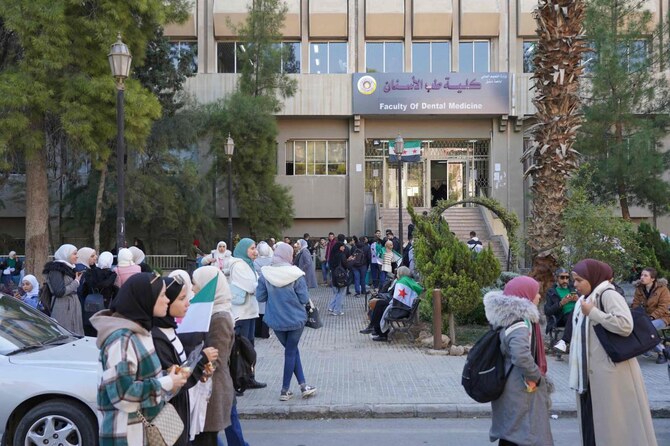
Above, Syrian students walk around the campus of the Damascus University in the Syrian capital on Dec. 15, 2024. (AFP)
Short Url
Updated 15 December 2024
Follow

Syrian authorities reopen schools, a week after upheaval that overthrew Assad

  • Officials said most schools were opening around the country on Sunday, which is the first day of the working week in most Arab countries
  • However some parents were not sending their children to class due to uncertainty over the situation

DAMASCUS: Students returned to classrooms in Syria on Sunday after the country’s new rulers ordered schools reopened in a potent sign of some normalcy a week after militants swept into the capital in the dramatic overthrow of President Bashar Assad.
The country’s new de facto leader, Ahmad Al-Sharaa, faces a massive challenge to rebuild Syria after 13 years of civil war that killed hundreds of thousands of people. Cities were bombed to ruins, the economy was gutted by international sanctions and millions of refugees still live in camps outside Syria.
Officials said most schools were opening around the country on Sunday, which is the first day of the working week in most Arab countries. However some parents were not sending their children to class due to uncertainty over the situation.
Pupils waited cheerfully in the courtyard of a boys’ high school in Damascus on Sunday morning and applauded as the school secretary, Raed Nasser, hung the flag adopted by the new authorities.
“Everything is good. We are fully equipped. We worked two, three days in order to equip the school with the needed services for the students’ safe return to school,” Nasser said, adding the Jawdat Al-Hashemi school had not been damaged.
In one classroom, a student pasted the new flag on a wall.
“I am optimistic and very happy,” said student Salah Al-Din Diab. “I used to walk in the street scared that I would get drafted to military service. I used to be afraid when I reach a checkpoint.”
As Syria starts trying to rebuild, its neighbors and other foreign powers are still working out a new stance on the country, a week after the collapse of the Assad government that was backed by Iran and Russia.
Sharaa — better known by his militant nom de guerre Abu Mohammed Al-Golani — leads the Hayat Tahrir Al-Sham (HTS), the Islamist group that swept Assad from power last week. HTS is a group formerly allied with Al-Qaeda that is designated a terrorist organization by many governments, and is also under United Nations sanctions.
UN Syria envoy Geir Pedersen said on Sunday he hoped for a swift end to the sanctions to help facilitate economic recovery.
“We will hopefully see a quick end to sanctions so that we can see really rallying around building up Syria,” Pedersen said as he arrived in Damascus to meet Syria’s caretaker government and other officials.
Top diplomats from the United States, Turkiye, the European Union and Arab nations met in Jordan on Saturday and agreed that a new government in Syria should respect minority rights, US Secretary of State Antony Blinken said.


MSF says conditions for Gaza medics ‘as hard as it’s ever been’ despite truce

Updated 4 sec ago
Follow

MSF says conditions for Gaza medics ‘as hard as it’s ever been’ despite truce

DOHA: Conditions for medics and patients in Gaza are as severe as ever despite a nearly two-month truce in the territory, the president of medical charity Doctors Without Borders (MSF) said in an AFP interview.
Israel and Palestinian militant group Hamas agreed in October to a US-backed truce deal for Gaza which stipulated an influx of aid to the territory devastated by two years of war and in the grip of a humanitarian crisis.
“It’s as hard as it’s ever been,” Javid Abdelmoneim said of conditions for medical staff operating in Gaza’s hospitals, speaking on the sidelines of the annual Doha Forum on diplomacy on Sunday.
“While we’re able to continue doing operations, deliveries, wound care, you’re using protocols or materials and drugs that are inferior, that are not the standard. So you’ve got substandard care being delivered,” he explained.
Abdelmoneim, who worked as a doctor in Gaza in 2024, said the ongoing truce was only a “ceasefire of sorts” with “still several to dozens of Palestinians being killed every day by Israel.”
Despite the truce, 376 Palestinians have been killed in Gaza, according to local health authorities, as well as three Israeli soldiers.
“We’re seeing the injured patients in the emergency rooms in which we work throughout the strip,” he added.
Aid agencies are pushing for more access for humanitarian convoys to enter Gaza while Israel has resisted calls to allow aid through the Rafah crossing from Egypt.
Aid ‘weaponized’
The MSF president said that since the truce began, aid “hasn’t come in to the level that’s necessary.”
“There isn’t a substantial change and it is being weaponized... So as far as we’re concerned that is an ongoing feature of the genocide. It’s being used as a chip and that’s something that should not happen with humanitarian aid,” Abdelmoneim said.
In 2024, MSF said its medical teams had witnessed evidence on the ground in Gaza and concluded that genocide was taking place.
Israel’s foreign ministry rejected the report saying at the time that it was “fabricated.”
Abdelmoneim said both the lack of supplies and the destruction of hospitals in the Palestinian territory — still not offset by the provision so far of field hospitals — meant care remained inadequate.
“Those two things together mean increased infection rates, increased stays and greater risk of complications. So it is a substandard level of care that you’re able to deliver,” he said.
The MSF president also sounded the alarm over the safety of medical staff in Sudan where at the end of October the paramilitary Rapid Support Forces (RSF) seized the North Darfur capital of El-Fasher, the army’s last stronghold in the western region.
The paramilitaries’ final advance after a bitter 18-month siege was followed by reports of widespread atrocities.
“One feature that has been consistent, no matter where you are in Sudan, no matter who controls the territory, are attacks on health care and blockages to supply movements and provision of health care,” Abdelmoneim said.
’Freedom, protection access’
The World Health Organization said at the end of October that it had received reports that more than 460 patients and their companions had been shot dead at a maternity hospital in El-Fasher during its capture by the RSF and of six health workers being abducted.
On Thursday, an RSF drone attack on the army-held town of Kalogi in Sudan’s South Kordofan state hit a children’s nursery and a hospital, killing dozens of civilians including children, a local official told AFP.
“Both sides need to allow humanitarian and medical workers freedom, protection and access to the population, and that includes supplies,” said Abdelmoneim, who also worked as a doctor in Omdurman in Sudan in February.
The MSF president said the charity’s medical teams receiving displaced people in Sudan and neighboring Chad were encountering “harrowing tales of sexual violence, tales of ethnically targeted violence, extortion” as well of “evidence that really does point to famine-like conditions.”
In Tawila, a town now sheltering more than 650,000 people fleeing El-Fasher and nearby Zamzam camp, also under RSF control, Abdelmoneim said the MSF had been told by survivors “that family members are detained and never seen again.”
“So our question is, what has happened to that population?” he said.
The medical charity was backing calls by the UN Human Rights Council for an enquiry into the reported violations.
“We would encourage all member states to support that, an independent investigation inside El-Fasher,” Abdelmoneim said.