


ISLAMABAD: Pakistan has been eyeing an increase in olive cultivation to boost its agricultural growth, its national food security minister said this week, adding that it could position the country as a major player in the global olive oil market.
According to the Journal of Agriculture and Food Research from June 2024, Pakistan has 80 million wild and 5 million planted olive trees. Olives are important for their food and nutritional benefits. Cultivating olives on a large scale in Pakistan will help in meeting the local demand for edible oil in the country.
In 2022, Pakistan became the 19th member of the International Olive Council, the only intergovernmental organization in the world that brings together olive oil and table olive producing and consuming stakeholders. Pakistan exported virgin and extra virgin olive oil worth 1.9 million in 2022.
The South Asian country, which has been facing an economic crisis, is currently turning its focus to agriculture as a driving force for economic growth, with ambitious plans to enhance cultivation, modernize processing, and expand exports.
Speaking at an event in Islamabad for the promotion of olive cultivation on a commercial scale, Pakistan’s National Food Security Minister Rana Tanveer Hussain said it would not only boost the gross domestic product, but also generate employment in rural areas.
“We will bring an increase in cultivation. We will definitely put this industry in processing and packing,” he said on Friday. “And God willing, that day will not be far when our olive oil will become popular in other countries. Because it contents, as far as I know, are very good.”

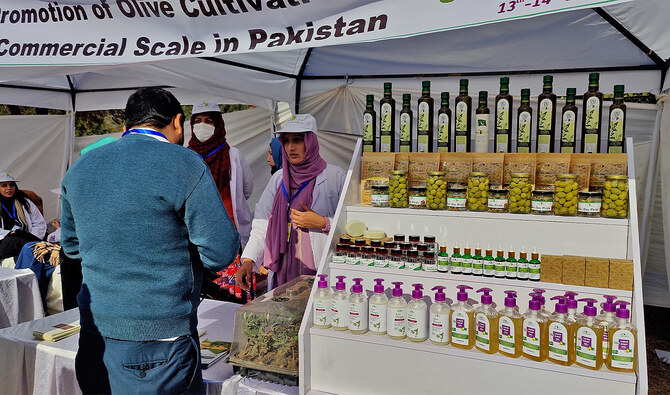
Jars of olive pickles are displayed at a stall at the Grand National Olive Gala 2024 in Islamabad, Pakistan, on December 13, 2024. (AN photo)
Agriculture is the backbone of Pakistan’s economy and accounts for nearly half of the employed labor force in the country, according to the Pakistan Bureau of Statistics (PBS).
“In the last few years, no sector had a contribution in economic growth like agriculture, which accounted for 6.5 percent of GDP,” Hussain said, emphasizing agriculture’s critical role in the country’s economy.
Pakistan’s financial and private sectors are also stepping up to support this momentum.
Muhammad Shoaib Qaisrani, vice president of the National Bank of Pakistan, shared that substantial investments were being made in the agriculture sector to boost production.
“We have disbursed Rs368 billion ($1.33 billion) into agriculture,” he shared. “With the addition of olives, we are expecting to inject another up to Rs40 billion ($144.4 million) to further support this sector.”
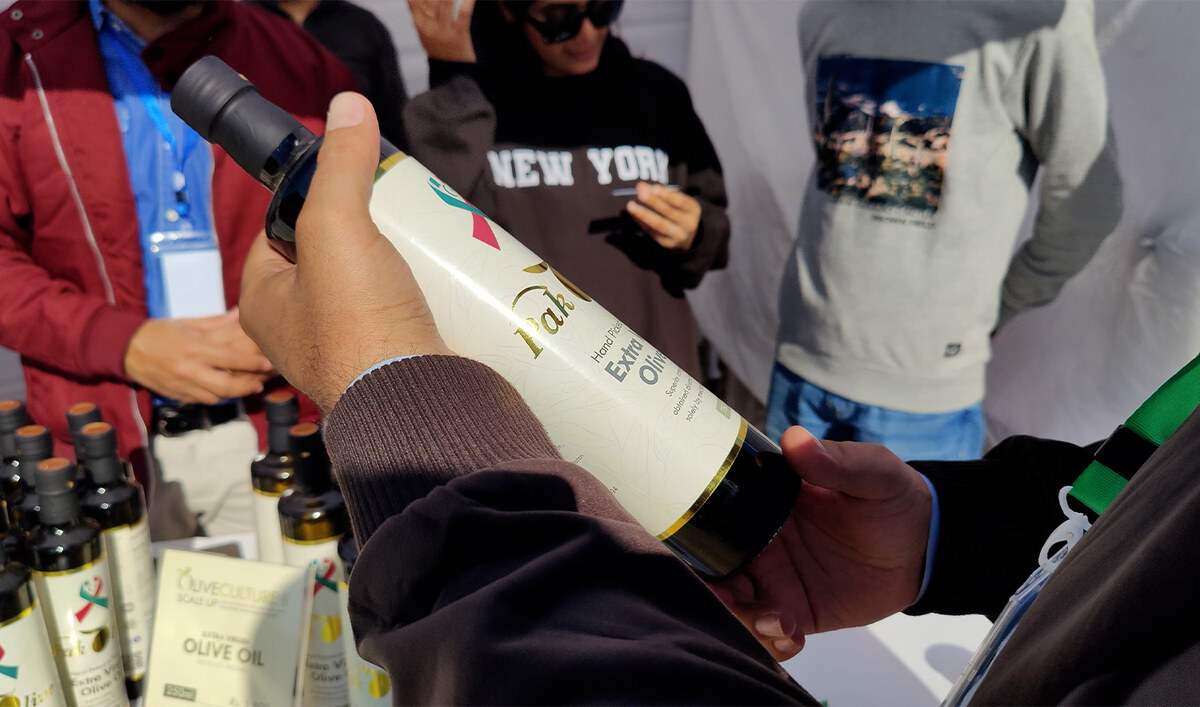
A customer is checking a bottle of olive oil at the Grand National Olive Gala 2024 in Islamabad, Pakistan, on December 13, 2024. (AN photo)
The private sector is embracing the potential of olives, with entrepreneurs and women playing a transformative role in the country’s olive oil industry. Women-led initiatives, particularly in rural areas, have been thriving, with many women involved in producing olive-based products like soaps, cosmetics and pickles.
Aiza Imran, brand manager at Loralai Olives that cultivates and processes olives, expressed optimism about Pakistan’s position in the olive oil market.
“When we think of olive oil, we think of Italy or Spain. That’s what we are trying to do with Pakistan, and Loralai specifically, because it’s known to have the best quality oil in the region,” she said.

Participants attend the Grand National Olive Gala 2024 in Islamabad, Pakistan, on December 13, 2024. (AN photo)
These ventures are not only empowering women economically but also contributing to local value addition, driving innovation and inclusivity in the industry, according to Alamgir Khan, an official at Khazana Support Organization, a Khyber Pakhtunkhwa-based entity that aims to enhance capacity-building of women.
Entrepreneurs are leveraging modern techniques and creative marketing to expand the industry’s reach, fostering job creation and promoting Pakistan’s olive oil as a high-quality product in global markets. The collaborative efforts are reshaping the narrative around entrepreneurship and gender roles in agriculture.
“We have soaps, cosmetics, pickles. We have made a group of females, and they make these products,” Khan told Arab News. “They have displayed their work, showing how olives contribute to diverse industries.”
Olives are also recognized for their vast health benefits.
“From a nutritional point of view to skin cosmetics, healthy living, longevity, and anti-aging, olives are the best,” said Dr. Daud Qazi, chairman of the World Association for Regenerative Medicine, while emphasizing their versatility.


