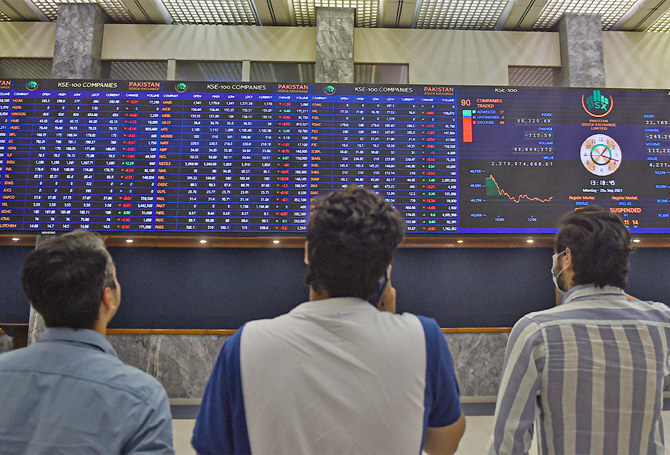
ISLAMABAD: Pakistan’s stock market continued to extend its rally on Friday and surpassed the unprecedented 115,000-point mark before pulling back during the weekend trading session as investors locked in profits from the recent surge, analysts said.
The benchmark KSE-100 index surged by 121.30 points, or 0.11 percent, to close at 114,301.80 points from Thursday’s close of 114,180.50 points. The index hit an intraday high of 115,172.44 points after climbing 991.94 points during the weekend trading session.
Stock analysts attributed the ongoing rally to expectations of a policy rate cut by the Pakistani central bank next week.
“The monetary policy is due on Dec. 16 (Monday) and there are expectations of a sharp rate cut,” Raza Jafri, head of equities at Intermarket Securities, told Arab News. “The stock market is reacting accordingly.”
Arif Habib Corporation’s Chief Executive Officer Ahsan Mehanti said the market reached a new all-time high on Friday due to positive sentiment originating from recent growth projections and lowering inflation.
“Asian Development Bank raising growth projections to three percent and lowering inflation forecast to 10 percent for FY25 played the role of a catalyst in the record surge at PSX,” he said.
Pakistan’s annual consumer inflation also slowed to 4.9 percent in November, lower than the government’s forecast and the lowest in nearly six years. This is down from 38 percent last year.
Commenting on the market’s bullish run this week, Jafri said Pakistani companies were currently trading at a relatively low price-to-earnings ratio of six times their profits, significantly below the 10-year average of 7.5 times and the historical peak of 12 times.
Mehanti said the stocks rallied to new highs this week over Finance Minister Muhammad Aurangzeb’s assurance of achieving macroeconomic stability, apart from surging global crude oil prices.
Pakistani stocks have performed significantly well this week on the back of investor confidence regarding a possible interest rate cut by the central bank at the next monetary policy meeting. The central bank has already slashed interest rates by 700 basis points (bps) in four consecutive meetings since June, bringing it to 15 percent.
According to a poll by Topline Securities, 71 percent of participants expect the central bank to announce a minimum rate cut of 200bps next week.
Trade data released by the Pakistan Bureau of Statistics also supports positive investor sentiment as the trade deficit narrowed by 7.39 percent during the first five months (July-November) of the current fiscal year, standing at $8.651 billion, compared to $9.341 billion during the same period last year.
Exports rose by 12.57 percent to hit $13.69 billion, while imports increased by 3.90 percent to $22.342 billion during this period. November’s trade deficit narrowed even further, dropping by 18.60 percent year-on-year to $1.589 billion compared to $1.952 billion in November 2023.


![]()

Pakistan stock market recovers to end weekend session below 115,000 points
Short Url
https://arab.news/54htp
Pakistan stock market recovers to end weekend session below 115,000 points
- KSE-100 index surged by 121.30 points, or 0.11 percent, to close at 114,301.80 following an intraday high of 115,172.44 points
- Analysts credit the stock market’s bullish run this week to investor confidence regarding possible interest rate cut on Dec. 16
Latest updates


© 2026 SAUDI RESEARCH & PUBLISHING COMPANY, All Rights Reserved And subject to Terms of Use Agreement.