

Syrian Shiites and other minorities flee to Lebanon, fearing Islamist rule

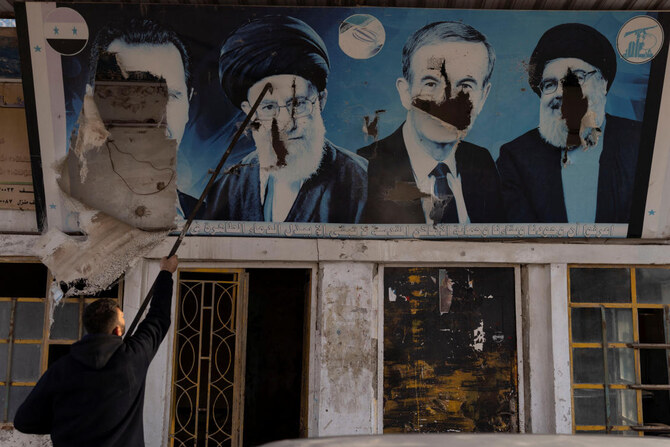
A worker tears down the pictures of Syria’s Bashar Assad, former Syrian President Hafez Assad, Lebanon’s late Hezbollah leader Hassan Nasrallah and Iran’s Supreme Leader Ayatollah Ali Khamenei at a gas station in Nubl, a Shiite village seized by militants, in rural Aleppo, Dec. 11, 2024. (Reuters)
Short Url
Updated 13 December 2024
Follow

Syrian Shiites and other minorities flee to Lebanon, fearing Islamist rule

  • Their accounts reflect fears of persecution despite promises of protection by Hayat Tahrir Al-Sham
  • Shiite communities have often been on the frontline of Syria’s 13-year civil war

BEIRUT/NUBL: Tens of thousands of Syrians, mostly Shiite Muslims, have fled to Lebanon since Sunni Muslim Islamists toppled Bashar Assad, fearing persecution despite assurances from the new rulers in Damascus that they will be safe, a Lebanese official said.
At the border with Lebanon, where thousands of people were trying to leave Syria on Thursday, a dozen Shiite Muslims interviewed by Reuters described threats made against them, sometimes in person but mostly on social media.
Their accounts reflect fears of persecution despite promises of protection by Hayat Tahrir Al-Sham (HTS) — the Sunni Islamist group which has emerged as the dominant force in the new Syria but is far from being the only armed faction on the ground.
Shiite communities have often been on the frontline of Syria’s 13-year civil war, which took on sectarian dimensions as Assad, from the minority Alawite faith, mobilized regional Shiite allies, including Lebanon’s Hezbollah, to help fight Sunni militants.
The senior Lebanese security official said more than 100,000 people, largely members of minority faiths, had crossed into Lebanon since Sunday, but could not give an exact number because most of them had used illegal crossings along the porous border.
At the main border crossing between Syria and Lebanon, Samira Baba said she had been waiting for three days to enter Lebanon with her children.
“We don’t know who sent these threats, on WhatsApp and Facebook,” she said. “The militants in charge haven’t openly threatened us, so it could be other factions, or individuals. We just don’t know. But we know it’s time to leave,” she said.
The new Syria holds uncertainty for many, especially minorities. Shiites are thought to number around a tenth of the population, which stood at 23 million before the war began.
While HTS, which has cut its ties with the global jihadist network Al-Qaeda, is the most powerful of the constellation of factions that fought Assad, there are numerous other armed groups, many of which are Islamist.
Ayham Hamada, a 39-year-old Shiite who was serving in the army when Assad fell, said the government’s collapse was so sudden that it left him and his brother, also a soldier, scrambling to decide whether to stay or go.
They fled to Damascus where they received threats, he said, without elaborating. “We are afraid of sectarian killings... this will be liquidation.”
Despite assurances voiced by HTS leader Ahmed Al-Sharaa, Hamada said minorities have been left without protection after Assad’s sudden flight. “Bashar took his money and fled and didn’t pay attention to us,” he said.
Many of the Shiites at the border were from Sayyeda Zeinab, a Damascus district home to a Shiite shrine where fighters from Hezbollah and other Shiite militias were based. Supported by Iran’s Revolutionary Guards, the Shiite militias also came from Iraq and Afghanistan, and recruited some Syrian Shiites.
Elham, a 30-year-old nurse, said she had been waiting at the crossing for days without food or water with her 10-day-old niece and two-year-old son.
A Shiite from Damascus, she said she fled to rural areas when the government fell. When she returned, she found her house looted and torched. She and others said that armed, masked men raided their homes and ordered them at gunpoint to leave, or be killed.
“They took our car because they said it’s theirs. You daren’t say a word. We left everything and fled.”
Reuters could not immediately reach HTS officials for comment on threats received by minorities.

’WE ARE ALL ONE PEOPLE’
In parts of Syria’s north, however, some residents who fled when HTS went on the offensive in late November said they now felt confident to return.
“My wife is Sunni. We are all one people and one nation,” Hussein Al-Saman, 48, a Shiite father of three told Reuters, next to the main mosque in the Shiite town of Nubl, where Hezbollah once stationed fighters.
He praised HTS leader Sharaa for his efforts to protect the community, saying he “enabled us to come to our houses.”
“We were a minority and didn’t have a choice but to stand with (Assad). But now that the war is over we are free... I hope for my children to just live comfortably under the new government.”
Bassam Abdulwahab, an official overseeing the returns, said essential services had been restored. “Security was provided to protect the minorities,” he said, adding that this “is the approach of the commanding leadership.”
“We carry the responsibility of protecting the minorities in Syria. What happens to us happens to them,” he said.
At the entrance to Nubl, a statue of Assad lay toppled. Further into the town, residents cleaned stores and repaired damaged buildings, while officials in military fatigues coordinated the return of those who had fled.
“The (Assad) government forced the minorities here to live in a situation where they had to be enemies of their neighbors,” said Muhyie Al-Dien, who works in mining. “The government played its game so it could divide us and our Sunni brothers.”
While some in Nubl spoke hopefully of the future, one 41-year-old man, who gave his name as Hami and declined to speak on camera, was more cautious. “We are Shiite and the new leadership is Sunni. We don’t know what will happen,” he said.


Syrian military tells civilians to evacuate contested area east of Aleppo amid rising tensions

Updated 15 January 2026
Follow

Syrian military tells civilians to evacuate contested area east of Aleppo amid rising tensions

  • Syria’s military has announced it will open a “humanitarian corridor” for civilians to evacuate from an area in Aleppo province
  • This follows several days of intense clashes between government forces and the Kurdish-led Syrian Democratic Forces

DAMASCUS: Syria’s military said it would open a corridor Thursday for civilians to evacuate an area of Aleppo province that has seen a military buildup following intense clashes between government and Kurdish-led forces in Aleppo city.
The army’s announcement late Wednesday — which said civilians would be able to evacuate through the “humanitarian corridor” from 9 a.m. to 5 p.m. Thursday — appeared to signal plans for an offensive in the towns of Deir Hafer and Maskana and surrounding areas, about 60 kilometers (40 miles) east of Aleppo city.
The military called on the Kurdish-led Syrian Democratic Forces and other armed groups to withdraw to the other side of the the Euphrates River, to the east of the contested zone.
Syrian government troops have already sent troop reinforcements to the area after accusing the SDF of building up its own forces there, which the SDF denied. There have been limited exchanges of fire between the two sides, and the SDF has said that Turkish drones carried out strikes there.
The government has accused the SDF of launching drone strikes in Aleppo city, including one that hit the Aleppo governorate building on Saturday shortly after two Cabinet ministers and a local official held a news conference there.
The tensions in the Deir Hafer area come after several days of intense clashes last week in Aleppo city that ended with the evacuation of Kurdish fighters and government forces taking control of three contested neighborhoods. The fighting killed at least 23 people, wounded dozens more, and displaced tens of thousands.
The fighting broke out as negotiations have stalled between Damascus and the SDF, which controls large swaths of northeast Syria, over an agreement to integrate their forces and for the central government to take control of institutions including border crossings and oil fields in the northeast.
Some of the factions that make up the new Syrian army, which was formed after the fall of former President Bashar Assad in a rebel offensive in December 2024, were previously Turkiye-backed insurgent groups that have a long history of clashing with Kurdish forces.
The SDF for years has been the main US partner in Syria in fighting against the Daesh group, but Turkiye considers the SDF a terrorist organization because of its association with the Kurdistan Workers’ Party, or PKK, which has waged a long-running insurgency in Turkiye. A peace process is now underway.
Despite the long-running US support for the SDF, the Trump administration has also developed close ties with the government of interim Syrian President Ahmad Al-Sharaa and has pushed the Kurds to implement the integration deal. Washington has so far avoided publicly taking sides in the clashes in Aleppo.
The SDF in a statement warned of “dangerous repercussions on civilians, infrastructure, and vital facilities” in case of a further escalation and said Damascus bears “full responsibility for this escalation and all ensuing humanitarian and security repercussions in the region.”
Adm. Brad Cooper, commander of US Central Command, said in a statement Tuesday that the US is “closely monitoring” the situation and called for “all parties to exercise maximum restraint, avoid actions that could further escalate tensions, and prioritize the protection of civilians and critical infrastructure.” He called on the parties to “return to the negotiating table in good faith.”
Al-Sharaa blasts the SDF
In a televised interview aired Wednesday, Al-Sharaa praised the “courage of the Kurds” and said he would guarantee their rights and wants them to be part of the Syrian army, but he lashed out at the SDF.
He accused the group of not abiding by an agreement reached last year under which their forces were supposed to withdraw from neighborhoods they controlled in Aleppo city and of forcibly preventing civilians from leaving when the army opened a corridor for them to evacuate amid the recent clashes.
Al-Sharaa claimed that the SDF refused attempts by France and the US to mediate a ceasefire and withdrawal of Kurdish forces during the clashes due to an order from the PKK.
The interview was initially intended to air Tuesday on Shams TV, a broadcaster based in Irbil — the seat of northern Iraq’s semi-autonomous Kurdish region — but was canceled for what the station initially said were technical reasons.
Later the station’s manager said that the interview had been spiked out of fear of further inflaming tensions because of the hard line Al-Sharaa took against the SDF.
Syria’s state TV station instead aired clips from the interview on Wednesday. There was no immediate response from the SDF to Al-Sharaa’s comments.