

Thousands attend funeral of Afghan minister killed in Daesh attack 

Afghan men leave after attending the funeral ceremony of Khalil Ur-Rahman Haqqani, the Minister for Refugees and Repatriation, in Sarana of Paktia province, south of Kabul, on December 12, 2024. (REUTERS)
Short Url
Updated 13 December 2024
Follow

Thousands attend funeral of Afghan minister killed in Daesh attack 

  • Minister for Refugees Khalil Ur-Rahman Haqqani killed on Wednesday in suicide bombing 
  • Haqqani was the brother of Jalaluddin Haqqani, founder of the feared Haqqani network 

SARANA, Afghanistan: Thousands of Afghans on Thursday attended the funeral of the refugees minister, AFP journalists saw, after he was killed in a suicide bombing in Kabul the day before in an attack claimed by the Daesh group.

The Minister for Refugees and Repatriation, Khalil Ur-Rahman Haqqani, was killed on Wednesday afternoon in a suicide bombing at the ministry’s offices in the Afghan capital.

Thousands of men, many of them armed, gathered for Haqqani’s funeral in his home village of Sarana, in a mountainous area of Paktia province, south of Kabul.

The funeral included heavy security, with armored vehicles, snipers and personnel manning the area and the road from Kabul, which was jammed with hundreds of cars as mourners traveled from surrounding provinces.

Senior Taliban officials, including the Chief of Army Staff Qari Fasihuddin Fitrat, and Maulawi Abdul Kabir, political deputy of the prime minister’s office, attended the funeral, according to an AFP team on site.

The deceased’s nephew, the powerful interior minister, Sirajuddin Haqqani, also attended, along with foreign minister Amir Khan Muttaqi.

In a speech there, Muttaqi said the latest attacks had been planned “abroad,” denouncing, without naming them, “countries harboring” the organization.

“We call on all nations to work together to stop the common enemy, which does not recognize any kind of morality.”
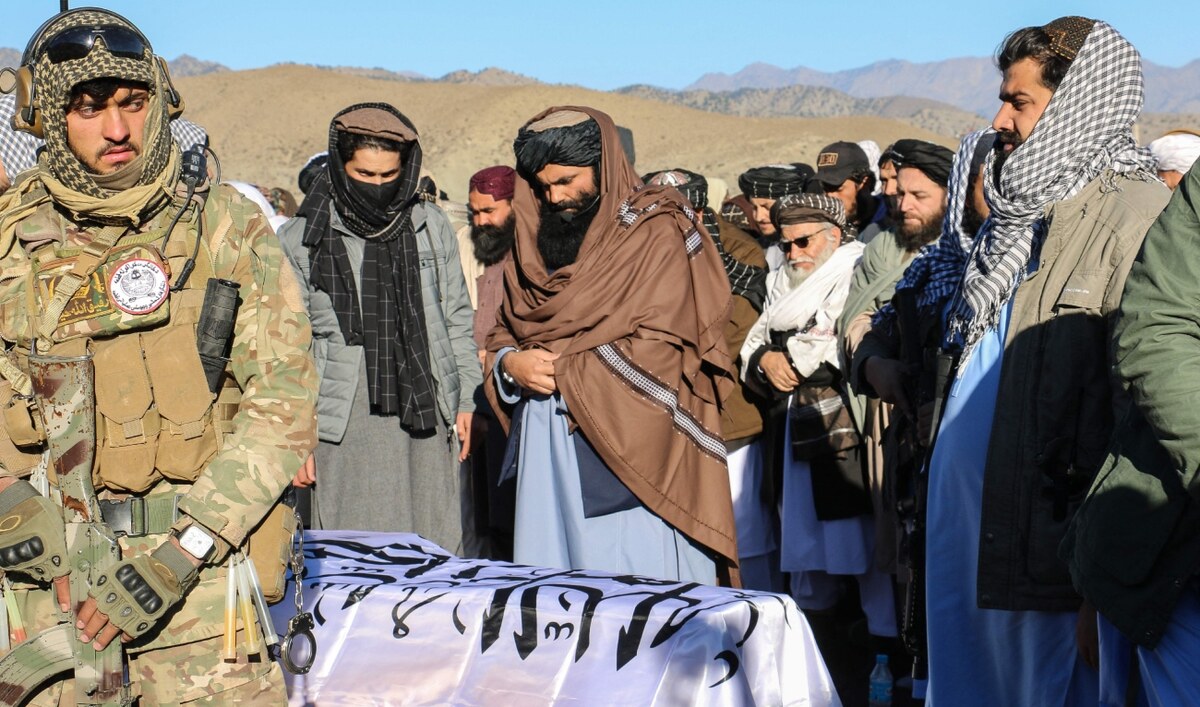


Sirajuddin Haqqani (C), the Taliban interior minister, attends the funeral ceremony of Khalil Ur-Rahman Haqqani, the Minister for Refugees and Repatriation, in Sarana of Paktia province, south of Kabul, on December 12, 2024. (AFP)

In September, the Taliban authorities said Daesh had training camps in Balochistan province of Pakistan, which also regularly faces attacks.

Haqqani, the highest ranked member of the Taliban government to be killed in an attack since their return to power, “was a big loss for us, the system and the nation,” said Paktia resident Hedayatullah, 22.

“May God protect our other leaders and keep them victorious.”

“Our leader... who had his life brutally taken away, achieved martyrdom,” said Bostan, 53, haranguing the “cowardly attack” that killed Haqqani.

The United Nations mission in Afghanistan condemned the attack on Thursday, offering condolences to the victims’ families.

“There can be no place for terrorism in the quest for stability,” the UN Assistance Mission in Afghanistan (UNAMA) said on X.

The European Union and the Organization of Islamic Cooperation also condemned the attack, along with Qatar, Saudi Arabia, Pakistan and Iran.

Haqqani — who is on US and UN sanctions lists and never appeared without an automatic weapon in his hand — was the brother of Jalaluddin Haqqani, founder of the feared Haqqani network responsible for some of the most violent attacks during the Taliban’s two-decade insurgency.

The Daesh group claimed responsibility for the attack, saying a bomber detonated an explosive vest inside the ministry, according to a statement on its Amaq news agency, as translated by the SITE Intelligence Group.

Taliban authorities had already blamed Daesh for the “cowardly attack” — the first targeting a minister since the Taliban returned to power in 2021.

Violence has waned in Afghanistan since the Taliban forces took over the country that year, ending their war against US-led NATO coalition forces.

However, the regional chapter of Daesh is active in Afghanistan and has regularly targeted civilians, foreigners and Taliban officials with gun and bomb attacks.


Energy independence, transition take center stage at India’s flagship industry forum

Updated 4 sec ago
Follow

Energy independence, transition take center stage at India’s flagship industry forum

  • Modi announces investment opportunities of $500 billion in India’s energy ecosystem
  • India, Canada launch ministerial energy dialogue during India Energy Week 2026

NEW DELHI: Thousands of top industry executives, innovators and policymakers are gathered in Goa for India Energy Week 2026, where they are discussing global energy transition technologies, including hydrogen and future fuels.

Organized under the patronage of India’s Ministry of Petroleum and Natural Gas, the event opened on Tuesday and will run through Jan. 30, featuring 10 country pavilions and exhibitions by more than 700 local and international industry players.

The organizers expect 75,000 people to visit the venue at the ONGC Advanced Training Institute in Goa — a petroleum industry training campus operated by Oil and Natural Gas Corporation, India’s largest state‑owned oil and gas company.

In his opening remarks, Prime Minister Narendra Modi announced investment opportunities of up to $500 billion in oil and gas exploration, refining, and energy infrastructure.

“We are doing reforms to empower domestic hydrocarbons and are creating a transparent and investor-friendly environment for global collaboration. India is now working on the mission of energy independence, moving beyond energy security,” he said.

“We are striving to take investment in our oil and gas sector to $100 billion by the end of this decade.”

The minister of petroleum and natural gas, Hardeep Singh Puri, told participants that India’s share of global energy demand is estimated to be 10 percent by 2050 — about 30 percent more than at present — and it will be backed by conventional and renewable energy sources.

“While renewable and alternative energy sources are expanding at pace, conventional energy will remain essential to meet growing demand. Energy transition, energy security, and system resilience must advance together, and energy addition has emerged as a practical pathway to balance these priorities,” he said.

“India is diversifying its energy journey on a sustainable path. With strong progress across green hydrogen, compressed biogas, CNG (compressed natural gas), and LNG (liquefied natural gas), India continues to address the energy trilemma of availability, affordability and sustainability.”

India depends mainly on Russia, Iraq and Saudi Arabia for crude, and Qatar for LNG.

A new source for both may become Canada, whose Energy Minister Timothy Hodgson launched with Puri the India-Canada Ministerial Energy Dialogue on the sidelines of the Goa event on Tuesday.

Hodgson told India Energy Week participants that Canada could supply crude oil and LNG to India, as well as uranium — which India needs to achieve its target of 100 GW nuclear capacity by 2047.

“Canada used to provide 98 percent of its energy to one customer,” Hodgson said, referring to the US. “We are committed to diversifying our supply. We see the opportunity to work with India.”