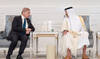
ISLAMABAD: Combatting smog and air pollution has remained at the center of discussions this week as the chief minister of Pakistan’s most populous Punjab province, Maryam Nawaz Sharif, visits China on a week-long trip.
Smog had choked Pakistan’s eastern Punjab province for weeks last month, sickening nearly two million people and shrouding vast swathes of the province in a toxic haze.
On Thursday, Lahore, the capital of Punjab, was listed as the world’s third most polluted city by Swiss air monitor IQAir, and its PM2.5 concentration, which comprises air particles that damage lungs, was 20.5 times the World Health Organization annual guideline value. Last month, the province had closed down schools and offices, banned outdoor activities and shortened timings for restaurants, shops and markets in a bid to control smog.
China has taken significant steps to combat its worsening air quality, declaring a “war on pollution” in 2015. Key measures include reducing coal consumption, increasing renewable energy capacity, and improving air quality monitoring systems. However, the Helsinki-based Center for Research on Energy and Clean Air (CREA) said last month in its annual assessment China’s emissions of carbon dioxide were on course to rise slightly this year, despite rapid progress on renewables and electric vehicles, putting a key 2025 climate target further out of reach.
“China is also a miracle in curbing pollution, smog mitigation, smog eradication and the steps that China has taken is not only an inspiration for us to learn from but also commend them,” CM Sharif said in televised comments during a meeting with Chinese Ecology and Environment Minister Huang Runqiu on Wednesday.
“I am also completely and absolutely committed to making Punjab into a climate resilient Punjab.”
Briefing Chinese officials on Pakistan’s short-, medium- and long-term plans to combat air pollution, Sharif said:
“There is a complete plan that is in place which is environment conservation, biodiversity conservation, sustainable development and, most critical areas where we are working on daily basis, is air pollution, improving air quality standards and eradicating smog.”
Sharif said Pakistan would adopt the Chinese model of shifting industries out of cities to give people cleaner air to breathe.
Earlier this week, Sharif’s office said Punjab would develop an advanced air quality management system with the help of China and had set up a Beijing-Punjab Clean Air Joint Working Group.
“I suggest we form a working group where we can sit together on taking some tangible measures for smog mitigation, smog eradication and improving the air quality in Pakistan,” Sharif added. “We can exchange technologies, ideas, success stories and follow in China’s footsteps.”
She urged the working group to adopt a knowledge sharing policy regarding policy formulation, technology transfer, data, sharing, emission reduction strategies and e-transport.
On Thursday, the Punjab CM also invited a Chinese solar company to establish a manufacturing plan in Pakistan during her visit to the Jinko Solar Company in Shanghai, state broadcaster Radio Pakistan reported.
“The CM directed the concerned authorities of Punjab government to take necessary steps for setting up the solar manufacturing plant in the province,” the report said.