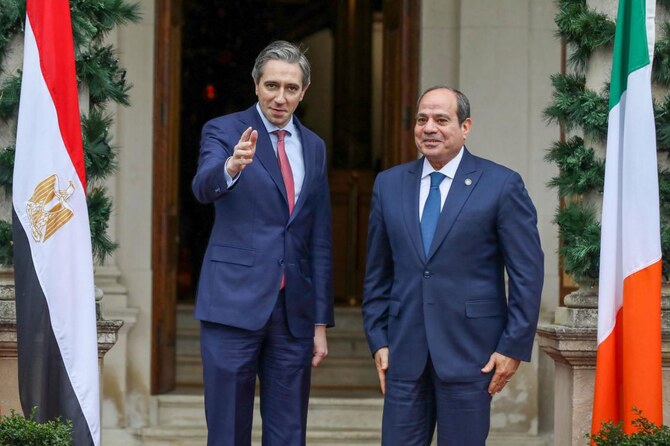
Egypt’s El-Sisi discusses Gaza ‘suffering’ on Dublin visit

1 / 2
Ireland's Prime Minister Simon Harris welcomes Egypt's President Abdel Fattah El-Sisi at Farmleigh House, in Dublin, on Dec. 11. (AFP)
2 / 2
Ireland's President Michael Higgins welcomes Egypt's President Abdel Fattah El-Sisi at Aras an Uachtarain, in Dublin, on Dec. 11. (AFP)
Short Url
Updated 11 December 2024
Follow

Egypt’s El-Sisi discusses Gaza ‘suffering’ on Dublin visit

  • El-Sisi praised Dublin’s “courageous positions" in support of the Palestinian cause

DUBLIN: Egyptian President Abdel Fattah El-Sisi met his Irish counterpart Michael Higgins and prime minister Simon Harris Wednesday for talks on the war in Gaza and boosting bilateral ties.
The two heads of state discussed the Middle East situation, including the political upheaval in Syria, according to a statement from Higgins’s office.
“The outrageous suffering in the absence of a ceasefire in Gaza was the central part of their discussion,” the statement added.
There had also been “agreement on the need to expand international recognition of the Palestinian state,” said Egyptian presidential spokesman Mohamed Al-Shenawy.
Ireland is among several European countries which in May formally recognized the State of Palestine, drawing anger from Israel.
El-Sisi praised Dublin’s “courageous positions in support of the Palestinian cause,” Shenawy added in a statement.
Eight Gazan children and their families, currently in Cairo, will soon be medically evacuated to Ireland, the Irish statement said.
El-Sisi later held a working lunch with Harris, who said before the meeting that he would raise the case of an Irish mother whose children have been kept by their father in Egypt since 2022.
The Dublin visit was the final leg of a European tour by El-Sisi that included stops in Norway and Denmark.
It marked the first trip to Ireland by an Egyptian president since Hosni Mubarak visited in 2006.


Britain needs to step up defense spending faster, says Starmer

Britain's Prime Minister Keir Starmer takes part in a panel discussion in Munich, Germany. (AP file photo)
Updated 5 sec ago
Follow

Britain needs to step up defense spending faster, says Starmer

  • Britain’s budget watchdog, the Office for Budget Responsibility, said last year that raising defense spending to 3 percent of the GDP would cost an additional £17.3 billion a year ($24 billion) in 2029-30

LONDON: Britain should step up and accelerate its ​defense spending, Prime Minister Keir Starmer said on Monday, following a report that the government was considering bringing forward its target to spend 3 percent of economic output on defense.
Britain, which has warned of the risks posed by Russia, said in February 2025 that it would lift annual defense spending to 2.5 percent of the GDP by 2027 and aim for 3 percent in the next Parliament, which is expected to begin after an ‌election due in ‌2029.
The BBC reported that the government was ​now ‌exploring ways to ​reach the 3 percent target by 2029. It said no decision had been taken but the government recognized current plans would not cover rising defense costs.

HIGHLIGHT

The BBC reported that the government is ​now ‌exploring ways to ​reach the 3 percent target by 2029.

Asked whether he would bring the target forward to 2029, Starmer echoed comments he made at the Munich Security Conference, where he said Europe had united to support Ukraine with the supply of weapons and munitions and to strengthen military readiness.
“We need to step up. That means on ‌defense spending, we need to go faster,” ‌Starmer told reporters on Monday. “We’ve obviously made commitments ​already in relation to that, but ‌it goes beyond just how much you spend.”
Latest NATO estimates show ‌that Britain spent 2.3 percent of the GDP on defense in 2024, above the alliance’s 2 percent guideline. But like other European countries, it has faced US pressure to spend more to protect the continent. Struggling with high debt and spending commitments, the government last ‌year cut its international aid budget to fund the hike in defense spending to 2.5 percent of GDP but is yet to publish an investment plan with spending priorities, something that has frustrated the defense industry.
Britain’s budget watchdog, the Office for Budget Responsibility, said last year that raising defense spending to 3 percent of the GDP would cost an additional £17.3 billion a year ($24 billion) in 2029-30.
Finance Minister Rachel Reeves has struggled to stay on track with her plans to repair the public finances. The BBC said the Finance Ministry was believed to be cautious about the new defense spending proposals.
A government spokesperson said Britain was “delivering ​the largest sustained increase in defense ​spending since the Cold War.”