

Pakistan stresses turning existing goodwill with Bangladesh into ‘tangible cooperation’

Outgoing High Commissioner of Bangladesh Muhammad Ruhul Alam Siddique pays a farewell call on Pakistan Prime Minister Shehbaz Sharif in Islamabad on December 11, 2024. (Photo courtesy: PMO)
Short Url
Updated 11 December 2024
Follow

Pakistan stresses turning existing goodwill with Bangladesh into ‘tangible cooperation’

  • Bangladesh’s outgoing high commissioner to Pakistan meets PM Shehbaz Sharif in Islamabad 
  • Pakistan’s relations with Bangladesh have seen a thaw following ex-PM Sheikh Hasina’s ouster

ISLAMABAD: Pakistan’s Prime Minister Shehbaz Sharif on Wednesday called for translating existing goodwill between Islamabad and Dhaka into “tangible cooperation,” his office said, as both countries move toward closer ties following the ouster of former premier Sheikh Hasina.
Established together as one independent nation in 1947, Bangladesh won liberation from then-West Pakistan in 1971. Relations between the two countries continued to deteriorate during Hasina’s administration, which prosecuted several members of the Jamaat-e-Islami (JI) party for war crimes relating to the 1971 conflict.
However, relations between Pakistan and Bangladesh have improved since Hasina was ousted in a bloody student-led protest in August. Islamabad’s ties with Dhaka have also improved as Bangladesh’s relations with India, where Hasina has sought refuge, have deteriorated. 
Bangladesh’s outgoing high commissioner to Pakistan, Ambassador Muhammad Ruhul Alam Siddique, paid a farewell call on Sharif in Islamabad at the end of his four-year tenure on Wednesday. 
“While conveying his warm wishes to Chief Adviser Dr. Muhammad Yunus, the Prime Minister remarked that the existing goodwill between Pakistan and Bangladesh needed to be translated into tangible cooperation,” the Prime Minister’s Office (PMO) said. 
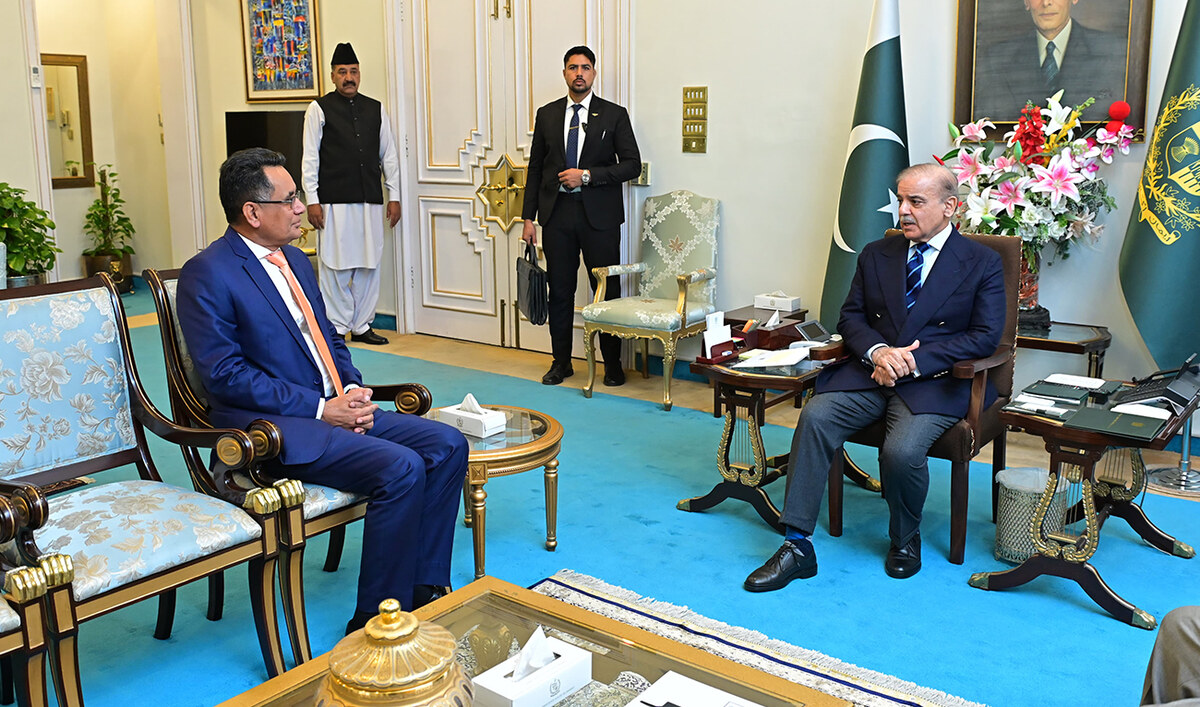


Outgoing High Commissioner of Bangladesh Muhammad Ruhul Alam Siddique pays a farewell call on Pakistan Prime Minister Shehbaz Sharif in Islamabad on December 11, 2024. (Photo courtesy: PMO)

Sharif acknowledged Siddique for promoting Pakistan-Bangladesh ties, stressing that Pakistan “greatly valued” its relations with Bangladesh rooted in shared history, common faith and cultural similarities. 
“The High Commissioner thanked the Prime Minister for the facilitation, courtesies and privileges extended to him during his stay in Pakistan,” the PMO added. 
Pakistan’s foreign office said in September that Islamabad sought “robust, multifaceted, friendly relations” with Bangladesh to ensure peace and stability in the region.
Sharif met Dr. Yunus in New York in September at a ceremony hosted by the Bangladeshi leader to mark the completion of 50 years of Bangladesh’s membership in the United Nations. 
Both sides agreed to forge stronger ties and enhance bilateral cooperation in various fields during their meeting.


Pakistan, China ink 24 agreements to develop digital corridor for IT cooperation

Updated 4 sec ago
Follow

Pakistan, China ink 24 agreements to develop digital corridor for IT cooperation

  • Both countries sign one government-to-government, seven government-to-business and 16 business-to-business MoUs
  • Digital corridor will create new avenues for Pakistani tech companies, expand cooperation with China in ICT, says state media

ISLAMABAD: Pakistan and China have signed 24 agreements to develop a digital corridor aimed at enhancing information technology (IT) cooperation between the two states, state-run media reported on Monday. 

The memoranda of understanding between the two sides were signed in Beijing, according to the state-owned Associated Press of Pakistan (APP). 

The MoUs include one government-to-government, seven government-to-business and 16 business-to-business agreements.

“The initiative focuses on developing an innovative and pragmatic digital corridor to enhance cooperation in the IT industry,” APP reported. 

APP said the digital corridor will create new avenues for Pakistani tech companies and expand bilateral cooperation with China in the information and communication technology infrastructure development.

The development is in line with Pakistan’s recent efforts to boost IT exports and enhance digital cooperation with regional allies. 

In November, Pakistan highlighted the “Digital Silk Road” as the next major phase of the China–Pakistan Economic Corridor (CPEC) while proposing new technology partnerships with Beijing, including joint ventures in 5G/6G, hardware manufacturing and ICT components. 

Launched in 2015, CPEC is a multibillion-dollar connectivity program linking western China to the Arabian Sea. The initiative has historically focused on energy projects, highways, power plants and the Gwadar port, with committed investments estimated at around $60 billion. 

As the two countries enter CPEC’s second phase, cooperation is expanding beyond physical infrastructure into technology, digital governance, manufacturing and skills development.

The Digital Silk Road is Beijing’s framework for cross-border connectivity in fiber, cloud services, data routing, smart manufacturing and emerging technologies. It is increasingly positioned as the backbone of CPEC’s next stage.