Russia vows retaliation after Ukrainian ATACMS strike

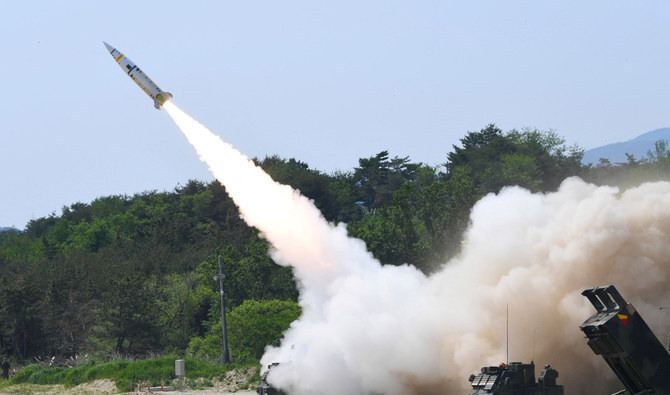
Russia on Wednesday vowed retribution against Ukraine, accusing Kyiv of firing Western-supplied missiles on a military airfield in its southern Rostov region. (AFP/File)
Short Url
Updated 11 December 2024
Follow

Russia vows retaliation after Ukrainian ATACMS strike

  • Putin has previously threatened to launch a hypersonic ballistic missile at the center of Kyiv if Ukraine did not halt its attacks on Russian territory using US-supplied ATACMS missiles
  • One US official said Wednesday that Russia might soon target Ukraine with another of its new Oreshnik missiles

MOSCOW: Russia on Wednesday vowed retribution against Ukraine, accusing Kyiv of firing Western-supplied missiles on a military airfield in its southern Rostov region.
President Vladimir Putin has previously threatened to launch a hypersonic ballistic missile at the center of Kyiv if Ukraine did not halt its attacks on Russian territory using US-supplied ATACMS missiles.
And one US official said Wednesday that Russia might soon target Ukraine with another of its new Oreshnik missiles.
Hours after Ukraine’s overnight attack, Russia claimed its troops had recaptured territory in its western Kursk region, where Ukraine occupies swathes of territory.
And Putin told Hungary’s Prime Minister Viktor Orban that Kyiv’s “destructive” approach made a peace deal impossible.
Kyiv has been on edge since Russia fired its nuclear-capable Oreshnik missile at the city of Dnipro last month in a major escalation of the nearly three-year conflict.
Putin called that retaliation for Kyiv firing US ATACMS and British Storm Shadow long-range missiles against targets on Russian territory.
In the latest attack, Russia’s defense ministry said Wednesday that Ukraine fired six ATACMS missiles at a military airfield in Taganrog, a port city in the southern Rostov region.
“Two of the missiles were shot down by the combat crew of the Pantsir air defense system, while the others were deflected by electronic warfare equipment,” the ministry added.
It said no military personnel were hurt but that falling shrapnel “slightly damaged” military vehicles and buildings nearby.
“This attack by Western long-range weapons will not go unanswered and appropriate measures will be taken,” it added.
And one US official, speaking on condition of anonymity, said Wednesday: “Russia has signalled its intent to launch another experimental Oreshnik missile at Ukraine, potentially in the coming days.”
Ukrainian President Volodymyr Zelensky had earlier hailed “tangible blows against Russian targets last night,” which he said would help bring peace closer.
In a post on Telegram he said Ukraine had hit “military facilities on the territory of Russia, as well as facilities of the fuel and energy complex, which is working for aggression against our state and people.”
Ukraine’s general staff earlier claimed it had hit an oil depot in Russia’s Bryansk border region, also in an overnight strike.
Videos purportedly taken in the Bryansk region showed a distant fireball illuminating the night sky over an urban area, while air raid sirens could be heard in footage from the southern Rostov region.
Both sides have ramped up aerial attacks in recent weeks, seeking to boost their positions on the battlefield ahead as ceasefire talks build ahead of US President-elect Donald Trump coming to power next month.
Ukrainian officials said Wednesday the death toll from a Russian missile strike on the southern city of Zaporizhzhia a day earlier had climbed to nine.
And Russia’s army said it had recaptured two villages in the western Kursk region, where Kyiv has been waging a cross-border offensive since August.
Hungary’s Orban, who met Trump in Florida earlier this week, held a call with Putin on Wednesday to discuss the Ukraine conflict, drawing scorn from Kyiv.
During the call — which was requested by Orban — Putin said that Ukraine had adopted a “destructive” position that ruled out any agreement between Moscow and Kyiv.
The Kremlin said Orban had “expressed interest in assisting the joint search for political-diplomatic paths to resolve the crisis.”
Zelensky blasted Orban for talking to the Kremlin leader, saying it risked undermining European unity against Russia.
“No one should boost (their) personal image at the expense of unity, everyone should focus on shared success. Unity in Europe has always been key to achieving it,” Zelensky said in a post on X.


Refugee firefighters in Mauritania battle bushfires to give back to the community that took them in

Updated 2 sec ago
Follow

Refugee firefighters in Mauritania battle bushfires to give back to the community that took them in

MBERA: The men move in rhythm, swaying in line and beating the ground with spindly tree branches as the sun sets over the barren and hostile Mauritanian desert. The crack of the wood against dry grass lands in unison, a technique perfected by more than a decade of fighting bushfires.
There is no fire today but the men — volunteer firefighters backed by the UN refugee agency — keep on training.
In this region of West Africa, bushfires are deadly. They can break out in the blink of an eye and last for days. The impoverished, vast territory is shared by Mauritanians and more than 250,000 refugees from neighboring Mali, who rely on the scarce vegetation to feed their livestock.
For the refugee firefighters, battling the blazes is a way of giving back to the community that took them in when they fled violence and instability at home in Mali.
Newcomers with an old tradition
Hantam Ag Ahmedou was 11 years old when his family left Mali in 2012 to settle in the Mbera refugee camp in Mauritania, 48 kilometers (30 miles) from the Malian border. Like most refugees and locals, his family are herders and once in Mbera, they saw how quickly bushfires spread and how devastating they can be.
“We said to ourselves: There is this amazing generosity of the host community. These people share with us everything they have,” he told The Associated Press. “We needed to do something to lessen the burden.”
His father started organizing volunteer firefighters, at the time around 200 refugees. The Mauritanians had been fighting bushfires for decades, Ag Ahmedou said, but the Malian refugees brought know-how that gave them an advantage.
“You cannot stop bushfires with water,” Ag Ahmedou said. “That’s impossible, fires sometimes break out a hundred kilometers from the nearest water source.”
Instead they use tree branches, he said, to smother the fire.
“That’s the only way to do it,” he said.
The volunteer ‘brigade’
Since 2018, the firefighters have been under the patronage of the UNHCR. The European Union finances their training and equipment, as well as the clearing of firebreak strips to stop the fires from spreading. The volunteers today count over 360 refugees who work with the region’s authorities and firefighters.
When a bushfire breaks out and the alert comes in, the firefighters jump into their pickup trucks and drive out. Once at the site of a fire, a 20-member team spreads out and starts pounding the ground at the edge of the blaze with acacia branches — a rare tree that has a high resistance to heat.
Usually, three other teams stand by in case the first team needs replacing.
Ag Ahmedou started going out with the firefighters when he was 13, carrying water and food supplies for the men. He helped put out his first fire when he was 18, and has since beaten hundreds of blazes.
He knows how dangerous the task is but he doesn’t let the fear control him.
“Someone has to do it,” he said. “If the fire is not stopped, it can penetrate the refugee camp and the villages, kill animals, kill humans, and devastate the economy of the whole region.”
A climate-vulnerable nation
About 90 percent of Mauritania is covered by the Sahara Desert. Climate change has accelerated desertification and increased the pressure on natural resources, especially water, experts say. The United Nations says tensions between locals and refugees over grazing areas is a key threat to peace.
Tayyar Sukru Cansizoglu, the UNHCR chief in Mauritania, said that with the effects of climate change, even Mauritanians in the area cannot find enough grazing land for their own cows and goats — so a “single bushfire” becomes life-threatening for everyone.
When the first refugees arrived in 2012, authorities cleared a large chunk of land for the Mbera camp, which today has more than 150,000 Malian refugees. Another 150,000 live in villages scattered across the vast territory, sometimes outnumbering the locals 10 to one.
Chejna Abdallah, the mayor of the border town of Fassala, said because of “high pressure on natural resources, especially access to water,” tensions are rising between the locals and the Malians.
Giving back
Abderrahmane Maiga, a 52-year-old member of the “Mbera Fire Brigade,” as the firefighters call themselves, presses soil around a young seedling and carefully pours water at its base.
To make up for the vegetation losses, the firefighters have started setting up tree and plant nurseries across the desert — including acacias. This year, they also planted the first lemon and mango trees.
“It’s only right that we stand up to help people,” Maiga said.
He recalls one of the worst fires he faced in 2014, which dozens of men — both refugees and host community members — spent 48 hours battling. By the time it was over, some of the volunteers had collapsed from exhaustion.
Ag Ahmedou said he was aware of the tensions, especially as violence in Mali intensifies and going back is not an option for most of the refugees.
He said this was the life he was born into — a life in the desert, a life of food scarcity and “degraded land” — and that there is nowhere else for him to go. Fighting for survival is the only option.
“We cannot go to Europe and abandon our home,” he said. “So we have to resist. We have to fight.”