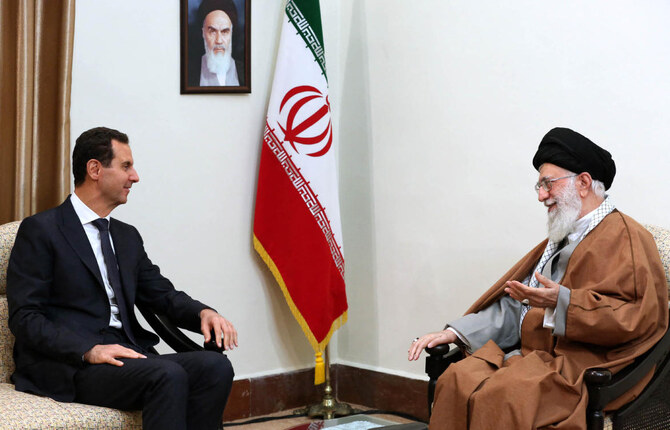
DUBAI: Iran’s Supreme Leader Ayatollah Ali Khamenei said on Wednesday that the toppling of Syrian President Bashar Assad was the result of a plan by the United States and Israel.
One of Syria’s neighbors also had a role, he said. He did not name the country but appeared to be referring to Turkiye, which has backed anti-Assad militants.
Assad’s overthrow is widely seen as a major blow to the Iran-led “Axis of Resistance” political and military alliance that opposes Israeli and US influence in the Middle East.
“What happened in Syria was mainly planned in the command rooms of America and Israel. We have evidence of this. A neighboring government of Syria was also involved,” Khamenei said in a speech reported by Iranian state media.
The neighbor had a “clear role and continues to do so,” he said.
NATO member Turkiye, which controls swathes of land in northern Syria after several cross-border incursions against the Syrian Kurdish YPG militia, has been a main backer of opposition groups aiming to topple Assad since the outbreak of the civil war in 2011.
Iran spent billions of dollars propping up Assad during the war and deployed its Revolutionary Guards to Syria to keep its ally in power.
Hours after Assad’s fall, Iran said it expected relations with Damascus to continue based on the two countries’ “far-sighted and wise approach” and called for the establishment of an inclusive government representing all segments of Syrian society.
In his speech, Khamenei also said the Iran-led alliance would gain in strength across the entire region.
“The more pressure you exert, the stronger the resistance becomes. The more crimes you commit, the more determined it becomes. The more you fight against it, the more it expands Khamenei said.
“Iran is strong and powerful— and will become even stronger,” he said.


![]()

Iran’s Khamenei says toppling of Syria’s Assad was result of US-Israeli plan
Short Url
https://arab.news/7je5u
Iran’s Khamenei says toppling of Syria’s Assad was result of US-Israeli plan
- One of Syria’s neighbors also had a role, Khamenei said. He did not name the country but appeared to be referring to Turkiye
- Assad’s overthrow is widely seen as a major blow to the Iran-led “Axis of Resistance”


Latest updates








© 2026 SAUDI RESEARCH & PUBLISHING COMPANY, All Rights Reserved And subject to Terms of Use Agreement.