

Dam protesters blocking Pakistan’s Karakoram Highway give government 15 days to meet demands

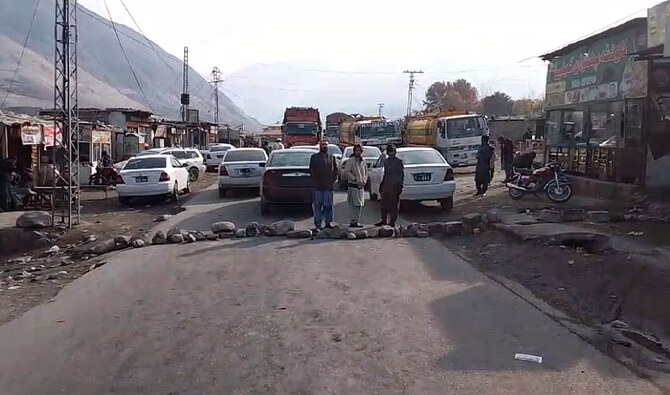
Traffic is blocked on the Karakoram Highway, which connects the remote northern Gilgit-Baltistan region to the rest of Pakistan, as protesters demand financial compensation and resettlement for those displaced by Diamer-Bhasha dam construction, on December 10, 2024. (Photo courtesy: Social Media)
Short Url
Updated 11 December 2024
Follow

Dam protesters blocking Pakistan’s Karakoram Highway give government 15 days to meet demands

  • Government plans to build Diamer-Bhasha dam on River Indus between Khyber Pakhtunkhwa province and Gilgit-Baltistan
  • Protesters’ demands include the resettlement of those displaced by the dam as well as financial compensation for them

KHAPLU, Gilgit-Baltistan: Demonstrators who have been blocking the Karakoram Highway linking the remote northern Gilgit-Baltistan region to the rest of Pakistan to protest the construction of a dam said on Wednesday they would allow the road to be opened for 15 days, giving the government until then to meet demands. 

The government plans to build the Diamer-Bhasha dam on the River Indus between Kohistan district in Khyber Pakhtunkhwa province and Diamer district in Gilgit Baltistan by 2028-29. It is estimated that plans to build the dam and reservoir will displace more than 4,200 families in nearby areas. Once constructed, the dam will submerge a large section of the Karakoram Highway to China, Pakistan’s Water and Power Development Authority (WAPDA) estimates.

For the last two days, hundreds of protesters have been blocking the KKH in the Diamer district in protest against WAPDA, whom they say has not paid them compensation for land they gave up for the construction of the dam. 

Three rounds of negotiations with the government had failed, Shahid Iqbal, a member of the protesters’ core committee, told Arab News.

“Though all negotiations with the government couldn’t reach a conclusion, we don’t want to disturb the public, that’s why we are opening the road to facilitate commuters,” Muhammad Iqbal, the leader of the protesters’ core committee, told Arab News on Wednesday via telephone from the region.

“And on assurances of the senior superintendent of police, Sher Khan, speaking on behalf of the government, we have extended the deadline for 15 days. The local administration has promised to resolve our issues after consulting with the general manager of WAPDA within 15 days.”

Iqbal said the protest would resume after 15 days if the government failed to meet demands, including the resettlement of those displaced by the dam’s construction as well as financial compensation for affectees. 

Speaking to Arab News, the spokesperson of the Gilgit-Baltistan government, Faizullah Faraq, said the government would consider all “valid demands” of protesters. 

“Officials from WAPDA, the district administration, and police are representing the government side, while five members of [dam] affectees are taking part in the negotiation process,” Faraq told Arab News.

He said Diamer-Bhasha dam affectees had protested multiple times in the past but their latest move to block the KKH had left “hundreds of passengers stranded on both sides.”

“They have presented their demands and the government will leave no stone unturned to fulfil their valid demands,” the official added. 

The $12-$14 billion Diamer-Bhasha dam should generate 4,500 megawatts (MW) of electricity, and a vast new reservoir would regulate the flow of water to farmland that is vulnerable to increasingly erratic weather patterns. With a gross water storage capacity of 8.1-million-acre feet (MAF), the dam is expected to help irrigate 1.23 million acres of additional land. 

China and Pakistan signed a memorandum of understanding in December 2016 for Beijing to help fund and develop Pakistan’s Indus Basin dams, though no timelines were released. Pakistan estimates there is 40,000 MW of hydro potential.

Pakistan has been keen for years to build a cascade of mega dams along the Indus flowing down from the Himalayas, but has struggled to raise money from international institutions amid opposition from its nuclear-armed neighbor India.

Those ambitions have been revived by China’s Belt and Road infrastructure corridor for Pakistan, a key cog in Beijing’s creation of a modern-day Silk Road network of trade routes connecting Asia with Europe and Africa.



Pakistan’s deputy PM says country will not send forces to Gaza to disarm Hamas

Updated 27 December 2025
Follow

Pakistan’s deputy PM says country will not send forces to Gaza to disarm Hamas

  • Ishaq Dar says Pakistan open to peacekeeping but Gaza’s internal security is Palestinian responsibility
  • Pakistan’s top religious clerics from different schools have warned against sending forces to Palestine

ISLAMABAD: Deputy Prime Minister Ishaq Dar said on Saturday Pakistan was willing to contribute to an international peacekeeping force in Gaza, though it would not deploy troops to disarm or de-weaponize Hamas.

The statement follows media reports saying Washington views Pakistan as a potentially significant contributor given its battle-hardened military and wants it to be part of International Stabilization Force (ISF), which is part of United States President Donald Trump’s 20-point framework for a Gaza peace plan.

The plan announced by Trump at the White House on September 29 was formally adopted at the Sharm El-Sheikh Peace Summit in October. Co-chaired by Trump and Egyptian President Abdel Fattah El-Sisi, the summit brought together leaders from 27 countries to sign the “Trump Declaration for Enduring Peace and Prosperity.”

Deployment of troops from Muslim-majority countries during a transitional stabilization phase is a key part of the plan before the war-ravaged Palestinian territory moves toward reconstruction and a longer-term political settlement.

“If they say that we should go and start fighting, disarm Hamas, de-weaponize them, and go and destroy the tunnels that Hamas has built until now, that is not our job,” Dar, who is also the country’s foreign minister, told reporters during a year-end briefing in Islamabad.

He emphasized there was clarity between Pakistan’s civil and military leadership over the matter.

“We have a very complete understanding on this matter that we cannot do that kind of work,” he added.

The deputy prime minister said Pakistan had been using the term “peacekeeping” and had never used the phrase “peace enforcement” while discussing the force.

“I have been very clear: Pakistan will be happy to join if the mandate is not peace enforcement and disarming and de-weaponizing Hamas.”

The government’s stance comes amid growing domestic pressure over the issue.

On Monday, a group of Pakistan’s top religious leaders, chaired by prominent scholar Mufti Taqi Usmani, warned the government against yielding to what they described as international pressure to send forces to Gaza.

In a joint statement from Karachi, the clerics — representing Deobandi, Barelvi, Ahl-e-Hadees and Shia schools of thought — said that Washington wanted Muslim countries to send their forces to Gaza to disarm Hamas.

“Several Muslim governments have already refused this, and pressure is being increased on Pakistan,” it added.

Addressing such concerns, Dar said Pakistan would not land its forces in Palestine to “fight Muslims.”

Israel has repeatedly called for the disarmament of Hamas as a precondition for any long-term settlement, and the United Nations Security Council has also endorsed the ISF framework in November.

However, Dar maintained during the media briefing the internal security of Gaza was the Palestinian responsibility.

“The Palestinian Authority, their government, it is their job, it is the job of their law enforcement agency,” he said

The deputy prime minister also highlighted Pakistan’s involvement in the “Arab Islamic Group of Eight,” including Saudi Arabia, Jordan, Egypt, the United Arab Emirates, Qatar, Turkiye and Indonesia, which has been coordinating on the crisis.

He said the efforts of these countries had brought some peace to Palestine and reduced bloodshed.

“Our declared policy is that there should be an independent two-state solution,” he continued while calling for pre-1967 borders.