Ukraine’s Zelensky boosts funding for drone deployment

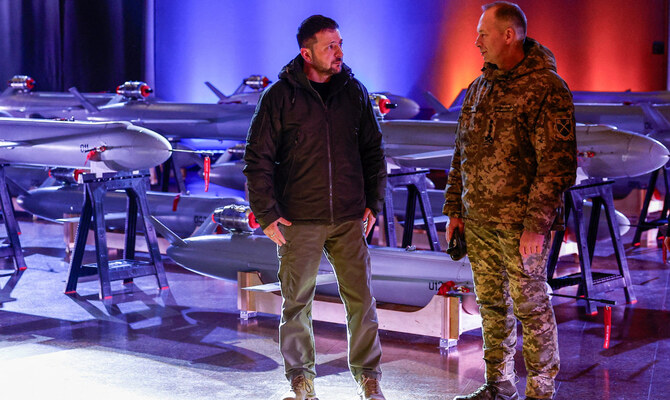
Ukraine's President Volodymyr Zelenskiy and Commander in Chief of the Ukrainian Armed Forces Colonel General Oleksandr Syrskyi visit an exhibition of new Ukrainian made drone-missiles Peklo dedicated to the Day of Ukrainian Armed Forces, amid Russia's attack on Ukraine, in Kyiv, Ukraine December 6, 2024. (Reuters)
Short Url
Updated 10 December 2024
Follow

Ukraine’s Zelensky boosts funding for drone deployment

  • Zelensky has increasingly focused on the deployment of drones in the war, which has extended over 33 months since Russia invaded in February 2022

Ukrainian President Volodymyr Zelensky said on Monday he had issued orders to increase funding for equipping the country’s brigades with new drones.
Zelensky, speaking in his nightly video address, said he had received a report from Pavlo Palisa, a former military commander and the president’s newly-appointed deputy chief of staff, to provide additional funding for drones.
“We recently approved a decision about the amount of such direct funds. But now I see that the amount is insufficient,” Zelensky said.
“I instructed the prime minister to increase financing for brigades in the coming days, to increase several times over.”
Zelensky has increasingly focused on the deployment of drones in the war, which has extended over 33 months since Russia invaded in February 2022.
In October, the president said Ukraine had already contracted to produce 1.5 million drones this year and was capable of ramping up production to four million annually.
Drone production was virtually non-existent in Ukraine before Russia’s invasion in February 2022.


Most of Iranian women’s soccer team leave Australia

Updated 11 March 2026
Follow

Most of Iranian women’s soccer team leave Australia

GOLD COAST: The Iranian women’s soccer team left Australia without seven squad members after tearful protests of their departure outside Sydney Airport and frantic final efforts inside the terminal by Australian officials, who sought to ensure the women understood they were being offered asylum.

As the team’s flight time drew nearer and they passed through security late on Tuesday, each woman was taken aside to meet alone with officials who explained through interpreters that they could choose not to return to Iran.

Before the team traveled to the airport, seven women had accepted humanitarian visas allowing them to remain permanently in Australia and were ushered to a safe location by Australian police officers. 

One has since changed her mind, underscoring the tense and precarious nature of their decisions.

“In Australia, people are able to change their mind,” said Australian Home Affairs Minister Tony Burke, who had hours earlier posted photos of the seven women granted humanitarian visas to his social media accounts, their identities clearly visible.

After what Burke described as “emotional” meetings between the remaining women who reached the airport and Australian officials, the rest of the team declined offers of asylum and boarded their flight.

It was a dramatic conclusion to an episode that had gripped Australia since the Iranian team’s first game at the Asian Cup soccer tournament, when they remained silent during their national anthem.