

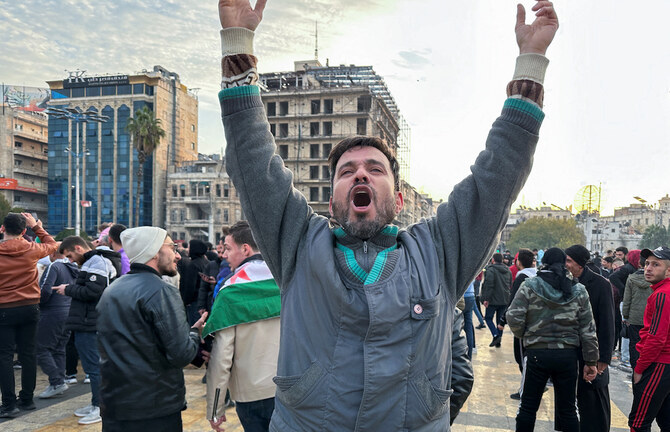

CAIRO: Nations have called for stability and an end of fighting in Syria after president Bashar Assad fled Damascus and militants took control of the capital, ending his 24-year rule.
Egypt has called on all parties in Syria to preserve the capabilities of the state and national institutions, the Egyptian foreign ministry said on Sunday, following the surprise ousting of Assad.
The foreign ministry, in the first comments on the situation in Syria from an Arab government, said it was following the situation with great care, affirming its support for the Syrian people and the country’s sovereignty and unity.
Turkish Foreign Minister Hakan Fidan said Sunday that international and regional actors should ensure a smooth transition from the Assad government of after Islamist-led militants took Damascus.
“We have to work very hard... with Syrian people, not just Turkiye, but also regional actors, the international actors, to make sure that there is a good and smooth transition period, no more harm to the civilian people,” Fidan said at the Doha Forum in Qatar.
In a press conference, Fidan said the Syrian people were not in a position to rebuild on their own and international actors and regional powers had to act with prudence and preserve the country’s territorial integrity.
Terrorist organizations must not be allowed to take advantage of the situation, he added.
“As of this morning, Syria has reached a stage where Syrian people will shape the future of their own country. Today there is hope,” Fidan said.
“The new (Syrian) administration must be established in an orderly manner, the principle of inclusiveness must never be compromised, there must never be a desire for revenge... It is time to unite and reconstruct the country,” he added.
Asked about the whereabouts of Assad, Fidan said he believed he was out of the country.
Germany’s top diplomat called the fall of Assad “a great relief” for the people of war-torn country, while warning against radicalization.
“The end of Assad represents for millions of people in Syria a great relief,” said Annalena Baerbock, adding, “the country must not now fall into the hands of other radicals, whatever form they take.”
Jordan affirms the importance of preserving the unity and security of Syria in light of the fast-developing recent events, the government said on Sunday.
Jordan added that bolstering the state of security in the region “is being worked on”, according to Petra News Agency. Jordan underscored its dedication to safeguarding Syria’s security, stability, and territorial integrity, and further emphasized the urgency of restoring the functionality of Syria’s national institutions, Petra reported.
France meanwhile welcomed news of the fall of Assad and called for fighting to end and a peaceful political transition in the country.
“Now is the time for unity in Syria,” the foreign ministry said in a statement.
“France calls for weapons to fall silent, for the democratic institutions to be preserved, for the sovereignty and territorial integrity of Syria to be respected,” it added.
“It calls for a peaceful political transition, one that respects the diversity of the Syrian people, and protects civilians and all minorities, in accordance with international law. It calls on all Syrians to unite, to reconcile, and to reject all forms of extremism.
“Steadfast in its position and in its solidarity with the Syrian people since the start of the revolution in 2011, France now invites its partners to do everything in their power to help the Syrians find the path toward reconciliation and reconstruction, through an inclusive political solution, in accordance with the United Nations Security Council Resolution 2254 and with the will of the Syrian people. France will play its full part in this,” it continued.
UK Prime Minister Keir Starmer issued a statement on Sunday afternoon in which he said Britain welcomed the fall of Assad.
“The developments in Syria in recent hours and days are unprecedented, and we are speaking to our partners in the region and monitoring the situation closely. The Syrian people have suffered under Assad’s barbaric regime for too long and we welcome his departure,” the statement said.
“Our focus is now on ensuring a political solution prevails and peace and stability is restored. We call on all sides to protect civilians and minorities and ensure essential aid can reach the most vulnerable in the coming hours and days,” it added.
Spain will support a peaceful solution for Syria that provides stability for the region, Foreign Minister Jose Manuel Albares said following the reported fall of the Assad regime.
Madrid wants “any solution for the future of Syria to be a peaceful one... that benefits the Syrian people and in some way brings new stability to the Middle East and not more instability”, Albares told Spanish public television.
“We have to take steps to ensure that it’s the Syrian people who decide how they are governed and by whom in future and, of course, that Syria’s territorial integrity is maintained,” he said.
China’s foreign ministry said Sunday it hopes Syria “returns to stability as soon as possible.”
Beijing “is closely following the development of the situation in Syria and hopes that Syria returns to stability as soon as possible”, the foreign ministry said in a statement.
The UAE diplomatic advisor to the president said that non-state actors should not be allowed the opportunity to exploit political vacuums, shortly after Syrian opposition fighters declared the fall of Bashar Assad’s regime in Damascus.
“Unfolding events in Syria are also a clear indication of political failure and the destructive nature of conflict and chaos,” Anwar Gargash told the Manama Dialogue security forum in the Bahraini capital in the first official comments from the UAE on the matter.
Gargash also urged Syrians to collaborate to avert tumult: “We hope that the Syrians will work together, that we don’t just see another episode of impending chaos.”
The UN Secretary-General emphasized the “historic opportunity for Syrians to build a stable and peaceful future” following nearly 14 years of war and the fall of Assad, adding: “The future of Syria is a matter for the Syrians to determine.” He urged calm and the protection of all Syrians’ rights during the transition period.
Highlighting the need for international support, he called for an inclusive and comprehensive political transition that respected Syria’s "sovereignty, unity, independence, and territorial integrity,” Antonio Guterres said.
The UN remained committed to helping Syrians create a future rooted in “reconciliation, justice, freedom, and prosperity,” honoring the memory of those who suffered throughout the conflict.
UN special envoy for Syria Geir Pedersen underscored the clear desire expressed by millions of Syrians that stable and inclusive transitional arrangements are put in place, according to a statement published on Sunday.
The diplomat urged all Syrians to prioritize dialogue, unity, and respect for international humanitarian law and human rights as they seek to rebuild their society, adding he stands ready to support the Syrian people in their journey toward a stable and inclusive future.
– with wires


