

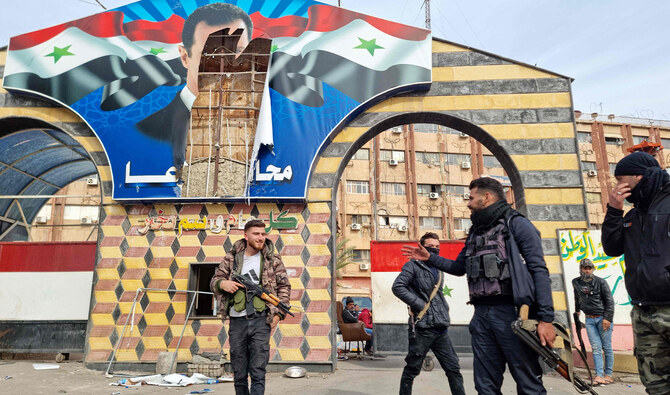

AMMAN/BEIRUT: Syrian President Bashar Assad boarded a plane and left Damascus for an unknown destination on Sunday, two senior army officers told Reuters, as Syrian opposition forces said they had entered the capital with no sign of army deployments.
Thousands in cars and on foot congregated at a main square in Damascus waving and chanting “Freedom,” witnesses said.
“We celebrate with the Syrian people the news of freeing our prisoners and releasing their chains and announcing the end of the era of injustice in Sednaya prison,” said the rebels.
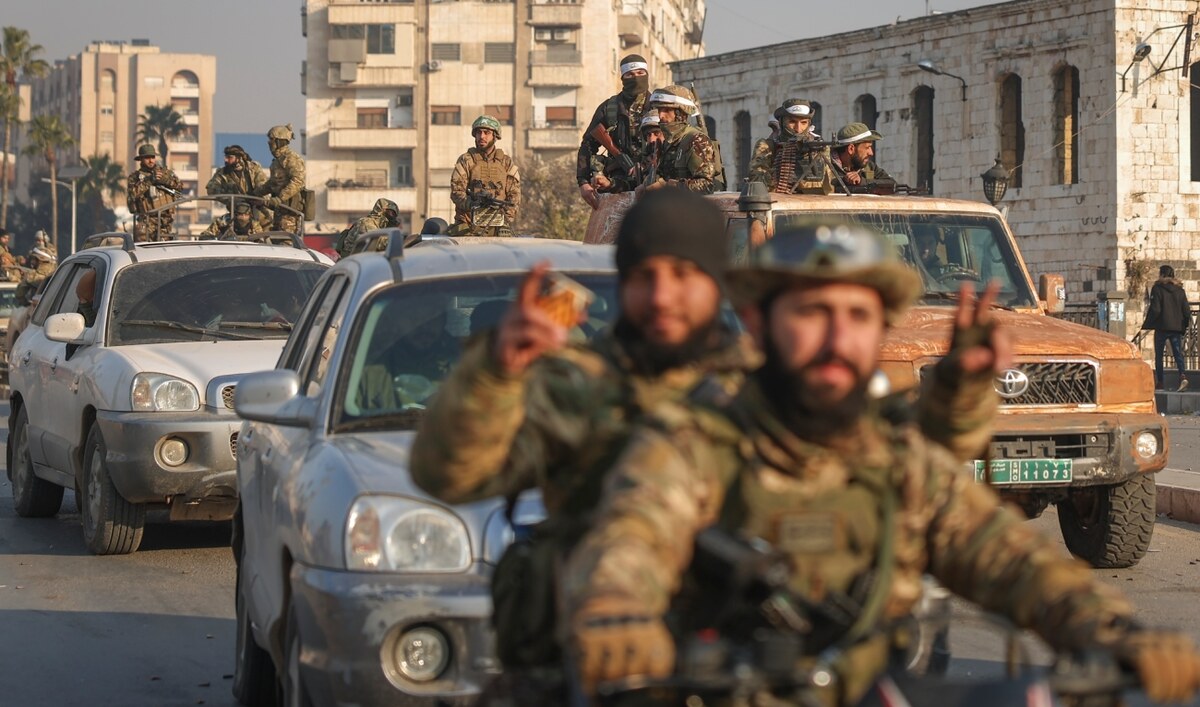
Syrian opposition fighters ride along the streets in the aftermath of the opposition's takeover of Hama, Syria, on December 6, 2024. (AP)
Sednaya is a large military prison on the outskirts of Damascus where the Syrian government detained thousands.
Just hours earlier, rebels announced they had gained full control of the key city of Homs after only a day of fighting, leaving Assad’s 24-year rule dangling by a thread.
Intense sounds of shooting were heard in the center of Damascus, two residents said on Sunday, although it was not immediately clear what the source of the shooting was.
In rural areas southwest of the capital, local youths and former rebels took advantage of the loss of authority to come to the streets in acts of defiance against the Assad family’s authoritarian rule.
Thousands of Homs residents poured onto the streets after the army withdrew from the central city, dancing and chanting “Assad is gone, Homs is free” and “Long live Syria and down with Bashar Assad.”
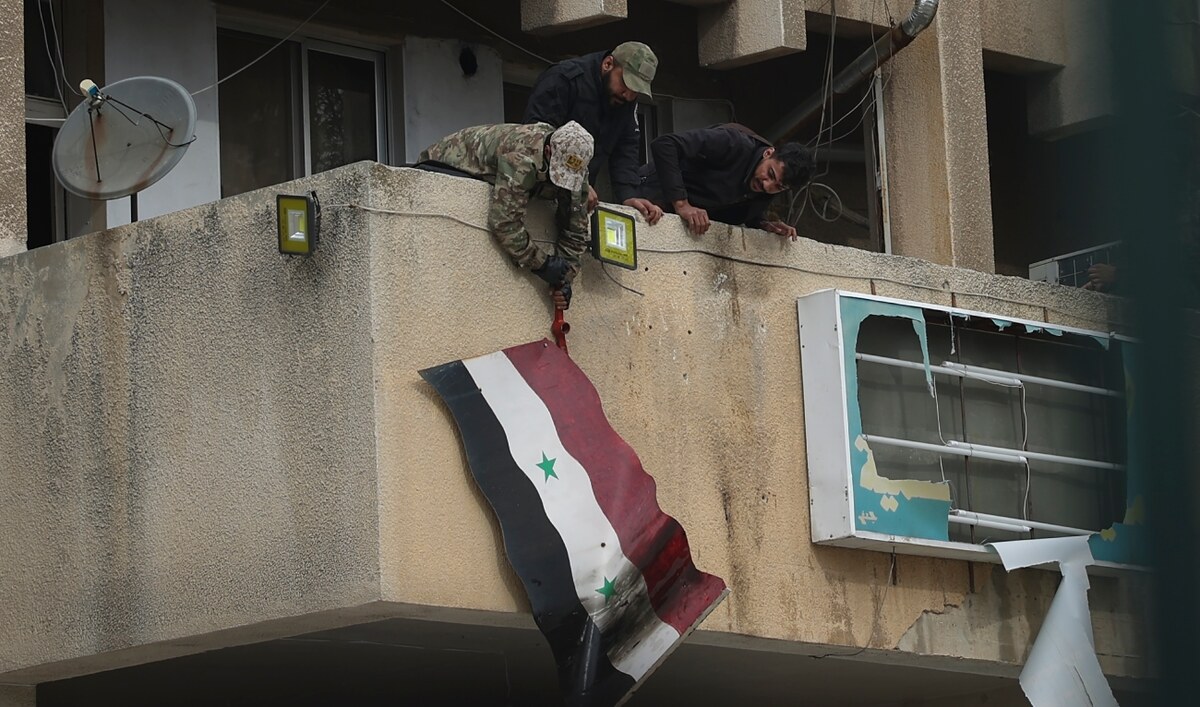
Syrian opposition fighters remove a government Syrian flag from an official building in Salamiyah, east of Hama in Syria on December 7, 2024. (AP)
Rebels fired into the air in celebration, and youths tore down posters of the Syrian president, whose territorial control has collapsed in a dizzying week-long retreat by the military.
The fall of Homs gives the insurgents control over Syria’s strategic heartland and a key highway crossroads, severing Damascus from the coastal region that is the stronghold of Assad’s Alawite sect and where his Russian allies have a naval base and air base.
Homs’ capture is also a powerful symbol of the rebel movement’s dramatic comeback in the 13-year-old conflict. Swathes of Homs were destroyed by gruelling siege warfare between the rebels and the army years ago. The fighting ground down the insurgents, who were forced out.
Hayat Tahrir Al-Sham commander Abu Mohammed Al-Golani, the main rebel leader, called the capture of Homs a historic moment and urged fighters not to harm “those who drop their arms.”
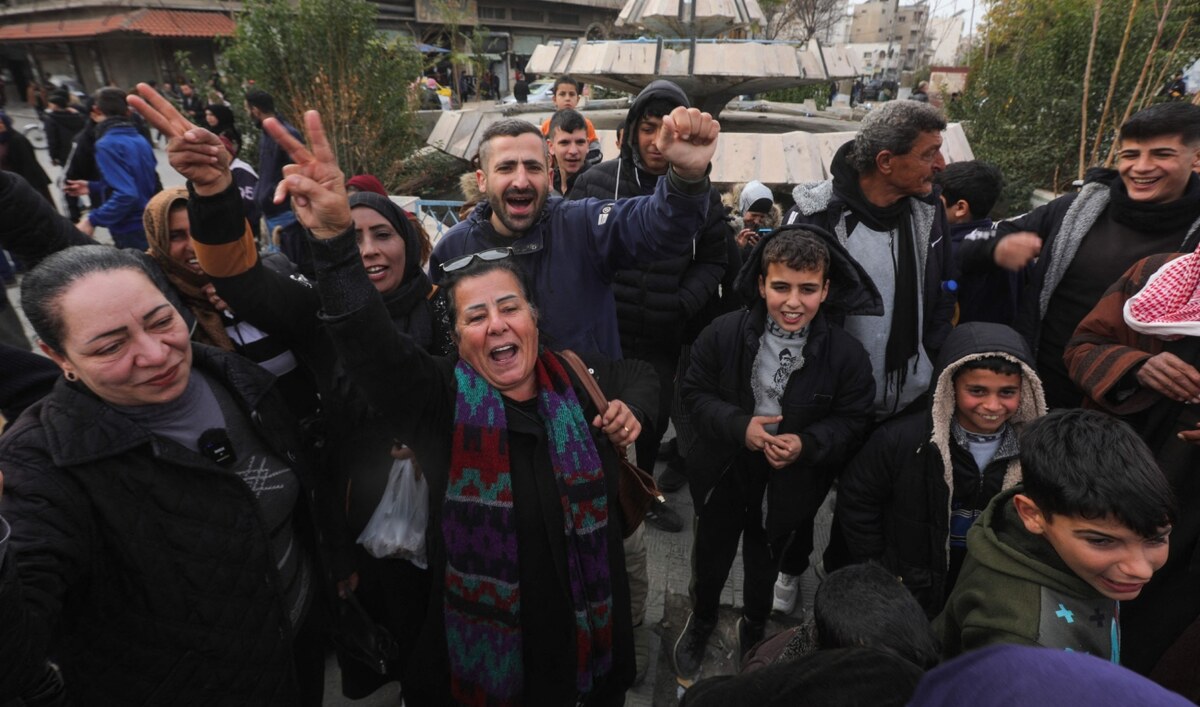
Residents celebrate in the Syrian city of Salamiyah in the Hama governorate, days after anti government forces captured and took control of the area, on December 7, 2024. (AFP)
Rebels freed thousands of detainees from the city prison. Security forces left in haste after burning their documents.
Residents of numerous Damascus districts turned out to protest Assad on Saturday evening, and security forces were either unwilling or unable to clamp down.
Syrian rebel commander Hassan Abdul Ghani said in a statement early Sunday that operations were ongoing to “completely liberate” the countryside around Damascus and rebel forces were looking toward the capital.
In one suburb, a statue of Assad’s father, the late President Hafez Assad, was toppled and torn apart.
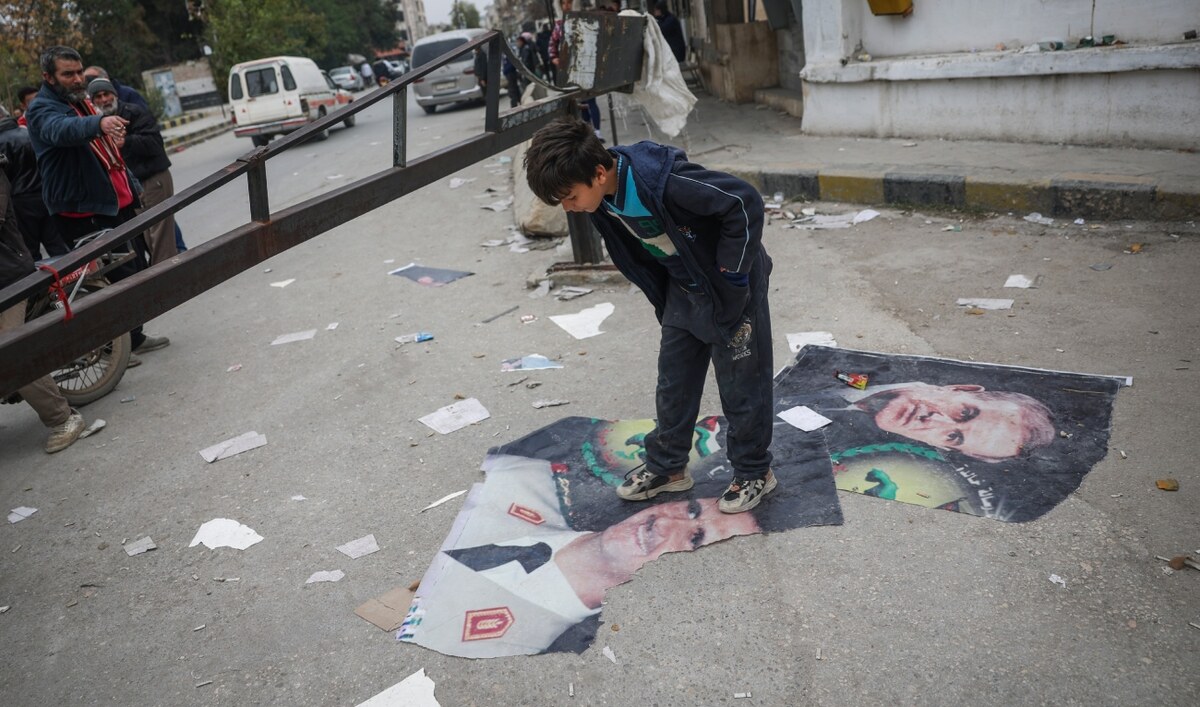
A boy steps over pictures of Syrian President Bashar Assad and his late father, Hafez Assad, right, Salamiyah, east of Hama in Syria, on December 7, 2024. (AP)
The Syrian army said it was reinforcing around Damascus, and state television reported on Saturday that Assad remained in the city.
Outside the city, rebels swept across the entire southwest over 24 hours and established control.
The fall of Homs and threat to the capital pose an immediate existential danger to the Assad dynasty’s five-decade reign over Syria and the continued influence there of its main regional backer, Iran.
The pace of events has stunned Arab capitals and raised fears of a new wave of regional instability.
Qatar, Saudi Arabia, Jordan, Egypt, Iraq, Iran, Turkiye and Russia issued a joint statement saying the crisis was a dangerous development and calling for a political solution.
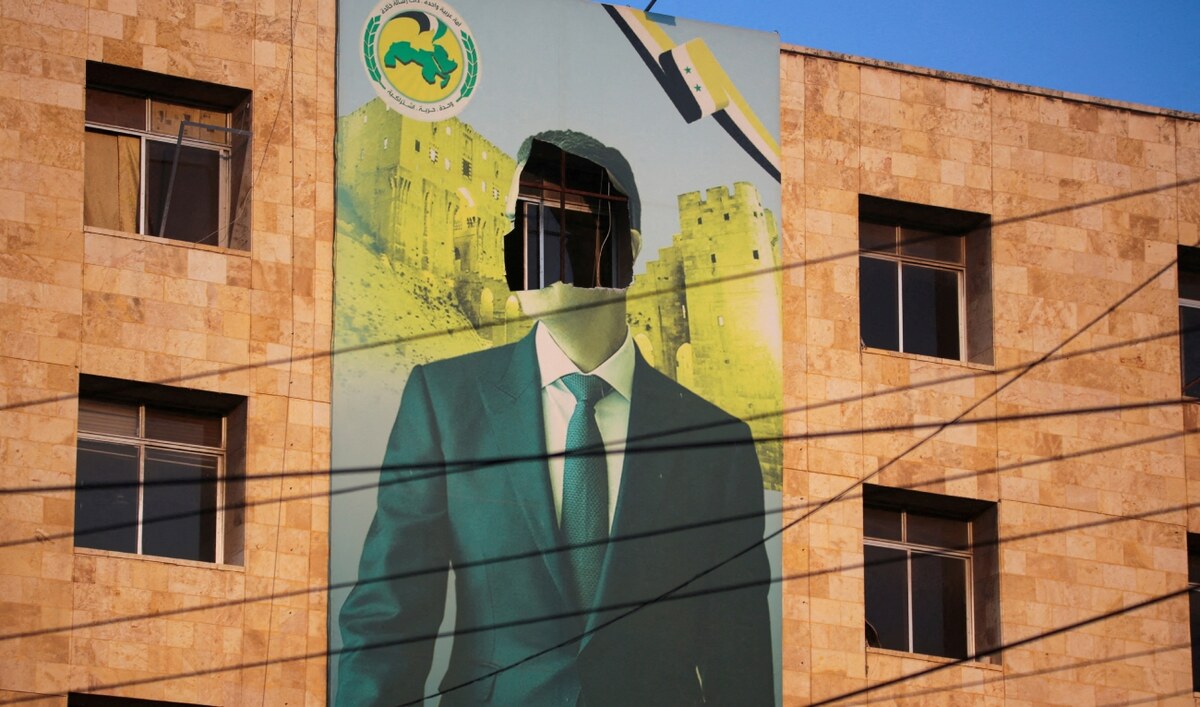
A view shows a damaged poster of Syria's President Bashar al-Assad in Aleppo, after the Syrian army said that dozens of its soldiers had been killed in a major attack by rebels who swept into the city, in Syria November 30, 2024. (REUTERS)
But there was no indication they agreed on any concrete steps, with the situation inside Syria changing by the hour.
Syria’s civil war, which erupted in 2011 as an uprising against Assad’s rule, dragged in big outside powers, created space for jihadist militants to plot attacks around the world and sent millions of refugees into neighboring states.
Hayat Tahrir Al-Sham, the strongest rebel group, is the former Al-Qaeda affiliate in Syria regarded by the US and others as a terrorist organization, and many Syrians remain fearful it will impose draconian Islamist rule.
Golani has tried to reassure minorities that he will not interfere with them and the international community that he opposes Islamist attacks abroad. In Aleppo, which the rebels captured a week ago, there have not been reports of reprisals.
When asked on Saturday whether he believed Golani, Russian Foreign Minister Sergei Lavrov replied, “The proof of the pudding is in the eating.”
Lebanon’s Iran-backed Hezbollah group withdrew from the Syrian city of Qusayr on the border with Lebanon before rebel forces seized it, Syrian army sources said on Sunday.
At least 150 armored vehicles carrying hundreds of Hezbollah fighters left the city, long a point on the route for arms transfers and fighters moving in and out of Syria, the sources said. Israel hit one of the convoys as it was departing, one source said.
Assad long relied on allies to subdue the rebels. Russian warplanes conducted bombing while Iran sent allied forces including Hezbollah and Iraqi militia to reinforce the Syrian military and storm insurgent strongholds.
But Russia has been focused on the war in Ukraine since 2022 and Hezbollah has suffered big losses in its own gruelling war with Israel, significantly limiting its ability or that of Iran to bolster Assad.
US President-elect Donald Trump has said the US should not be involved in the conflict and should “let it play out.”


