Restored Notre-Dame Cathedral reopens, five years after fire

1 / 4
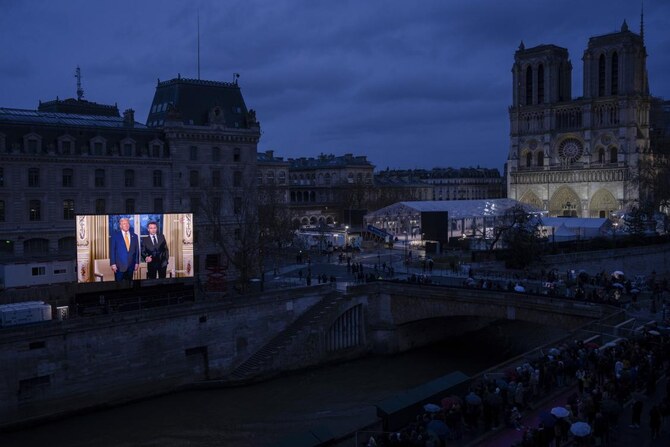
The meeting between President-elect Donald Trump and French President Emmanuel Macron is shown on a large screen for the crowds gathered near France’s iconic Notre Dame Cathedral, Dec. 7, 2024 in Paris before it’s formal reopening. (AP)
2 / 4
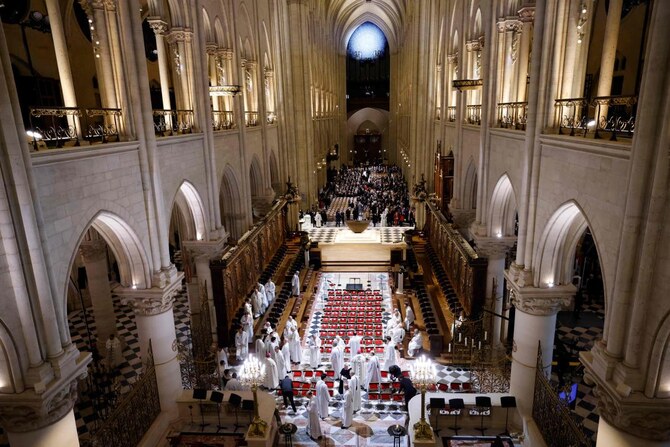
Clergy and guests gather inside Notre-Dame Cathedral ahead of a ceremony to mark the re-opening of the landmark cathedral, in central Paris, on Dec. 7, 2024. (AFP)
3 / 4
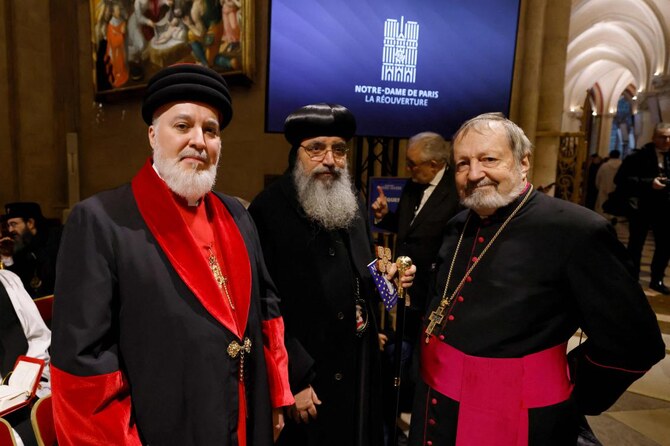
Religous leaders gather inside Notre-Dame Cathedral ahead of a ceremony to mark the re-opening of the landmark cathedral, in central Paris, on Dec. 7, 2024. (AFP)
4 / 4
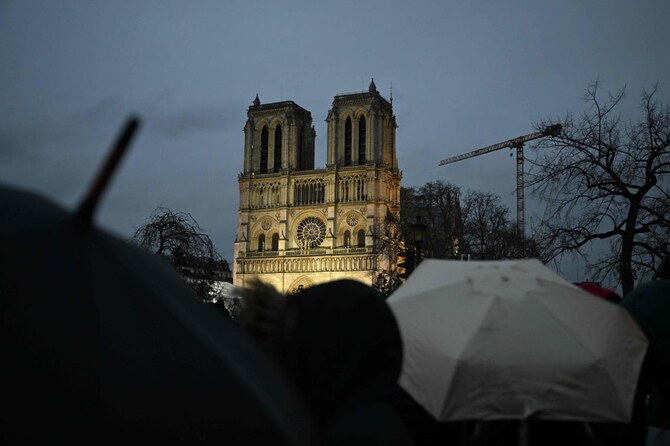
Crowds gather in the rain outside Notre-Dame Cathedral ahead of a ceremony to mark the re-opening of the landmark cathedral, in central Paris, on Dec. 7, 2024.. (AFP)
Short Url
Updated 07 December 2024
Follow

Restored Notre-Dame Cathedral reopens, five years after fire

  • The 860-year-old medieval building has been meticulously restored, with a new spire and rib vaulting
  • Tourists, who still cannot go inside the cathedral, snapped pictures with the restored building in the background as final preparations for the event went on inside

PARIS: French President Emmanuel Macron welcomed guests set to include Donald Trump on Saturday at Paris’ Notre-Dame Cathedral for its reopening ceremony, five-and-a-half years after a huge fire brought the Gothic masterpiece close to collapse.
The 860-year-old medieval building has been meticulously restored, with a new spire and rib vaulting, its flying buttresses and carved stone gargoyles returned to their past glory and white stone and gold decorations shining brightly once again.
Getting US President-elect Trump to attend, and organizing a meeting between him and Ukraine’s leader Volodymyr Zelensky at the Elysee Palace ahead of the Notre-Dame ceremony was a coup for Macron as he faces a political crisis at home, after parliament ousted his prime minister.
Zelensky joined Britain’s Prince William, Italian Prime Minister Giorgia Meloni and former French presidents Francois Hollande and Nicolas Sarkozy, who were arriving for the evening ceremony.
Tech billionaire Elon Musk, a close adviser in Trump’s transition team, was also set to attend, a French government source said.
Earlier, tourists, who still cannot go inside the cathedral, snapped pictures with the restored building in the background as final preparations for the event went on inside.
“It was very sad to see it burnt down and all black and ashy but amazing to see it rebuilt. Yeah, it’s very special,” said 26-year-old US tourist Amanda Nguyen, from Texas.
Some Parisians were particularly thrilled.
“What does Notre-Dame mean to me? This. Look, it’s here,” said careworker Pascal Tordeux, displaying a tattoo on his arm representing the cathedral. “It means everything.”
“I saw the construction every day from my window, the spire being brought down, being brought back. I saw it burn, I saw it rise again. I followed it day by day,” said Tordeux, who lives across the river from Notre-Dame.
On the evening of April 15, 2019, dismayed Parisians rushed to the scene and TV viewers worldwide watched horrified as the fire raged through the cathedral.
“The planet was shaken on that day,” Macron said ahead of Saturday’s event. “The shock of the reopening will – I believe and I want to believe – be as strong as that of the fire, but it will be a shock of hope.”
THOUSANDS WORKED ON RESTORATION
Forecast strong winds mean the non-religious part of the celebrations, including Macron’s speech, which had been set to be held outside the cathedral, will also be held inside.
Would-be visitors can now book a free ticket online, on the Cathedral’s website. But on Saturday, the first day bookings could be made for the coming days, all tickets were gone, a message on the site said.
Group visits will be allowed next year — from Feb. 1 for religious groups or from June 9 for tourists with guides. The Catholic Church expects the cathedral to welcome 15 million visitors each year.
Thousands of experts — from carpenters and stonemasons to stained glass window artists — worked around the clock for the last five years, using age-old methods to restore, repair or replace everything that was destroyed or damaged.
“Notre-Dame is more than a Parisian or French monument. It’s also a universal monument,” said historian Damien Berne.
“It’s a landmark, an emblem, a point of reference that reassures in a globalized world where everything evolves permanently,” said Berne, a member of the scientific council for the restoration.
The cathedral’s first stone was laid in 1163, and construction continued for much of the next century, with major restoration and additions made in the 17th and 18th centuries.
Victor Hugo helped make the cathedral a symbol of Paris and France when he used it as a setting for his 1831 novel “The Hunchback of Notre-Dame.” Quasimodo, the main character, has been portrayed in Hollywood movies, an animated Disney adaptation and in musicals.
So much money poured in for the renovation from all over the world — more than 840 million euros ($880 million), according to Macron’s office — there are still funds left over for further investment in the building.


‘A den of bandits’: Rwanda closes thousands of evangelical churches

Updated 22 December 2025
Follow

‘A den of bandits’: Rwanda closes thousands of evangelical churches

  • A 2018 law introduced new rules on health, safety, and financial disclosures, and requires all preachers to have theological training
  • Observers say the real reason for the closures comes down to control, noting that even those who complied with the law had been shut down 
  • President Kagame has described the church as a relic of the colonial period, a chapter of its history with which the country is still grappling


KIGALI: Grace Room Ministries once filled giant stadiums in Rwanda three times a week before the evangelical organization was shut down in May.
It is one of the 10,000 churches reportedly closed by the government for failing to comply with a 2018 law designed to regulate places of worship.
The law introduced new rules on health, safety, and financial disclosures, and requires all preachers to have theological training.
President Paul Kagame has been vocal in his criticisms of the evangelical churches that have sprouted across the small country in Africa’s Great Lakes region.
“If it were up to me I wouldn’t even reopen a single church,” Kagame told a news briefing last month.
“In all the development challenges we are dealing with, the wars... our country’s survival — what is the role of these churches? Are they also providing jobs? Many are just thieving... some churches are just a den of bandits,” he said.
The vast majority of Rwandans are Christian according to a 2024 census, with many now traveling long and costly distances to find places to pray.
Observers say the real reason for the closures comes down to control.
Kagame’s government is saying “there’s no rival in terms of influence,” Louis Gitinywa, a lawyer and political analyst based in Kigali, told AFP.
The ruling party “bristles when an organization or individual gains influence,” he said, a view also expressed to AFP by an anonymous government official.

‘Deceived’ 

The 2018 law requires churches to submit annual action plans stating how they align with “national values.” All donations must be channelled through registered accounts.
Pastor Sam Rugira, whose two church branches were shut down last year for failing to meet fire safety regulations, said the rules mostly affected new evangelical churches that have “mushroomed” in recent years.
But Kagame has described the church as a relic of the colonial period, a chapter of its history with which the country is still grappling.
“You have been deceived by the colonizers and you let yourself be deceived,” he said in November.
The closure of Grace Room Ministries came as a shock to many across the country.
Pastor Julienne Kabanda, had been drawing massive crowds to the shiny new BK Arena in Kigali when the church’s license was revoked.
The government had cited unauthorized evangelical activities and a failure to submit “annual activity and financial reports.”
AFP was unable to reach Kabanda for comment.

‘Open disdain, disgust’ 

A church leader in Kigali, speaking to AFP on condition of anonymity, said the president’s “open disdain and disgust” for churches “spells tough times ahead.”
“It is unfair that even those that fulfilled all requirements are still closed,” he added.
But some say the clampdown on places of worship is linked to the 1994 Rwandan genocide in which around 800,000 people, mostly ethnic Tutsis, were slaughtered.
Ismael Buchanan a political science lecturer at the National University of Rwanda, told AFP the church could sometimes act as “a conduit of recruitment” for the Democratic Forces for the Liberation of Rwanda (FDLR), the Hutu militia formed in exile in DR Congo by those who committed the genocide.
“I agree religion and faith have played a key role in healing Rwandans from the emotional and psychological wounds after the genocide, but it also makes no sense to have a church every two kilometers instead of hospitals and schools,” he said.
Pastor Rugira meanwhile suggested the government is “regulating what it doesn’t understand.”
It should instead work with churches to weed out “bad apples” and help them meet requirements, especially when it comes to the donations they rely on to survive, he said.