Restored Notre-Dame Cathedral reopens, five years after fire

1 / 4
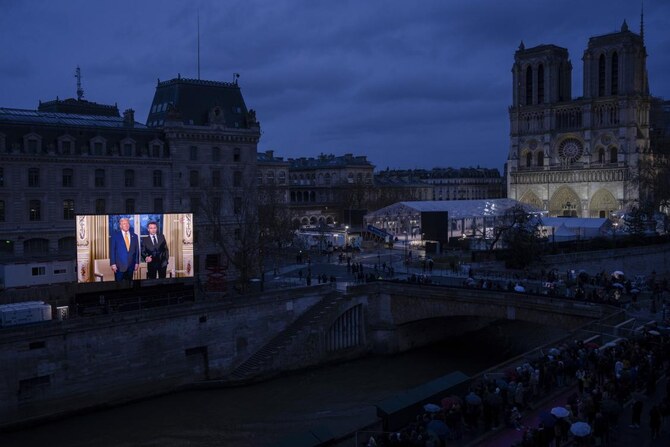
The meeting between President-elect Donald Trump and French President Emmanuel Macron is shown on a large screen for the crowds gathered near France’s iconic Notre Dame Cathedral, Dec. 7, 2024 in Paris before it’s formal reopening. (AP)
2 / 4
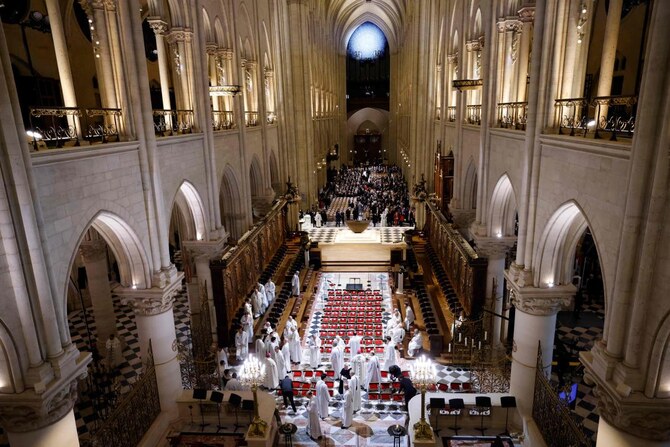
Clergy and guests gather inside Notre-Dame Cathedral ahead of a ceremony to mark the re-opening of the landmark cathedral, in central Paris, on Dec. 7, 2024. (AFP)
3 / 4
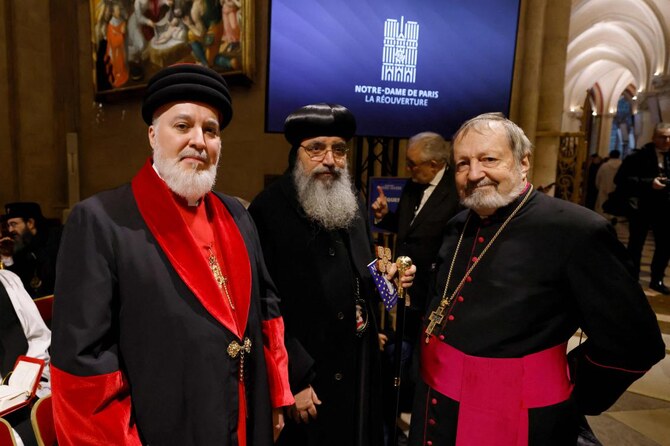
Religous leaders gather inside Notre-Dame Cathedral ahead of a ceremony to mark the re-opening of the landmark cathedral, in central Paris, on Dec. 7, 2024. (AFP)
4 / 4
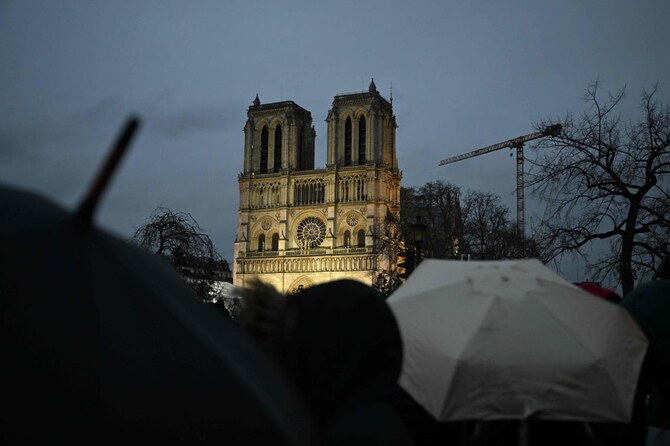
Crowds gather in the rain outside Notre-Dame Cathedral ahead of a ceremony to mark the re-opening of the landmark cathedral, in central Paris, on Dec. 7, 2024.. (AFP)
Short Url
Updated 07 December 2024
Follow

Restored Notre-Dame Cathedral reopens, five years after fire

  • The 860-year-old medieval building has been meticulously restored, with a new spire and rib vaulting
  • Tourists, who still cannot go inside the cathedral, snapped pictures with the restored building in the background as final preparations for the event went on inside

PARIS: French President Emmanuel Macron welcomed guests set to include Donald Trump on Saturday at Paris’ Notre-Dame Cathedral for its reopening ceremony, five-and-a-half years after a huge fire brought the Gothic masterpiece close to collapse.
The 860-year-old medieval building has been meticulously restored, with a new spire and rib vaulting, its flying buttresses and carved stone gargoyles returned to their past glory and white stone and gold decorations shining brightly once again.
Getting US President-elect Trump to attend, and organizing a meeting between him and Ukraine’s leader Volodymyr Zelensky at the Elysee Palace ahead of the Notre-Dame ceremony was a coup for Macron as he faces a political crisis at home, after parliament ousted his prime minister.
Zelensky joined Britain’s Prince William, Italian Prime Minister Giorgia Meloni and former French presidents Francois Hollande and Nicolas Sarkozy, who were arriving for the evening ceremony.
Tech billionaire Elon Musk, a close adviser in Trump’s transition team, was also set to attend, a French government source said.
Earlier, tourists, who still cannot go inside the cathedral, snapped pictures with the restored building in the background as final preparations for the event went on inside.
“It was very sad to see it burnt down and all black and ashy but amazing to see it rebuilt. Yeah, it’s very special,” said 26-year-old US tourist Amanda Nguyen, from Texas.
Some Parisians were particularly thrilled.
“What does Notre-Dame mean to me? This. Look, it’s here,” said careworker Pascal Tordeux, displaying a tattoo on his arm representing the cathedral. “It means everything.”
“I saw the construction every day from my window, the spire being brought down, being brought back. I saw it burn, I saw it rise again. I followed it day by day,” said Tordeux, who lives across the river from Notre-Dame.
On the evening of April 15, 2019, dismayed Parisians rushed to the scene and TV viewers worldwide watched horrified as the fire raged through the cathedral.
“The planet was shaken on that day,” Macron said ahead of Saturday’s event. “The shock of the reopening will – I believe and I want to believe – be as strong as that of the fire, but it will be a shock of hope.”
THOUSANDS WORKED ON RESTORATION
Forecast strong winds mean the non-religious part of the celebrations, including Macron’s speech, which had been set to be held outside the cathedral, will also be held inside.
Would-be visitors can now book a free ticket online, on the Cathedral’s website. But on Saturday, the first day bookings could be made for the coming days, all tickets were gone, a message on the site said.
Group visits will be allowed next year — from Feb. 1 for religious groups or from June 9 for tourists with guides. The Catholic Church expects the cathedral to welcome 15 million visitors each year.
Thousands of experts — from carpenters and stonemasons to stained glass window artists — worked around the clock for the last five years, using age-old methods to restore, repair or replace everything that was destroyed or damaged.
“Notre-Dame is more than a Parisian or French monument. It’s also a universal monument,” said historian Damien Berne.
“It’s a landmark, an emblem, a point of reference that reassures in a globalized world where everything evolves permanently,” said Berne, a member of the scientific council for the restoration.
The cathedral’s first stone was laid in 1163, and construction continued for much of the next century, with major restoration and additions made in the 17th and 18th centuries.
Victor Hugo helped make the cathedral a symbol of Paris and France when he used it as a setting for his 1831 novel “The Hunchback of Notre-Dame.” Quasimodo, the main character, has been portrayed in Hollywood movies, an animated Disney adaptation and in musicals.
So much money poured in for the renovation from all over the world — more than 840 million euros ($880 million), according to Macron’s office — there are still funds left over for further investment in the building.


US allies, foes alarmed by capture of Venezuela’s Maduro

Updated 4 sec ago
Follow

US allies, foes alarmed by capture of Venezuela’s Maduro

  • Countries such as Russia and China, which had ties with Maduro’s government, were quick to condemn the operation but alarm also shared by France and EU
Paris — FRA
Paris, France, Jan 3, 2026 : The US military operation that led to the seizure of Venezuelan President Nicolas Maduro on Saturday sparked alarm across the international community, with allies and foes of Washington and Caracas expressing disquiet.
US President Donald Trump said Maduro and his wife would be taken to New York to face federal charges after military strikes and an operation which he described as looking like a “television show.”
The Venezuelan government decried what it termed a “extremely serious military aggression” by Washington and declared a state of emergency.
Countries such as Russia and Iran, which had longstanding ties with Maduro’s government, were quick to condemn the operation but their alarm was also shared by Washington’s allies including France and the EU.
Here is a rundown of the main reaction.

- Russia -

Russia demanded the US leadership “reconsider its position and release the legally elected president of the sovereign country and his wife.”

- China -

Beijing said “China is deeply shocked and strongly condemns the US’s blatant use of force against a sovereign state and its action against its president.”

- Iran -

Iran, which Trump bombed last year, said it “strongly condemns the US military attack on Venezuela and a flagrant violation of the country’s national sovereignty and territorial integrity.”

- Mexico -

Mexico, which Trump has also threatened with military force over drug trafficking, strongly condemned the US military action in Venezuela, saying it “seriously jeopardizes regional stability.”

- Colombia -

Colombian President Gustavo Petro — whose country neighbors Venezuela — called the US action an “assault on the sovereignty” of Latin America which would lead to a humanitarian crisis.

- Brazil -

Brazilian President Luiz Inacio Lula da Silva slammed the US attacks as a “serious affront” to Venezuela’s sovereignty.

- Cuba -

Cuba, a strong ally of Venezuela, denounced “state terrorism against the brave Venezuelan people.”

- Spain -

Spain offered to mediate in the crisis to find a way to a peaceful solution, while calling for “de-escalation and restraint.”
- France -

France condemned the US operation, saying it undermined international law and no solution to Venezuela’s crisis can be imposed from the outside.

- EU -

The EU more generally expressed concern at the developments and urged respect for international law, even as it noted that Maduro “lacks legitimacy.”
EU candidate country North Macedonia, along with fellow Balkan nations Albania and Kosovo, backed Washington, however.
“We stand with the United States and the Venezuelan people for freedom and democracy,” North Macedonia FM Timco Mucunski said on X.

- Britain -

British Prime Minister Keir Starmer said all countries should “uphold international law” and added that “the UK was not involved in any way in this operation” as he urged patience in order to “establish the facts.”

- Italy -

In a rare expression of support for the US operation by a major European country, far-right Italian Prime Minister Giorgia Meloni — a Trump ally — argued the US military action in Venezuela was “legitimate” and “defensive.”

- Israel -

Israel also hailed the operation, saying Washington acted as the “leader of the free world.”

- Ukraine -

Ukraine — dependent on US support in its war against invading Russia — did not address the legality of a big country like America using military force against a much smaller one like Venezuela.
Foreign minister Andriy Sybiga instead focused on Maduro’s lack of legitimacy and the Venezuelan government’s repression, while backing “democracy, human rights, and the interests of Venezuelans.”

- South Africa -

South Africa, which Trump accuses of alleged discrimination — and even “genocide” — of minority white Afrikaners, said: “Unlawful, unilateral force of this nature undermines the stability of the international order and the principle of equality among nations.”

- UN -

UN Secretary-General Antonio Guterres was “deeply alarmed” by the US strikes, with his spokesman quoting him as saying it could “constitute a dangerous precedent.”