BEIRUT: Insurgents’ stunning march across Syria gained speed on Saturday with news that they had reached the suburbs of the capital and with the government forced to deny rumors that President Bashar Assad had fled the country.
The militants’ moves around Damascus, reported by an opposition war monitor and an insurgent commander, came after the Syrian army withdrew from much of southern part of the country, leaving more areas, including two provincial capitals, under the control of opposition fighters.
The advances in the past week were among the largest in recent years by opposition factions, led by a group that has its origins in Al-Qaeda and is considered a terrorist organization by the US and the United Nations. As they have advanced, the insurgents, led by the Hayat Tahrir Al-Sham group, or HTS, have met little resistance from the Syrian army.
The UN’s special envoy for Syria, Geir Pedersen, on Saturday called for urgent talks in Geneva to ensure an “orderly political transition.” Speaking to reporters at the annual Doha Forum in Qatar, he said the situation in Syria was changing by the minute.
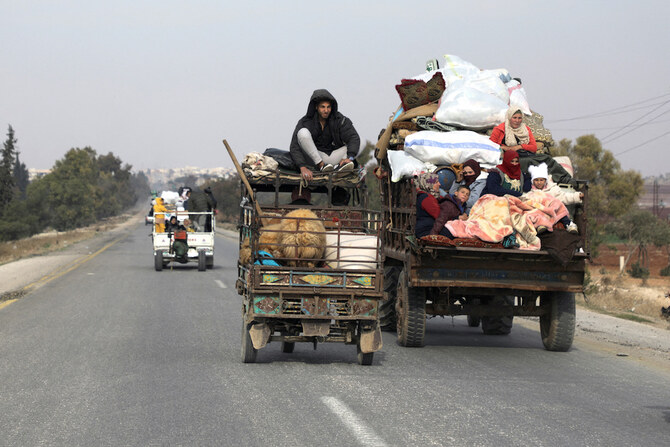
In Damascus, people rushed to stock up on supplies. Thousands rushed the Syria border with Lebanon, trying to leave the country.
Many shops in the capital were shuttered, a resident told The Associated Press, and those that remained open ran out of staples such as sugar. Some shops were selling items at three times the normal price.
“The situation is very strange. We are not used to that,” the resident said, insisting on anonymity, fearing retributions.
“People are worried whether there will be a battle (in Damascus) or not.”
It was the first time that opposition forces reach the outskirts of Damascus since 2018, when Syrian troops recaptured the area following a yearslong siege.
Assad’s status
Amid the developments, Syria’s state media denied rumors flooding social media that Assad has left the country, saying he is performing his duties in Damascus.
Assad’s chief international backer, Russia, is busy with its war in Ukraine. Lebanon’s powerful Hezbollah, which at one point sent thousands of fighters to shore up Assad’s forces, has been weakened by a yearlong conflict with Israel. Iran, meanwhile, has seen its proxies across the region degraded by regular Israeli airstrikes.
Pedersen said a date for the talks in Geneva on the implementation of UN Resolution 2254 would be announced later. The resolution, adopted in 2015, called for a Syrian-led political process, starting with the establishment of a transitional governing body, followed by the drafting of a new constitution and ending with UN-supervised elections.
The insurgents’ march
Rami Abdurrahman, who heads the Britain-based Syrian Observatory for Human Rights, an opposition war monitor, said insurgents were in the Damascus suburbs of Maadamiyah, Jaramana and Daraya. Opposition fighters were also marching from eastern Syria toward the Damascus suburb of Harasta, he added.
A commander with the insurgents, Hassan Abdul-Ghani, posted on the Telegram messaging app that opposition forces had begun the “final stage” of their offensive by encircling Damascus.
Syria’s military, meanwhile, sent large numbers of reinforcements to defend the key central city of Homs, Syria’s third largest, as insurgents approached its outskirts.
The shock offensive began Nov. 27, during which gunmen captured the northern city of Aleppo, Syria’s largest, and the central city of Hama, the country’s fourth largest city.
HTS leader Abu Mohammed Al-Golani told CNN in an interview Thursday from Syria that the aim is to overthrow Assad’s government.
The Britain-based Observatory said Syrian troops have withdrawn from much of the two southern provinces and are sending reinforcements to Homs, where a battle is looming. If the insurgents capture Homs, they would cut the link between Damascus, Assad’s seat of power, and the coastal region where the president enjoys wide support.
The Syrian army said in a statement Saturday that it has carried out redeployment and repositioning in Sweida and Daraa after its checkpoints came under attack by “terrorists.” The army said it is setting up a “strong and coherent defensive and security belt in the area,” apparently to defend Damascus from the south.
The Syrian government has referred to opposition gunmen as terrorists since conflict broke out in March 2011.
After the fall of the cities of Daraa and Sweida early Saturday, Syrian government forces remained in control of five provincial capitals — Damascus, Homs and Quneitra, as well as Latakia and Tartus on the Mediterranean coast.
Tartus is home to the only Russian naval base outside the former Soviet Union while Latakia is home to a major Russian air base.
Diplomacy in Doha
In Qatar, the foreign ministers of Iran, Russia and Turkiye met to discuss the situation in Syria. Turkiye is a main backer of the militants.
Qatar’s top diplomat, Sheikh Mohammed bin Abdulrahman Al Thani, criticized Assad for failing to take advantage of the lull in fighting in recent years to address the country’s underlying problems. “Assad didn’t seize this opportunity to start engaging and restoring his relationship with his people,” he said.
Sheikh Mohammed said he was surprised by how quickly the militants have advanced and said there is a real threat to Syria’s “territorial integrity.” He said the war could “damage and destroy what is left if there is no sense of urgency” to start a political process.
After the fall of the cities of Daraa and Sweida early Saturday, Syrian government forces remained in control of five provincial capitals — Damascus, Homs and Quneitra, as well as Latakia and Tartus on the Mediterranean coast.
On Friday, US-backed fighters of the Kurdish-led Syrian Democratic Forces captured wide parts of the eastern province of Deir Ezzor that borders Iraq as well as the provincial capital that carries the same name. The capture of areas in Deir Ezzor is a blow to Iran’s influence in the region as the area is the gateway to the corridor linking the Mediterranean to Iran, a supply line for Iran-backed fighters, including Lebanon’s Hezbollah.
With the capture of a main border crossing with Iraq by the SDF and after opposition fighters took control of the Naseeb border crossing to Jordan in southern Syria, the Syrian government’s only gateway to the outside world is the Masnaa border crossing with Lebanon.


![]()

Syrian insurgents reach Damascus suburbs as residents flee or stock up on supplies
Short Url
https://arab.news/v666b
Syrian insurgents reach Damascus suburbs as residents flee or stock up on supplies
- Thousands rushed Syria border with Lebanon, trying to leave country
- Pace of events raised fears of fresh wave of regional instability


Latest updates


© 2026 SAUDI RESEARCH & PUBLISHING COMPANY, All Rights Reserved And subject to Terms of Use Agreement.