

Flareup of Syria civil war is ‘bitter fruit of collective failure’ of diplomacy: UN chief

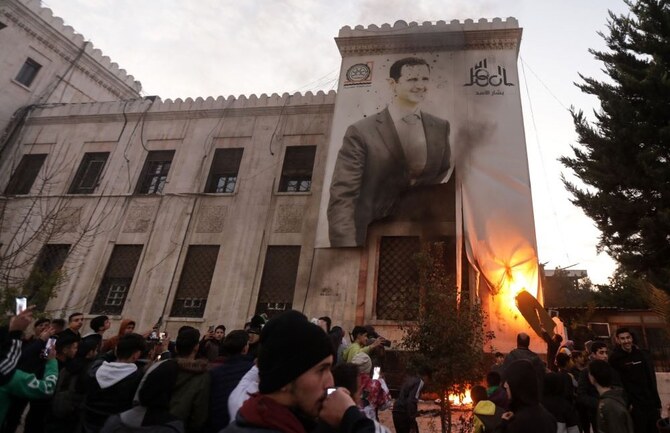
Residents in Hama set ablaze a large banner bearing a picture of Syria’s President Bashar Assad hanging on the facade of a municipal building on December 5, 2024. (AFP)
Short Url
Updated 05 December 2024
Follow

Flareup of Syria civil war is ‘bitter fruit of collective failure’ of diplomacy: UN chief

  • Antonio Guterres: ‘Syria is a crossroads of civilization. It’s painful to see its progressive fragmentation’
  • Coalition of opposition forces have launched their largest offensive in years, seizing Aleppo and now Hama

NEW YORK: The current flareup of the Syrian civil war is the “bitter fruit of a chronic collective failure” to agree a nationwide ceasefire and implement Security Council resolutions, the UN secretary-general said on Thursday.

Calling for the restoration of Syria’s “sovereignty, unity, independence and territorial integrity,” Antonio Guterres added that “after 14 years of conflict, it’s high time for all parties to engage seriously with Geir Pedersen, my special envoy for Syria, to finally chart a new, inclusive and comprehensive approach to resolving this crisis, in line with Security Council Resolution 2254. It’s time for serious dialogue.”

Resolution 2254, adopted in 2015, outlines a roadmap for a political resolution to the conflict, calling for a ceasefire, humanitarian access, and a Syrian-led political process involving all parties.

It emphasizes free and fair elections, constitutional reform and a transitional government, with the goal of achieving peace and stability in Syria.

The civil war, which had been at a stalemate for the past few years, was reignited last week when a coalition of opposition forces, including Hayat Tahrir Al-Sham — which is sanctioned by the UN Security Council — and an umbrella group of Turkey-backed militias called the Syrian National Army launched their largest offensive against the government in years.

They quickly swept through villages outside Aleppo, the largest city in Syria, much of which they now control. They met little resistance there as the Syrian military quickly withdrew.

On Thursday, they swept into the central city of Hama from which government forces again redeployed.

Rebels now appear to be heading further south, inching ever closer to the capital Damascus, President Bashar Assad’s seat of power.

There have been reports of civilian casualties, displacements of tens of thousands of people, damage to civilian infrastructure, and interruptions in essential services and humanitarian aid. 

Guterres discussed the current “grave developments” with Turkish President Recep Tayyip Erdogan.

He told reporters in New York that he emphasized to Erdogan “all” parties’ obligations to protect civilians, “the urgent need for immediate humanitarian access to all civilians in need, and a return to the UN-facilitated political process to end the bloodshed.” 

Erdogan’s office said he told the UN chief that the conflict has reached a new phase that is “being managed calmly.”

Guterres said: “Syria is a crossroads of civilization. It’s painful to see its progressive fragmentation.”

He added that during his tenure as high commissioner for refugees, he witnessed “the immense generosity” of the Syrian people who opened “their hearts and their homes” to countless Iraqi refugees.

“There were no refugee camps in Syria. Refugees lived among the Syrian people,” he said. “It breaks my heart to see their suffering grow, along with the threats to regional and indeed international security.”

Guterres again urged “all those with influence to do their part for the long-suffering people of Syria.”


Hundreds flee to government-held areas in north Syria ahead of possible offensive

Updated 16 January 2026
Follow

Hundreds flee to government-held areas in north Syria ahead of possible offensive

  • Many of the civilians who fled used side roads to reach government-held areas
  • Men, women and children arrived in cars and pickup trucks that were packed with bags of clothes

DEIR HAFER, Syria: Scores of people carrying their belongings arrived in government-held areas in northern Syria on Friday ahead a possible attack by Syrian troops on territory held by Kurdish-led fighters east of the city of Aleppo.
Many of the civilians who fled used side roads to reach government-held areas because the main highway was blocked with barriers at a checkpoint that previously was controlled by the Kurdish-led and US-backed Syrian Democratic Forces, Associated Press journalists observed.
The Syrian army said late Wednesday that civilians would be able to evacuate through the “humanitarian corridor” from 9 a.m. to 5 p.m. Thursday. The announcement appeared to signal plans for an offensive against the SDF in the area east of Aleppo.
There were limited exchanges of fire between the two sides.
Men, women and children arrived in cars and pickup trucks that were packed with bags of clothes, mattresses and other belongings. They were met by local officials who directed them to shelters.
In other areas, people crossed canals on small boats and crossed a heavily damaged pedestrian bridge to reach the side held by government forces.
The SDF closed the main highway but about 4,000 people were still able to reach government-held areas on other roads, Syrian state TV reported.
A US military convoy arrived in Deir Hafer in the early afternoon but it was not immediately clear whether those personnel will remain. The US has good relations with both sides and has urged calm.
Inside Deir Hafer, many shops were closed and people stayed home.
“When I saw people leaving I came here,” said Umm Talal, who arrived in the government-held area with her husband and children. She added that the road appeared safe and her husband plans to return to their home.
Abu Mohammed said he came from the town of Maskana after hearing the government had opened a safe corridor, “only to be surprised when we arrived at Deir Hafer and found it closed.”
SDF fighters were preventing people from crossing through Syria’s main east-west highway and forcing them to take a side road, he said.
The tensions in the Deir Hafer area come after several days of intense clashes last week in Aleppo, previously Syria’s largest city and commercial center, that ended with the evacuation of Kurdish fighters from three neighborhoods north of the city that were then taken over by government forces.
The fighting broke out as negotiations stalled between Damascus and the SDF over an agreement reached in March to integrate their forces and for the central government to take control of institutions including border crossings and oil fields in the northeast.
The US special envoy to Syria, Tom Barrack, posted on X Friday that Washington remains in close contact with all parties in Syria, “working around the clock to lower the temperature, prevent escalation, and return to integration talks between the Syrian government and the SDF.”
The SDF for years has been the main US partner in Syria in fighting against the Daesh group, but Turkiye considers the SDF a terrorist organization because of its association with Kurdish separatist insurgents in Turkiye.