

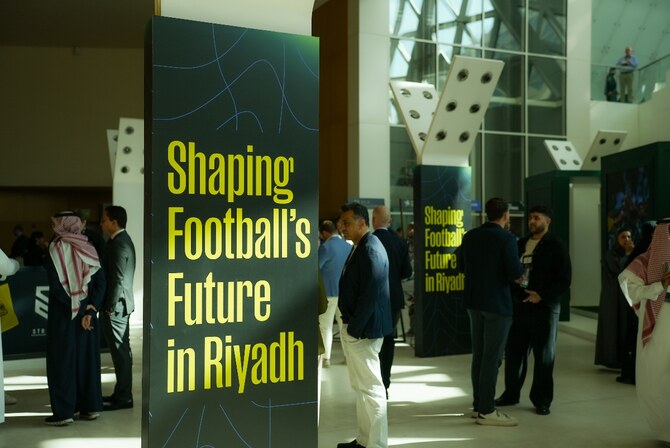

RIYADH: The second and final day of the World Football Summit provided an exciting platform for football leaders to share their insights on the sport’s evolving role in society.
One of the most engaging discussions came during the closing ceremony from Mauricio Macri, executive chairman of the FIFA Foundation and former president of Argentina, who offered his perspective on the power of football to bridge cultures and unite people.
Macri emphasized that we are witnessing the dawn of a new era — what he called the “Expectations Revolution Era.”
“Football will continue to be more and more in our lives. People are more and more interested in their teams and the players, and social media has created a new engagement between the idols and the fans,” he said.
He pointed to Saudi Arabia as a prime example of a country using football strategically to boost its international influence.
“We see a country called Saudi Arabia, crashing in with a very aggressive strategy … but under that, there is an intelligent strategy, especially at the academic level. People are increasing their engagement and their passion, and this is wonderful because football unites the world,” Macri said. “So many countries have disputes, and now they dispute over kicking the ball. That’s much more friendly than using weapons. Football is the new religion of the world,” he added, echoing FIFA President Gianni Infantino’s famous sentiment.
Macri also shared a humorous story about his experience in Saudi Arabia following the country’s historic World Cup win over Argentina.
“I had an appointment with my friend Yasir Al-Rumayyan the day after the first match. I couldn’t believe it. I had to travel here to Saudi Arabia. When I entered the airport, they saw my passport. Everybody was laughing at me. The day after Saudi Arabia defeated Argentina, I have never seen such happiness in this country like that day,” he laughed.
Turning to the subject of social media and its impact on players, Macri advised athletes to focus on their true identities.
“Focus on who they are,” he said, highlighting the importance of authenticity in the digital age.
He also offered a comparison between running a popular football club and leading a country, suggesting that managing a football club could be even more challenging: “Running a very popular football club is more difficult than running a country — and I have been in both situations! Nobody cares about politics, but everybody cares about football.”
Recalling the goals Saudi Arabia scored against Argentina, Macri praised the second as “wonderful” and likened it to a Messi strike: “The first one was from an angle that was impossible. The ball pounded twice just before the hand of the goalkeeper,” he recalled.
Macri’s broader vision for the FIFA Foundation is ambitious, with a focus on empowering the next generation of young people. His goal is to reach a million refugee children and teach them digital skills, education, and robotics.
“They will build their own robot to play football among other kids,” he said, highlighting the potential for football to inspire and teach life skills to young people worldwide.
Meanwhile, in a panel discussion titled “Fan of Tomorrow: How is the stadium experience changing with the times,” speakers explored the role of technology in enhancing fan engagement.
They discussed innovations such as integrating public transport systems to provide seamless journeys for fans, and the use of augmented and virtual reality technologies to create emotionally engaging stadium experiences.
Data integration was also a key focus, with panelists stressing the importance of creating a 360-degree view of sports infrastructure to help plan cities and enhance the fan experience.
One of the key initiatives discussed was the creation of a one-stop platform to track sports infrastructure and venue availability in Riyadh.
Yazeed Al-Rasheed, chief marketing and communication officer at the local organizing committee of AFC Asian Cup Saudi Arabia, reflected on lessons learned from the 2023 Club World Cup.
“The Club World Cup that we hosted last year in Jeddah was a great exercise for us, even to test ourselves, and our capabilities,” he said.
He also highlighted the significance of the experience in preparing for future events, including the 2027 AFC Asian Cup: “We are investing in ourselves and our people, our teams, to be educated, to be aware, to try to see. By 2027, we will have a full-fledged system with services, airports, and airlines. It’s going to be totally different,” he said.
Alrasheed’s comments were echoed by Turki bin Oudah, general manager of the sports sector at the Royal Commission for Riyadh City, who discussed the city’s plans to create a comprehensive, user-friendly platform for residents and visitors.
“We have the database now that is ready. We are at the phase of developing that dashboard or tableau for residents and visitors. This will be a one-stop shop that gives you a 360-view of all the sports infrastructure in the city of Riyadh,” he said.
Bin Oudah also touched on the broader legacy of Saudi Arabia’s sports development, emphasizing that the real legacy of hosting major events would be the lasting impact on the people. “Our main legacy is the people,” he said. “We are going to deliver a huge document of legacy for the next competition, not only for 2034, but we have a lot between 2034 and 2027 — not only sport, not only football, but winter games, Asian games, all of these big events are going to take advantage of the legacy we are going to leave behind.”
As the World Football Summit in Riyadh drew to a close, it was clear that Saudi Arabia is positioning itself as a global hub for sports and innovation.


