


RIYADH: Saudi Arabia now has 20 percent of its territory designated as protected areas, a significant rise from just 3 percent a decade ago, according to a senior official.
By 2030, this figure is projected to increase to 30 percent, said the Minister of State for Foreign Affairs and the Kingdom’s envoy for climate, Adel Al-Jubeir.
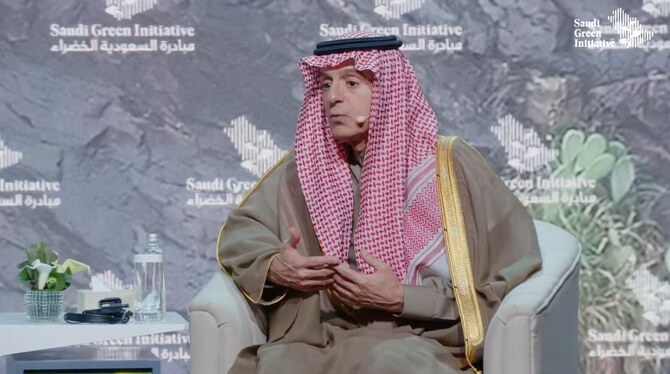
During the “Climate Envoy Perspective” panel at the 4th Saudi Green Initiative Forum, Al-Jubeir highlighted Saudi Arabia’s dedication to environmental preservation and sustainability.
“We are protecting 30 percent of our territory; it will be protected areas, both sea and land,” Al-Jubeir said, emphasizing the country’s efforts to conserve biodiversity and ensure sustainable resource management.
He added: “The fact is, we used to (have) 3 percent of our territory protected 10 years ago, now we’re almost at 20 percent, and by 2030 will be 30 percent.”
Saudi Arabia’s commitment to protecting its environment is evident in a wide range of initiatives. “We’re working on sustainable fishing in the Red Sea, as well as in the Gulf, and we’re making sure that everything we do is very, very in line with protecting our environment,” Al-Jubeir said.
He also noted that tourism projects along the Red Sea are being developed with rigorous sustainability and environmental standards, ensuring minimal impact on marine life.
The minister emphasized the progress of Saudi Arabia’s blue economy, drawing attention to the Kingdom’s announcement earlier regarding the launch of the National Red Sea Sustainability Strategy.
“We have launched more than 80 initiatives in Saudi Arabia, from turning waste into energy, from redesigning our cities, from planting trees, from capturing carbon, both naturally as well as using technology, and we are transitioning towards renewable energy,” Al-Jubeir added.
He highlighted the Kingdom’s ambitious energy goals, saying: “50 percent of our electricity by 2030 will come from renewable energy, the other 50 percent from natural gas.”
The Kingdom’s efforts extend beyond its borders, with the nation supporting global initiatives to combat environmental challenges. “We’re helping countries adopt a circular carbon economy approach so that they can deal with planting and environmental issues more effectively,” Al-Jubeir explained.
Addressing land degradation, the minister emphasized its global impact. “We believe that the issue of land degradation is not just an environmental issue; it’s a national security issue, it’s a global issue, because land degradation means less ability to produce food, which means people go from no-food areas to areas where they can grow food,” he said.
Al-Jubeir also underscored the economic benefits of sustainability. “When you invest in solar energy and wind, it’s not only sustainable and good for the environment, it’s also very good for the pocketbook,” he said. “Investors are more confident when they come to a country where they have clean water, clean air, and so this is part of what we’re doing.”
He continued: “For every dollar we spend restoring land, the benefits are anywhere from $7 to $30, akin to investing in technology. We are doing this, and we are trying to point this out to the world.”
Al-Jubeir added: “When you invest in resorts in the Red Sea, and you are very sensitive to the environment it increases the value of your investment, and it makes it more attractive. So, we don't see a contradiction between having the utmost concern for environmental issues and financial gains.”
The minister highlighted the broader importance of environmental preservation, stating: “People are more productive when the environment in which they live is pleasant. We breathe the same air as everybody else. We need the same water like everybody else, and so we are very, very sensitive to our environment and to ensuring that we protect it and that we restore it if it needs to be restored.”
Saudi Arabia, known as the world’s most efficient producer of oil and gas, is also emerging as a global leader in renewable energy. “We are an example for the world in terms of energy, in terms of renewable energy, in terms of our commitment to the environment,” Al-Jubeir said.
He stressed the Kingdom’s focus on collaboration and practical solutions to address climate challenges.
“We believe that we have the technology, we believe that we have the financial resources. We believe that by working together, we can overcome many of the challenges that we face, but we cannot do this if we’re trying to assign blame or trying to point fingers,” Al-Jubeir added.
“We believe we are facing a tremendous challenge in terms of the climate, and we believe that by working together and putting our resources together we will be able to confront and deal with this challenge effectively,” he said.


