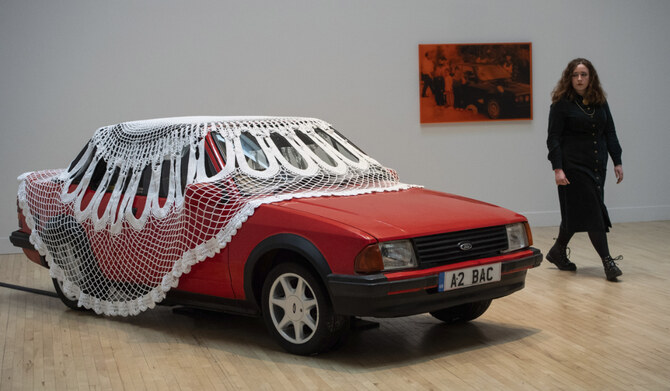

LONDON: An artist whose work exploring her Scottish Sikh identity includes a vintage Ford car draped in a crocheted doily won the UK’s prestigious Turner Prize on Tuesday, during a ceremony picketed by pro-Palestinian demonstrators.
Jasleen Kaur was awarded the 25,000-pound ($32,000) prize by actor James Norton at the Tate Britain gallery in London.
Kaur used her acceptance speech to express support for scores of demonstrators outside. She is among signatories to a letter demanding Tate, which runs several major British art museums, cut ties with donors who are linked to Israel over its war in Gaza.
“This is not a radical demand,” Kaur said. “This should not risk an artist’s career or safety.
“We need a proper ceasefire now,” she said.
The Israel-Hamas war has killed more than 43,000 Palestinians, according to Hamas health officials in Gaza. Israel launched the war in response to the militant group’s Oct. 7, 2023 cross-border attack that killed some 1,200 Israelis and took more than 250 hostage.
A jury led by Tate Britain director Alex Farquhar praised the way 38-year-old Kaur “weaves together the personal, political and spiritual” through “unexpected and playful combinations of material.”
Her winning exhibition mixes sculpture, print, everyday items — including family photos, a Ford Escort car and the popular Scottish soda Irn Bru — and immersive music to reflect on her upbringing in Glasgow’s Sikh community.
Three other finalists – Pio Abad, Claudette Johnson and Delaine Le Bas – received 10,000 pounds ($12,670) each.
Named for 19th-century landscape painter J.M.W. Turner and founded in 1984 to reward young artists, the prize helped make stars of shark-pickling artist Damien Hirst, potter Grayson Perry, sculptor Anish Kapoor and filmmaker Steve McQueen.
But it has also been criticized for rewarding impenetrable conceptual work and often sparks debate about the value of modern art, with winners such as Hirst’s “Mother and Child Divided,” which consists of two cows, bisected and preserved in formaldehyde, and Martin Creed’s “Lights On and Off” — a room with a light blinking on and off – drawing scorn from sections of the media.
In 2019, all four finalists were declared winners after they refused to compete against one another, “to make a collective statement in the name of commonality, multiplicity and solidarity.”
In 2021, all five finalists were collectives rather than individual artists.
The award was initially open to artists under 50 but now has no upper age limit.
Works by the four finalists are on display until Feb. 16.