Pakistan province forms grand jirga to broker truce after 133 killed in sectarian feuding

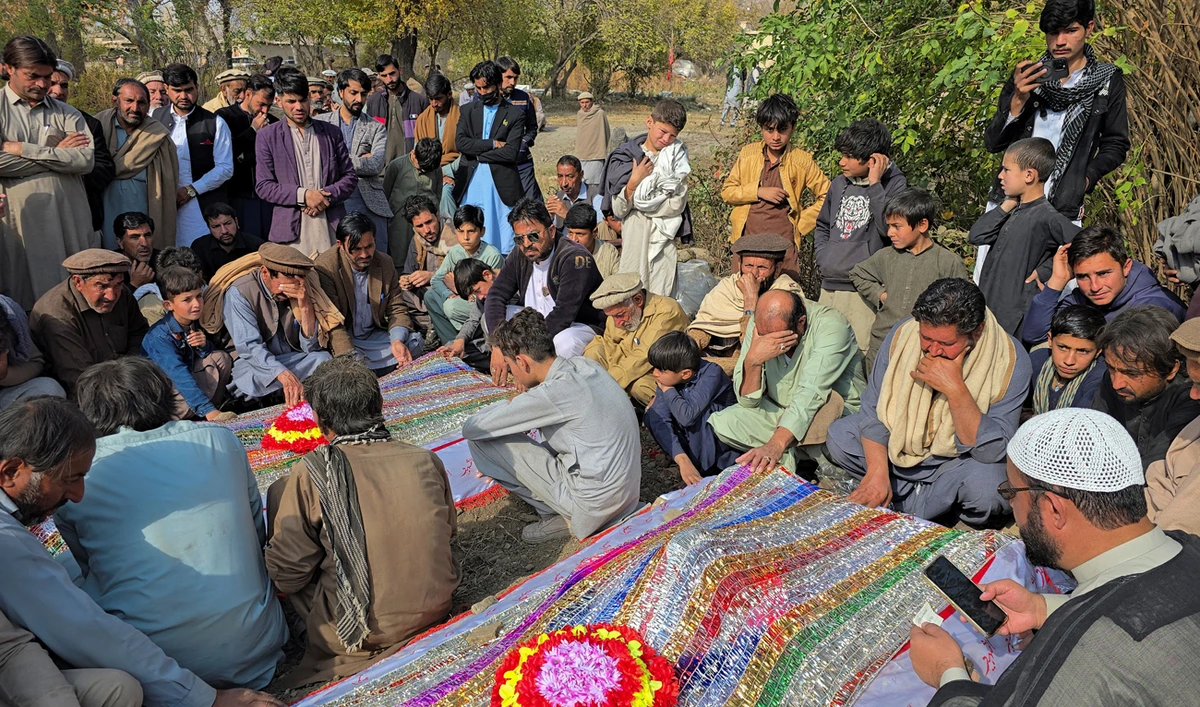
People mourn over the graves of relatives who were killed after gunmen opened fire on passenger vehicles in the Kurram tribal district, in Shalozan, Khyber Pakhtunkhwa on November 22, 2024. (REUTERS/File)
Short Url
Updated 03 December 2024
Follow

Pakistan province forms grand jirga to broker truce after 133 killed in sectarian feuding

  • 133 people killed, 177 injured in sporadic clashes in Kurram district since Nov. 21 with two failed attempts at a ceasefire
  • Grand jirga has participation of former lawmakers from tribal districts with representation from Sunni and Shiite sects

PESHAWAR: The government in Pakistan’s northwestern Khyber Pakhtunkhwa province has formed a grand council of elders to broker a ceasefire in the region’s Kurram district where over 130 people have been killed in sectarian clashes since last month and two earlier deals to stymie the fighting have failed, members of the new council said on Tuesday.
Pakistan is a Sunni-majority country, but Kurram has a large Shiite population, and the communities have clashed for decades. At least 133 people have been killed and 177 injured in sporadic clashes since Nov. 21, with two failed attempts at a ceasefire.
On Monday, the provincial cabinet approved what it called a “comprehensive action plan” aimed at “restoring durable peace and stability” in Kurram. The plan involves a new grand jirga comprising former parliamentarians and senators from tribal districts with representation from both the Sunni and Shiite sects, ex-senator Saleh Shah, a member of the council, told Arab News.
“We are fully empowered by the provincial government to move the peace efforts forward to settle the Kurram saga once and for all,” Shah said on Tuesday. “Because of the representation of members of both the sects in the jirga, I’m very much optimistic that we can settle the Kurram issue ... Since the day the jirga was formed, we are getting positive signals for a breakthrough.”
The latest fighting broke out last Thursday when two separate convoys of Shiite Muslims traveling under police escort were ambushed, killing more than 40. Since then days of fighting with light and heavy weapons have brought the region to a standstill, with major roads closed and mobile phone services cut as the death toll surged.
Shah said the jirga had already had its first meeting, and also met with KP chief minister Ali Amin Gandapur and Governor Faisal Karim Kundi. Meetings were now also planned with the Peshawar corps commander, the prime minister, the president and the army chief to discuss the overall security situation of the area.
The jirga will head to Kurram district after the apex committee meeting, attended by the prime minister, his cabinet and all three services chiefs, which was scheduled to be held on Dec. 5, Shah said. 
“The jirga members have the capacity to arrest peace in Kurram as we have seen many ups and downs in the region,” Shah said. “We are active in politics on the ground in KP and the tribal areas and we have the ability to set things on track.”
Another member of the Jirga, Sajjid Hussain Turi, a former minister for overseas Pakistanis, said the northwestern tribal areas in general and the Kurram district in particular were experiencing a “complete collapse of law and order.”
“I’m sure the newly-formed jirga can deliver in helping the government to identify pathways leading to eternal peace in Kurram,” he said. “All members of the jirga are well-experienced and political heavyweights to tackle challenges effectively.
“Our main purpose is to give a permanent solution to the people of Kurram. Second, we want to give peace to our children, otherwise we have spent our youth in incessant wars and fighting.”
Pakistan says illegal immigration to Europe down 47 percent amid major crackdown

Updated 6 sec ago
Follow

Pakistan says illegal immigration to Europe down 47 percent amid major crackdown

  • Over 1,700 human smugglers arrested nationwide this year, interior ministry says
  • EU praises Pakistan’s efforts as Brussels, Islamabad agree to deepen cooperation 

ISLAMABAD: Pakistan has achieved a 47 percent drop in illegal immigration to Europe this year, with more than 1,700 human smugglers arrested as part of an expanded nationwide crackdown, the interior ministry said on Thursday. 

The announcement followed Interior Minister Mohsin Naqvi’s meeting in Brussels with European Union Commissioner for Home Affairs and Migration Magnus Brunner, where both sides discussed efforts to curb human smuggling and strengthen migration cooperation.

Pakistan intensified action against illegal migration in 2023 after hundreds of migrants, including 262 Pakistanis, drowned when an overcrowded vessel sank off the Greek town of Pylos, one of the deadliest boat disasters in the Mediterranean. Authorities say they continue to target networks sending citizens abroad through dangerous routes, following heightened scrutiny at airports and a series of arrests involving forged documents.

“Commissioner Magnus Brunner paid strong tribute to the Government of Pakistan for achieving a 47 percent reduction in attempts to reach Europe through illegal ‘dunki’ routes during the past year and described Pakistan’s measures as exemplary,” the interior ministry said in a statement.

“Dunki routes” refer to irregular migration paths used by smugglers to move people across multiple borders toward Europe, the United Kingdom and the United States.

Pakistani authorities say the routes are controlled by transnational criminal networks that also engage in document fraud and other illicit activities.

“Mohsin Naqvi stated that 1,770 human smugglers and their agents have been arrested in Pakistan this year, which clearly reflects the government’s zero-tolerance policy against illegal immigration,” the interior ministry said. 

It added that Pakistan and the EU agreed to coordinate future strategies against illegal immigration, human smuggling and drug trafficking, including deeper information-sharing between law enforcement bodies. Brunner would soon visit Pakistan to acknowledge the country’s efforts and discuss next steps in reducing irregular migration flows, the statement said. 

It also quoted Naqvi as saying that the nexus between smuggling networks, drug mafias and militant groups posed a major challenge to Pakistan and required “international cooperation to confront it.”

Earlier in December, Pakistan announced it would roll out an AI-based immigration screening system in Islamabad from January next year to detect forged travel documents and prevent illegal departures.

In September, Pakistan’s Federal Investigation Agency released a list of more than 100 of the country’s “most wanted” human smugglers as part of its ongoing nationwide operation, identifying major hubs of trafficking activity across Punjab and the capital.