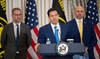
WASHINGTON: US President-elect Donald Trump on Monday warned Gaza militants of massive repercussions if hostages are not released by the time he takes office.
The threat comes after exhaustive diplomacy by outgoing President Joe Biden’s administration that has so far failed to secure a deal that would both end Israel’s war in Gaza and free hostages seized 14 months ago.
“If the hostages are not released prior to January 20, 2025, the date that I proudly assume Office as President of the United States, there will be ALL HELL TO PAY in the Middle East, and for those in charge who perpetrated these atrocities against Humanity,” Trump wrote on his Truth Social platform.
“Those responsible will be hit harder than anybody has been hit in the long and storied History of the United States of America. RELEASE THE HOSTAGES NOW!“
Trump has vowed staunch support for Israel and to dispense with Biden’s occasional criticism, but has also spoken of his desire to secure deals on the world stage.
Hamas staged the deadliest ever attack on Israel on October 7, 2023. The assault resulted in 1,208 deaths, mostly civilians, according to an AFP tally of Israeli official figures.
Militants seized 251 hostages during the attack, some of whom were already dead. Of those, 97 are still held in Gaza, including 35 the army says are dead.
Israel’s retaliatory campaign has killed 44,429 people in Gaza, according to figures from the territory’s health ministry that the United Nations considers reliable.


Trump warns ‘hell to pay’ if Gaza hostages not freed before his inauguration

https://arab.news/jd8j3
Trump warns ‘hell to pay’ if Gaza hostages not freed before his inauguration

- Trump has vowed staunch support for Israel and to dispense with Biden’s occasional criticism
- Israel’s retaliatory campaign post Oct. 7 has killed more than 44,000 people in Gaza


Lawsuit challenges Trump administration’s ending of protections for Somalis
- The lawsuit cites a series of statements Trump has made describing Somalis as “garbage” and “low IQ people” who “contribute nothing.”
BOSTON: Immigrant rights advocates filed a lawsuit on Monday seeking to stop US President Donald Trump’s administration from next week ending legal protections that allow nearly 1,100 Somalis to live and work in the United States. The lawsuit, brought by four Somalis and two advocacy groups, challenges the US Department of Homeland Security’s decision to end Temporary Protected Status for Somali immigrants, whom Trump has derided in public remarks. Outgoing Homeland Security Secretary Kristi Noem in January announced that TPS for Somalis would end on March 17, arguing that Somalia’s conditions had improved, despite fighting continuing between Somali forces and Al-Shabab militants. The plaintiffs, who include the groups African Communities Together and Partnership for the Advancement of New Americans, in the lawsuit filed in Boston federal court argue the move was procedurally flawed and driven by a discriminatory, predetermined agenda.
The lawsuit cites a series of statements Trump has made describing Somalis as “garbage” and “low IQ people” who “contribute nothing.”
The plaintiffs said the administration is ending TPS for Somalia and other countries due to unconstitutional bias against non-white immigrants, not based on objective assessments of country conditions.
“The termination of TPS for Somalia is racism masking as immigration policy,” Omar Farah, executive director at the legal group Muslim Advocates, said in a statement.
DHS did not respond to a request for comment. It has previously said TPS was “never intended to be a de facto amnesty program.”
TPS is a form of humanitarian immigration protection that shields eligible migrants from deportation and allows them to work. Under Noem, DHS has moved to end TPS for a dozen countries, sparking legal challenges. The administration on Saturday announced plans to pursue an appeal at the US Supreme Court in order to end TPS for over 350,000 Haitians. It also wants the high court to allow it to end TPS for about 6,000 Syrians.
SOMALI COMMUNITY TARGETED
Somalia was first designated for TPS in 1991, with its latest extension in 2024. About 1,082 Somalis currently hold TPS, and 1,383 more have pending applications, according to DHS. Somalis in Minnesota in recent months had become a target of Trump’s immigration crackdown, with officials pointing to a fraud scandal in which many people charged come from the state’s large Somali community. The Trump administration cited those fraud allegations as a basis for a months-long immigration enforcement surge in Democratic-led Minnesota, during which about 3,000 immigration agents were deployed, spurring protests and leading to the killing of two US citizens by federal agents.
In November, Trump announced he would end TPS for Somalis in Minnesota, and a month later said he wanted them sent “back to where they came from.”
The US Department of State advises against traveling to Somalia, citing crime and civil unrest among numerous factors.