



PARIS: French President Emmanuel Macron has begun a landmark three-day state visit to Saudi Arabia, where a one-on-one meeting with Crown Prince Mohammed bin Salman anchors an intensive diplomatic schedule.
Arriving in Riyadh on Monday evening, Macron was welcomed with an official ceremony. The Elysee Palace has dubbed the Dec. 2-4 visit “exceptional,” signaling the strategic importance the French government ascribes to Franco-Saudi relations.
It is the latest of several high-profile exchanges between the two nations, building upon the crown prince’s visit to France in April 2018, which laid the foundation for a new era in bilateral relations, Macron’s Gulf tour in December 2021, which concluded in Jeddah, and the crown prince’s return to Paris in June 2023.
According to the Elysee, Macron will first participate in expanded bilateral talks aimed at implementing a new strategic partnership framework. These discussions will establish joint sectoral committees between the two governments.

Macron was welcomed with an official ceremony on Monday. (AFP)
He will then hold private talks with the crown prince, followed by a working dinner bringing together both leaders and associated government officials from both countries. The two leaders are expected to focus on forging joint diplomatic initiatives to address mounting regional tensions.
Lebanon will take center stage in the talks, reflecting both nations’ longstanding influence in the country’s affairs. “Both France and Saudi Arabia have historically played crucial roles in supporting Lebanon,” a diplomatic source noted.
According to the Elysee, the leaders will explore joint initiatives to bolster the ceasefire agreed last week between Israel and the Iran-backed Hezbollah militia and to address Lebanon’s long-running political deadlock.
“We aim to chart a path forward together — not only to secure a presidential election but also to establish a framework for implementing essential reforms demanded by both the Lebanese people and the international community,” the source added.

Lebanon will take center stage in the talks, reflecting both nations’ longstanding influence in the country’s affairs. (AFP)
Building on commitments made during Macron’s December 2021 visit to Riyadh, the two governments have established a joint humanitarian fund targeting Lebanon’s pressing needs, so as to help the Lebanese population navigate through multiple, overlapping crises.
The Gaza conflict will be another critical focus of discussions. Since the Oct. 7, 2023 Hamas-led attack on southern Israel, the Palestinian territory has come under intense Israeli bombardment, leading to one of the world’s worst humanitarian crises.
French officials have noted Riyadh’s prominent role in diplomatic efforts to end the conflict between Israel and Hamas, participating in talks with French counterparts and leading a contact group through the Arab League and Organization of Islamic Cooperation.
“Both nations share common ground on Gaza,” an Elysee spokesperson said. “We are aligned in our urgent call for an immediate ceasefire in the region.”
Opinion
This section contains relevant reference points, placed in (Opinion field)
The talks will also encompass broader regional security concerns, according to French officials.
“Syrian developments must be addressed given their impact on regional stability,” the Elysee said, highlighting that discussions will also focus on monitoring Iranian arms shipments to Hezbollah via Syrian regime-controlled territory.
Beyond foreign policy matters, Tuesday’s agenda will focus on economic and environmental initiatives. Macron will tour Riyadh’s newly inaugurated elevated metro system, which features significant French technical involvement.
Saudi-French cooperation is already expanding into previously unexplored or underdeveloped sectors, spanning tourism, fintech, cybersecurity, renewable energy, telecommunications, space technology and artificial intelligence.

Macron will tour Riyadh’s newly inaugurated elevated metro system. (AFP)
Macron will join world leaders at the One Planet Summit’s plenary session, where sovereign wealth funds will convene to discuss climate initiatives. He will co-chair talks with Yasir Al-Rumayyan, governor of Saudi Arabia’s Public Investment Fund.
Afterward, Macron will visit the UNESCO World Heritage site of At-Turaif in Diriyah on the outskirts of Riyadh, where he will share a lunch with Saudi Minister of Culture Prince Badr bin Abdullah bin Farhan, in the presence of his counterpart Rachida Dati and various French and Saudi cultural sector representatives.
The day will continue with Macron attending the Saudi-French Economic Forum, where he will review key outcomes before joining the One Water Summit. The summit, co-chaired by the Saudi crown prince and Kazakh President Kassym-Jomart Tokayev, will bring together world leaders to tackle pressing water challenges.
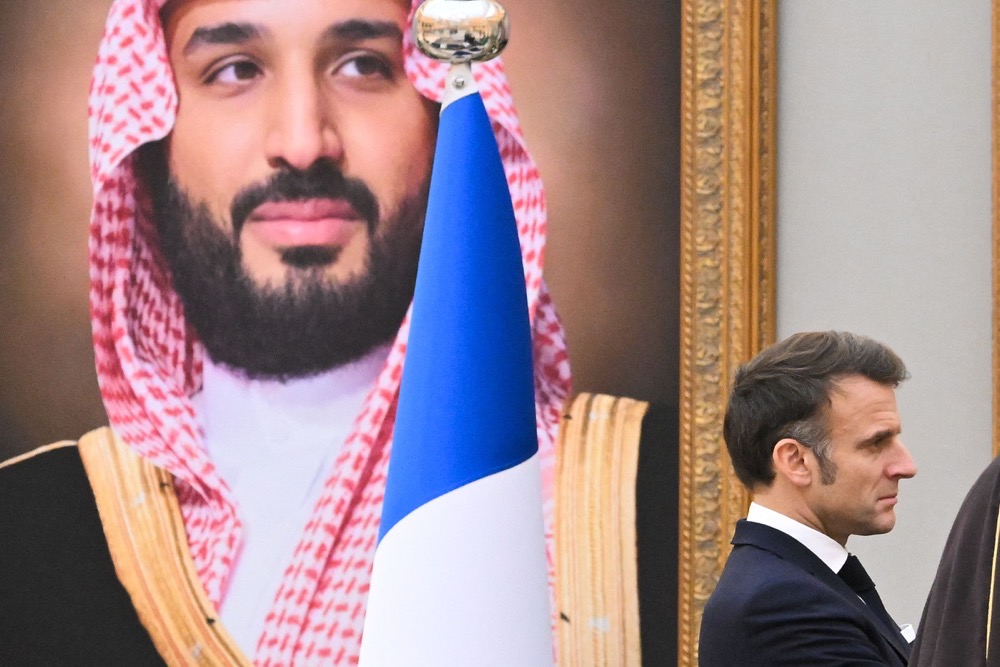
“Both nations share common ground on Gaza,” an Elysee spokesperson said. (AFP)
During the summit, leaders will participate in a series of roundtable discussions exploring water security, resource management, and their broader implications for global politics and economics.
Macron’s visit also coincides with Saudi Arabia hosting COP16, a global platform addressing desertification under the theme “Our Land. Our Future.”
Cultural ties will take center stage on Wednesday at the historic AlUla archaeological site in northwestern Saudi Arabia, where Macron will travel with a delegation of cultural officials.
He will tour the site before meeting with French-Saudi cultural cooperation stakeholders in the presence of Jean-Yves Le Drian, president of the French Agency for AlUla Development, and his counterpart Abir Al-Akel, who chairs the Royal Commission for AlUla.
AlUla stands as an example of Saudi-French partnership, showcasing collaborative expertise in culture, archaeology, construction, tourism and hospitality.
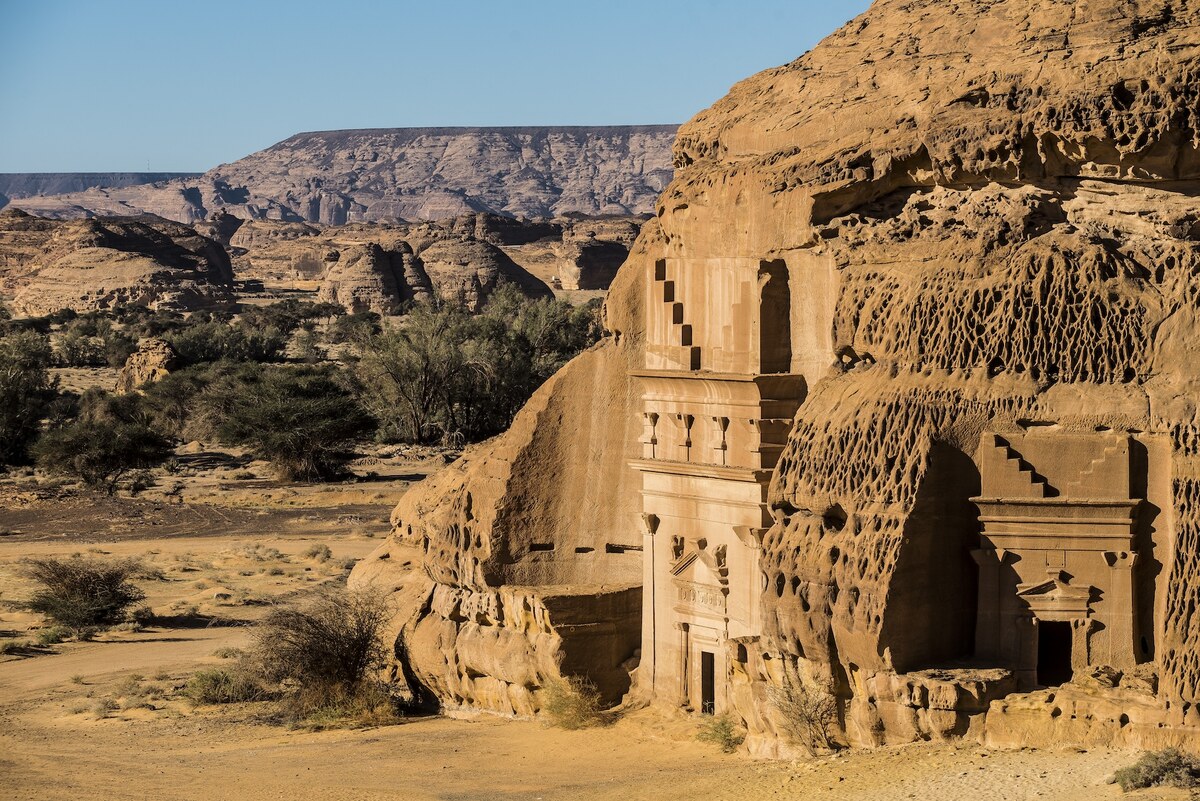
Cultural ties will take center stage on Wednesday at the historic AlUla archaeological site in northwestern Saudi Arabia. (Royal Commission for AlUla)
The state visit will conclude with Macron presiding over the groundbreaking of Villa Hegra, a new cultural hub designed to foster artistic collaboration between France and Saudi Arabia.
This symbolic project, establishing a dedicated artists’ residence, will mark a poignant final event of Macron’s three-day diplomatic mission.


