ANKARA: Turkiye, which backs militant factions in Syria, rejected Monday any suggestion that “foreign interference” was behind the offensive launched by Islamists in the country’s north.
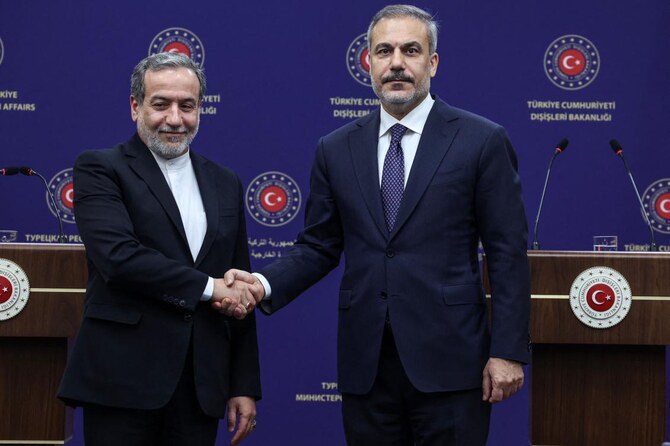
“It would be a mistake at this time to try to explain the events in Syria by any foreign interference,” Foreign Minister Hakan Fidan said at a joint press conference in Ankara with his Iranian counterpart Abbas Araghchi.
The recent flareup which saw Damascus losing swathes of territory in northwestern Syria, including Aleppo, during a lightning offensive by militants, was due to the government’s failure to engage in dialogue with armed opposition groups, he said.
“The lack of talks between [Damascus] and the opposition has brought the problem to this point,” he said, describing it as “a mistake to ignore the legitimate demands of the opposition.”
“Damascus must reconcile with its own people and the legitimate opposition,” he added.
Turkiye did “not want an escalation of the civil war,” said the minister who told US Secretary of State Antony Blinken in a phone call Sunday that Ankara would support moves “to reduce tension” in Syria.
Araghchi said it was crucial “to protect the achievements of the Astana process” to end Syria’s civil war, which groups Ankara, Moscow and Tehran, and pledged to convene fresh ministerial talks in the Kazakh capital “soon.”
The last such meeting took place in mid-November.
“Syria must not become a center for terrorist groups,” warned Araghchi in reference to the militant factions that staged last week’s attack.
Fidan also said it was “important that terror organizations do not take advantage of the instability” although he was referring to Kurdish-led rebels that Ankara sees as an offshoot of the banned Kurdistan Workers’ Party (PKK). The PKK has led a led a decades-long insurgency against Turkiye.
Turkish troops and Turkiye-backed militant factions control much of northern Syria, and Ankara is concerned that the recent outbreak of fighting could swell the flow of people fleeing across the border.
“We don’t want civilians to be killed or cities bombarded or people being displaced. We want these displaced people to be able to go back. The flow of refugees must be reversed,” he said.
Turkiye is already hosting some 3.2 million Syrian refugees, according to UN data.
Syria’s Bashar Assad on Monday branded the Islamist-led offensive as a bid to redraw the map of the region in line with US interests in a phone call with his Iranian counterpart Masoud Pezeshkian.
Both Iran and Russia, which have backed Assad since Syria’s civil war broke out in 2011, have said they will help Damascus fight back after losing Aleppo, with Tehran confirming it would keep its military advisers in Syria.


![]()

‘Foreign interference’ not behind Syria flareup: Turkiye
Short Url
https://arab.news/9xwzf
‘Foreign interference’ not behind Syria flareup: Turkiye


Latest updates


© 2026 SAUDI RESEARCH & PUBLISHING COMPANY, All Rights Reserved And subject to Terms of Use Agreement.