

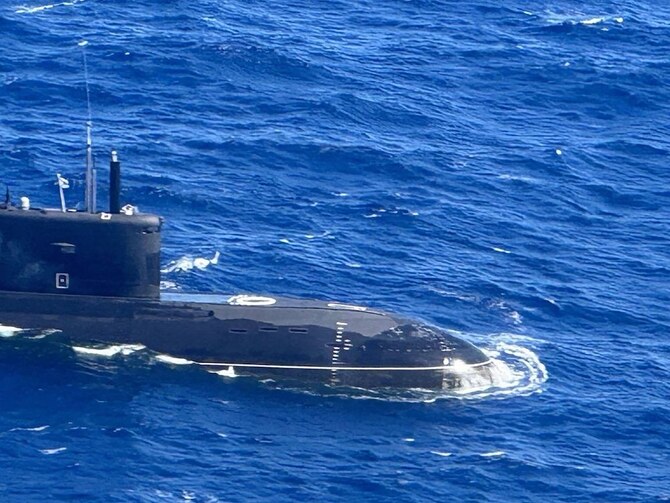
Philippine navy shadows Russian submarine in the South China Sea

1 / 2
Above, an aerial shot of a Russian Kilo-class submarine UFA 490, spotted 80 nautical miles from Mindoro island in the disputed South China Sea. (Armed Forces of the Philippines via AFP)
2 / 2
President Ferdinand Marcos Jr. did not elaborate on the submarine’s reported presence, saying he would let the military discuss the matter. (AFP file photo)
Short Url
Updated 02 December 2024
Follow

Philippine navy shadows Russian submarine in the South China Sea

  • A newspaper earlier reported that a Russian attack submarine surfaced inside Manila’s EEZ last week, citing security sources

MANILA: The Philippine military deployed a navy ship and air force planes to shadow a Russian submarine, which passed through the South China Sea off the country’s western coast last week, a security official said Monday.

The Russian submarine identified itself in response to a Philippine navy two-way radio inquiry, saying it was en route home to Russia’s eastern city of Vladivostok after joining an exercise with the Malaysian navy, Jonathan Malaya, assistant director-general of the National Security Council, said.

The submarine, like other foreign ships, has the right of “innocent passage” in the country’s exclusive economic zone but it still sparked concern when it was spotted on Thursday about 80 nautical miles (148 kilometers) off the Philippine province of Mindoro, Malaya said.

The submarine was sighted after it surfaced due to weather-related conditions, Malaya said.

“All of that is very concerning,” President Ferdinand Marcos Jr. told reporters when asked about the submarine. “Any intrusion into the West Philippine Sea, of our EEZ, of our baselines is very worrisome. So, yes, it’s just another one.”

Marcos used the Philippine name for the South China Sea, where his country plus Vietnam, Malaysia, Indonesia and other coastal states have faced an increasingly aggressive China, which claims the busy waterway virtually in its entirety.

An alarming spike in territorial confrontations, particularly between Chinese and Philippine coast guard and naval forces, starting last year has prompted closer surveillance by the United States and other Western governments of the key global trade route.

The Philippines coast guard said Monday that a Chinese military helicopter flew close to fishing boats manned by Filipinos in a “dangerous act of harassment” last week at Iroquois Reef, a disputed fishing area in the South China Sea.

Two Philippine coast guard patrol ships have been deployed to the area to protect Filipino fishermen, coast guard spokesperson Commodore Jay Tarriela said.

There was no immediate comment from Chinese officials.


Trump enters election year with big wins — and bigger political headwinds

Updated 1 sec ago
Follow

Trump enters election year with big wins — and bigger political headwinds

WASHINGTON: President Donald Trump stormed back into office with a shock-and-awe policy blitz that expanded presidential power and reshaped America’s relations with the world. But it has come at a steep cost: as he enters the New Year and midterm ​elections loom, his once unshakeable hold on Republicans is slipping, say historians and analysts.
Back in January, as Trump triumphantly returned to the White House for a second term, he vowed to remake the economy, the federal bureaucracy, immigration policy and much of US cultural life. He delivered on much of that agenda, becoming one of the most powerful presidents in modern US history.
Like all US presidents who cannot seek another term, Trump faces the inevitable waning of power in his second year. But he also begins the New Year with an erosion in political support.
Some Republican lawmakers are rebelling, and opinion polls show a growing number of voters are unhappy with the high cost of living, an aggressive immigration crackdown and a sense that Trump has pushed the boundaries of presidential power too far.
Trump’s approval rating slipped to ‌39 percent in recent days ‌to nearly its lowest level of his current term as Republican voters soured on his ‌handling ⁠of ​the economy, ‌according to a Reuters/Ipsos poll.
Now, Republicans are in danger of losing control of Congress in the November elections, threatening Trump’s domestic agenda and raising the specter of a third impeachment by Democrats if they win control of the House of Representatives.
Kush Desai, a White House spokesman, said lowering inflation — which he blamed on former Democratic President Joe Biden — has been a priority for Trump since his first day back in office.
“Much work remains,” Desai said, adding that Trump and his administration will continue to focus on the issue.

MOST POWERFUL PRESIDENT SINCE 1930s
In his first year back in the White House, Trump has cut the size of the federal civilian workforce, dismantled and closed government agencies, slashed humanitarian aid to foreign countries, ordered sweeping ⁠immigration raids and deportations, and sent National Guard troops into Democratic-run cities.
He has also triggered trade wars by imposing tariffs on goods from most countries, passed a massive tax-and-spending-cut bill, prosecuted ‌political enemies, canceled or restricted access to some vaccines, and attacked universities, law firms and ‍media outlets.
Despite promising to end the Ukraine war on the ‍first day he was in office, Trump has made little progress toward a peace deal, while asserting he has ended eight wars, ‍a claim widely disputed given ongoing conflicts in several of those hotspots.
All modern presidents have sought to expand their presidential power, but this year Trump has increased executive might at a rate rarely seen before, historians and analysts say. He has done this through executive orders and emergency declarations that have shifted decision-making away from Congress and to the White House.
The conservative majority on the US Supreme Court have mostly sided with Trump, and the Republican-controlled Congress has done little ​to stand in his way. And unlike his first term, Trump has total control over his cabinet, which is packed with loyalists.
“Donald Trump has wielded power with fewer restraints in the last 11 months than any president since ⁠Franklin Roosevelt,” said presidential historian Timothy Naftali.
In the first few years of his 1933-1945 White House tenure, Roosevelt, a Democratic president, enjoyed large majorities in Congress, which passed most of his domestic agenda to expand government with little resistance. He also enjoyed significant public support for his efforts to tackle the Great Depression and faced a fractured Republican opposition.
Analysts and party strategists say Trump’s difficulty in convincing voters that he understands their struggles with rising living costs could prompt some Republican lawmakers to distance themselves in an effort to protect their seats in November.
Trump hit the road this month to promote his economic agenda and kick off what aides say will be multiple speeches next year to try to convince voters he has a plan to reduce high prices, even though he is not on the ballot in November.
But his meandering 90-minute address to supporters in Pennsylvania earlier this month — in which he riffed on a range of subjects unrelated to the economy and derided the issue of “affordability” as a Democratic “hoax” — alarmed some Republican strategists.
A Republican with close ties to the White House conceded that Trump faces headwinds on the economy heading into the New Year and ‌the public mood on the rising cost of living has “become a persistent drag.”
“We have to remind voters they need to give the president a full four years,” said the Republican, speaking on condition of anonymity to more freely discuss internal discussions.