

Kosovo, Serbia engage in war of words after canal blast

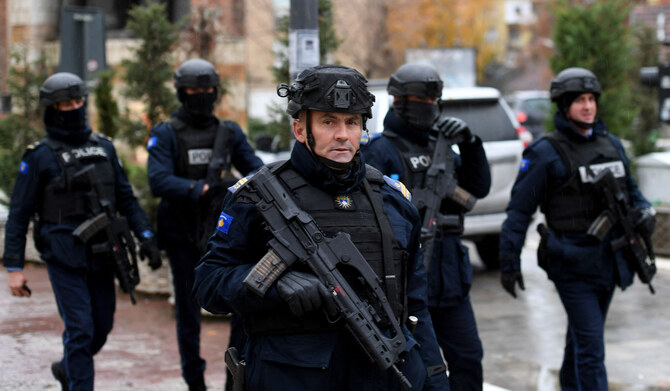
Kosovo Police officers patrol in the streets of Mitrovica, which is ethnically split between Serbs in the north and Albanians in the south, on November 30, 2024. (AFP)
Short Url
Updated 02 December 2024
Follow

Kosovo, Serbia engage in war of words after canal blast

  • The blast damaged a canal supplying water to hundreds of thousands of people and cooling systems at two coal-fired power plants that generate most of Kosovo’s electricity

BELGRADE: Kosovo and Serbia continued to sling allegations at each other on Sunday, just days after an explosion targeting a strategic canal in Kosovo sent tensions soaring between the long-time rivals.
During a press conference, Kosovo Prime Minister Albin Kurti accused Serbia of “copying Russian methods to threaten Kosovo and our region in general” after the explosion on Friday on the waterway near Zubin Potok, an area of Kosovo’s volatile north dominated by ethnic Serbs.
“Despite this, the effort is also destined to fail, as Kosovo is based on Western democratic values,” added Kurti.
The blast damaged a canal supplying water to hundreds of thousands of people and cooling systems at two coal-fired power plants that generate most of Kosovo’s electricity.
Kurti’s comments came just hours after Serbian President Aleksandar Vucic slammed the stream of accusations from Pristina during a live address to the country.
Vucic said the explosion and Kosovo’s accusations were “an attempt at a large and ferocious hybrid attack” on Serbia.
Belgrade’s Kosovo office said the strike gave the Pristina government an excuse to crack down on ethnic Serbs in Kosovo.
“We have no connection with it,” Vucic said of the attack.
He stopped short of directly accusing any individual or state of orchestrating the blast and said Serbian authorities had opened their own investigation.

Animosity between Serbia and Kosovo, which has an ethnic Albanian majority, has persisted since the end of a war in the late 1990s between Belgrade’s forces and ethnic Albanian separatists in what was then a province of Serbia.
Serbia has never recognized Kosovo’s 2008 declaration of independence.
The Kosovo prime minister said in Pristina that the attack would have had “enormous” consequences if it had been successful.
According to the premier, the attack had the potential to unleash major disruptions to Kosovo’s power and water supply for weeks.
“The goal was for most of our country in December to remain without water, in the dark, in the cold and without communication,” said Kurti.
A “temporary” repair had saved the water supply and there had been no impact on the electricity supply.
Serbian officials have fired back, saying that the accusations from Kosovo have ulterior motives.
Petar Petkovic, director of the Serbian government’s Kosovo office, said the incident had provided Kurti with a pretext to try to expel ethnic Serbs from northern Kosovo.
“What happened in the village of Varage gave Kurti an alibi to continue the attacks in the north of Kosovo... and to continue the policy of expulsion of the Serb people,” Petkovic told public broadcaster RTS.
The United States has condemned the canal attack.
“We will support efforts to find and punish those responsible and appreciate all offers of support to that effort,” State Department spokesman Matthew Miller posted on X.
Earlier on Sunday, Vucic vowed to cooperate with international bodies in the blast’s wake.

The Kosovo government on Sunday also announced measures to better protect critical infrastructure, including bridges, power stations and lakes, with police and security forces conducting patrols.
It was also stepping up cooperation between governing departments and international bodies “to prevent similar attacks in future,” it said.
Kosovo authorities arrested several suspects on Saturday.
Kosovo police chief Gazmend Hoxha said “200 military uniforms, six grenade launchers, two rifles, a pistol, masks and knives” had been seized in the operation.
Fuelling tensions, Kurti’s government has for months sought to dismantle a parallel system, backed by Belgrade, that provides social services and political offices for Kosovo’s ethnic Serb minority.
Friday’s attack followed violent incidents in northern Kosovo, including one in which hand grenades were hurled at a local council building and a police station this week.
Kosovo is to hold parliamentary elections on February 9.


US bringing seized tanker to port as Venezuela war fears build

Updated 2 sec ago
Follow

US bringing seized tanker to port as Venezuela war fears build

  • Washington took control of the tanker in a dramatic raid that saw US forces rope down from a helicopter onto the vessel
  • Trump told Politico that Maduro’s ‘days are numbered’ and declined to rule out a US ground invasion of Venezuela
WASHINGTON: An oil tanker seized by American forces off the Venezuelan coast will be brought to a port in the United States, the White House said Thursday, as fears mount of open conflict between the two countries.
Washington took control of the tanker in a dramatic raid that saw US forces rope down from a helicopter onto the vessel in an operation that Homeland Security Secretary Kristi Noem said was aimed at leftist Venezuelan leader Nicolas Maduro’s “regime.”
President Donald Trump’s administration has been piling pressure on Venezuela for months with a major naval build-up in the region that has been accompanied by strikes on alleged drug-trafficking boats that have killed close to 90 people.
Russian leader Vladimir Putin on Thursday expressed support during a phone call with his ally Maduro, but with Moscow’s forces tied down in a grinding war in Ukraine, its capacity to provide aid is limited.
“The vessel will go to a US port and the United States does intend to seize the oil,” White House Press Secretary Karoline Leavitt told journalists of the tanker.
“We’re not going to stand by and watch sanctioned vessels sail the seas with black-market oil, the proceeds of which will fuel narco-terrorism of rogue and illegitimate regimes around the world.”
Earlier on Thursday, Noem told a congressional hearing that the tanker operation was “pushing back on a regime that is systematically covering and flooding our country with deadly drugs” — a reference to US allegations of narcotics smuggling by Maduro’s government.
A video released Wednesday by US Attorney General Pam Bondi showed American forces descending from a helicopter onto the tanker’s deck, then entering the ship’s bridge with weapons raised.
Bondi said the ship was part of an “illicit oil shipping network” that was used to carry sanctioned oil.

Blatant theft

Venezuela’s foreign ministry said it “strongly denounces and condemns what constitutes blatant theft and an act of international piracy.”
UN Secretary-General Antonio Guterres on Thursday expressed concern over the escalating tensions and urged restraint.
“We are calling on all actors to refrain from action that could further escalate bilateral tensions and destabilize Venezuela and the region,” his spokesperson said.
US media reported that the tanker had been heading for Cuba — another American rival — and that the ship was stopped by the US Coast Guard.
Dick Durbin, the top Democrat on the Senate Judiciary Committee, said Thursday he questioned the legality of the tanker seizure and that “any president, before he engages in an act of war, has to have the authorization of the American people through Congress.”
“This president is preparing for an invasion of Venezuela, simply said. And if the American people are in favor of that, I’d be surprised,” Durbin told CNN.
Washington has accused Maduro of leading the alleged “Cartel of the Suns,” which it declared a “narco-terrorist” organization last month, and has offered a $50 million reward for information leading to his capture.
The US Treausury also imposed new sanctions Thursday targeting three of Maduro’s relatives as well as six companies shipping the South American country’s oil.
Trump told Politico on Monday that Maduro’s “days are numbered” and declined to rule out a US ground invasion of Venezuela.
The Trump administration alleges that Maduro’s hold on power is illegitimate and that he stole Venezuela’s July 2024 election.
Maduro — the political heir to leftist leader Hugo Chavez — says the United States is bent on regime change and wants to seize Venezuela’s oil reserves.