


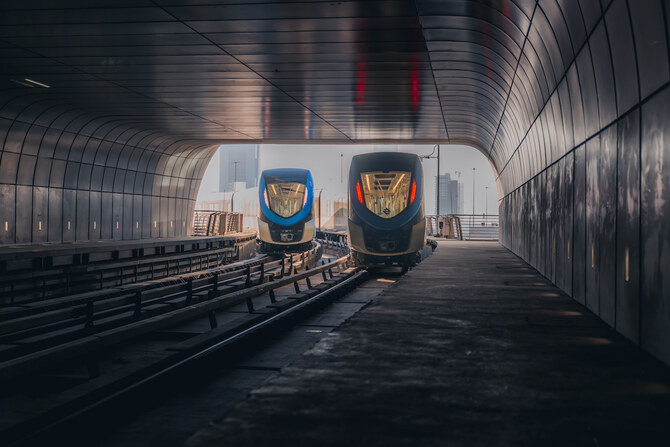


RIYADH: The Saudi capital is ending the year on a high as Riyadh Metro trains officially began running on Dec. 1.
Stations were buzzing with excitement across the blue, yellow, and purple lines as commuters celebrated the opening of a project which was 12 years in the making.
At the King Abdullah Financial District Station, which connects all three lines, Saudis, residents, and tourists spoke to Arab News about their eagerness to try out the city’s new mode of transportation.
Khalid Alohari, who was en route to visit his grandmother, told Arab News: “I live in the north, near to the KAFD Station, and my grandma is in the far east, so going by car was always a hassle. Now the metro will make visiting her so much easier. The experience is just phenomenal. I’ve been waiting for this.”

Medical student Khalid Alohari. (AN photo by Jaafer Alsaleh)
As a medical student at King Saud University, he was eligible for a 50 percent discount on all fares. He plans to use the metro system regularly to attend classes.
He added: “A month (of) using public transport, the metro, the buses, the supplementary cars, for just SR70 ($18) for a student, it’s just something we didn’t imagine could happen. I have a station close to my home. I’m going to take it to the university, and use it for the commute.
“As a medical student, I can use the 30-40 minutes of the commute to study, and it will also have a positive impact on my grades. It’s a win-win for everyone basically.”
He said that the metro will play a crucial role in reducing the growing traffic problem in Saudi Arabia, while also making transportation a greener experience as the system runs primarily on electrical energy rather than oil combustion.
Tourists Greg and Emma Turra were visiting Riyadh from Australia. Unsure how to spend their last day in the city, they decided to hop on the train to see where it took them. They were surprised to learn that the special day was the first they could have accessed the mass transit system.
Greg told Arab News: “We were just looking at a bit of time to waste on our last six hours, and what better way than doing this? It’s not every day you ride a train on its opening day.”

Tourist Greg Turra. (AN photo by Jaafer Alsaleh)
They started their journey from Alinma Bank Station on the blue line and made it to KAFD.
Emma said: “The first thing we saw was that it was brand new, modern, futuristic, and the architectural brilliance of it, really, is quite special.
“Everyone was so excited to be traveling on it — we couldn’t believe that. That’s how we realized that it was obviously the first day.”

Tourist Emma Turra. (AN photo by Jaafer Alsaleh)
She added that the system could be an attraction for tourists as the city’s traffic has been a well-known problem for tourists.
She added: “Before I came to Riyadh I was told the traffic was a nightmare. And when we arrived, we took close to two hours to get to our hotel. This line goes to the airport so that might be another option for people.”
Ameera Alrumaih, a student at Imam Mohammad Ibn Saud Islamic University, told Arab News: “I've been thinking about this project for forever.

Ameera Alrumaih, a student at Imam Mohammad Ibn Saud Islamic University. (AN photo by Jaafer Alsaleh)
“I’ve been seeing it being built near our house. Every outing we have, I always see the metro. I’ve been excited for forever to try it.”
Alrumaih and her friend hopped on the train from the university to grab breakfast at KAFD, and headed back to continue their classes.
Alrumaih said: “We traveled from our university to KAFD in less than 10 minutes, which is so much easier, especially for me. I think I would use it. I live in the east so from east to east I’ll still use my car, but from east to north I think I’ll use the metro.
“I’ve tried the metro in Istanbul and London. I think (in Riyadh) it is much clearer, much nicer and well-lit.”

Osama Alharbi. (AN photo by Jaafer Alsaleh)
Commuter Osama Alharbi arrived at KAFD Station from Khurais Road with a sense of pride, and said: “It was so easy to come here. It’s around 15 or 20 minutes around this time but if you take a car from my house to KAFD, maybe an hour.
“When I came to the train station the support was so amazing. The (station managers and assistants) came up to the door to bring me to the ticket (machine) and tell me about the prices.”
The only issue he noted was that there was no clear direction between the standard and first-class sections so travelers could easily hop in any of the cars.


