

Prominent artworks at Riyadh Metro stations blend daily life, creativity

1 / 5
Riyadh Art, one of the world’s largest public art programs, has unveiled four monumental public artworks with the launch of the Riyadh Metro. (SPA)
2 / 5
Riyadh Art, one of the world’s largest public art programs, has unveiled four monumental public artworks with the launch of the Riyadh Metro. (SPA)
3 / 5
Riyadh Art, one of the world’s largest public art programs, has unveiled four monumental public artworks with the launch of the Riyadh Metro. (SPA)
4 / 5
Riyadh Art, one of the world’s largest public art programs, has unveiled four monumental public artworks with the launch of the Riyadh Metro. (SPA)
5 / 5
Riyadh Art, one of the world’s largest public art programs, has unveiled four monumental public artworks with the launch of the Riyadh Metro. (SPA)
Short Url
Updated 03 December 2024
Follow

Prominent artworks at Riyadh Metro stations blend daily life, creativity

  • Masterpieces transform the daily commute into a celebration of art, architecture and creativity
  • Since its launch in 2019, Riyadh Art has seamlessly integrated art into the urban fabric

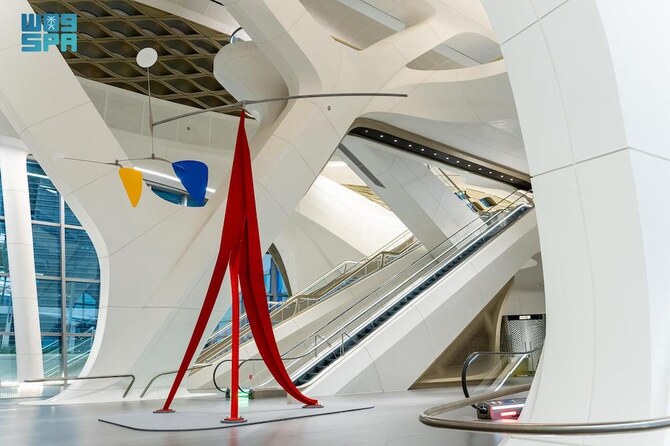
RIYADH: Riyadh Art, one of the world’s largest public art programs, has unveiled four monumental public artworks with the launch of the Riyadh Metro, transforming stations into cultural landmarks.

At the King Abdullah Financial District Metro Station, designed by the internationally acclaimed Zaha Hadid Architects, Alexander Calder’s “Janey Waney” takes center stage.

The lofty and colorful sculpture exemplifies Calder’s pioneering spirit in kinetic art, creating a dynamic and engaging experience for visitors.

Nearby, Robert Indiana’s “LOVE (Red Outside Blue Inside)” — one of the world’s most recognizable artworks — captivates visitors with its vibrant interplay of color and universal themes of connection and hope.

Together, these masterpieces transform the daily commute into a celebration of art, architecture and creativity.

At the Qasr Al-Hokm Downtown Metro Station, designed by the renowned architectural firm Snohetta, Ugo Rondinone’s “The Sun” makes a striking golden centerpiece, symbolizing energy and renewal.

Complementing this is Zaman Jassim’s “When the Moon is Full,” a reflective and poetic piece inspired by Riyadh’s cultural heritage.

“These permanent artworks embody our vision of transforming Riyadh into an open-air gallery that enriches the quality of life and fosters a deeper connection between people and art,” said architect Khalid Al-Hazani, executive director of Riyadh Art.

“By collaborating with some of the most creative minds of our time, we’re not just adding art to public spaces — we’re creating cultural landmarks that inspire and engage generations,” he added.

Al-Hazani told Arab News: “The beautiful thing is that there is a specialized program under Riyadh Art dedicated to installing artworks in all 85 stations that we’ve already selected, which will be produced and placed within the upcoming year.”

Led by the Royal Commission for Riyadh City, Riyadh Art is championing cultural innovation and economic diversification, and positioning the Kingdom’s capital as a global center for contemporary art and culture.

Since its launch in 2019, Riyadh Art has seamlessly integrated art into the urban fabric, displaying over 500 artworks by more than 500 local and international artists, hosting more than 6,000 community engagement activities, and engaging more than 6 million visitors.

As the program continues to expand, the number of artworks and initiatives is expected to grow significantly, fostering a sense of community, enriching the city’s identity, and elevating Riyadh’s standing as a global arts destination.


Saudi designer Njoud Alghamdi: ‘We want to sustain our cultural identity in a new form’ 

Updated 18 December 2025
Follow

Saudi designer Njoud Alghamdi: ‘We want to sustain our cultural identity in a new form’ 

  • The Saudi designer on revamping the date-serving experience with Muntj Studio 

DUBAI: Saudi product designer Njoud Alghamdi brought a culturally rooted product to last month’s Dubai Design Week with “Nawat” — showcased under the Designed in Saudi initiative by the Saudi Architecture and Design Commission. 

Alghamdi is the co-founder and lead product designer of Muntj Studio, which she describes as “a cultural design studio where we focus on sustaining our cultural identity.” 

But Alghamdi isn’t interested in simply reproducing products from the past. “I am passionate about cultural innovation,” she told Arab News.  

“Nawat” — which she describes as the studio’s “signature piece” — is a perfect example of that innovation. It was created to address an issue that occurs in gatherings across Saudi Arabia and the Gulf. 

“Nawat” is the studio’s “signature piece,” according to Njoud Alghamdi. (Supplied) 

 “As you know, dates hold a very special place for us,” she said. But Alghamdi and her team identified a common concern. “Usually when people eat dates, they are embarrassed dealing with the pits themselves,” she explained. “So usually, they hide it in their pockets or in a tissue.  

“We asked ourselves, ‘How we can solve this problem to make the experience easier for the users?’” she continued. The elegant result is “Nawat,” a rounded wooden vessel with openings designed to store date pits out of sight.  

Those openings were inspired by traditional Najdi architectural elements, with a particular focus on the motifs used in old Najdi doors. During the research phase, she and her team reviewed a range of patterns but chose not to use the sharper shapes found in older houses.  

“We didn’t want to use motifs like the triangle,” she said. “So, we found the perfect circular motif and used that. Najdi doors are also a symbol of welcoming.” 

This connection aligned naturally with the social role of dates in Khaleeji culture. “The date pit holds a very special place for us at every table,” she said. “We hope that reflects how friendly this object is.” 

The final product was crafted in Riyadh by local artisans, she explained. “They used natural wood with natural finishes as well.”  

The final product was crafted in Riyadh by local artisans. (Supplied) 

The studio is now developing an entire “Nawat” range, Alghamdi said, explaining that the collection will include different sizes and dimensions to fit a wider range of occasions.  

Alghamdi described the studio’s broader focus as creating contemporary objects that sustain cultural identity. “Most of our products reflect our Saudi identity in a new format,” she said. “We want to sustain our cultural identity in a new form that can share our story with the whole world.” 

Current projects include an incense burner inspired by the camel hump, intended to “support a more comfortable daily incense ritual.” She added that the studio is also working on “cultural games,” which she described as ways to express Saudi identity in an interactive way.  

“Playing a game is the perfect way to communicate,” she said. “We believe that by expressing our identities through these games, it will help us to spread our identity and culture to the whole world.” 

Dubai Design Week was a small step towards that goal.  

“Actually, this is one of my proudest moments, to be honest,” Alghamdi said. “Exhibiting with the Architecture and Design Commission is something really special to me. 

“We’re always grateful for all the support and empowerment that (the commission is) giving us,” she continued. “As a Saudi designer, they always ensure that we get the best (opportunities) to present our work. This is something that makes every Saudi designer super-excited to come up with the best designs, because (we have the chance to) reflect our identity and the (wider design) scene.”