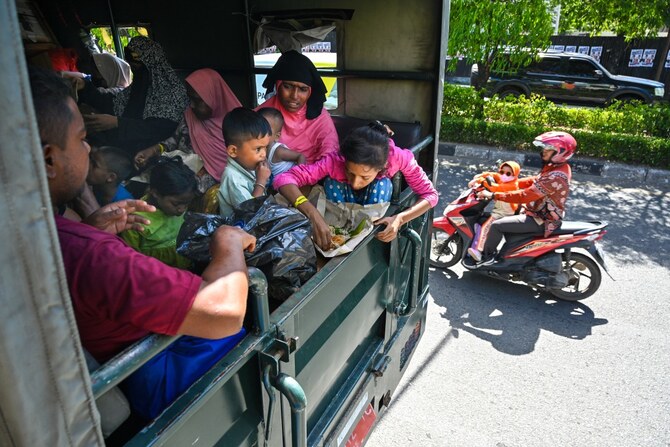
Banda Aceh: More than 100 Rohingya refugees including women and children have been rescued after their boat sank off the coast of Indonesia, the United Nations refugee agency said Saturday.
The mostly Muslim ethnic Rohingya are heavily persecuted in Myanmar and thousands risk their lives each year on long and dangerous sea journeys to reach Malaysia or Indonesia.
“We received a report from the East Aceh government that there are 116 refugees in total,” UNHCR’s Faisal Rahman told AFP on Saturday.
“The refugees are still on the beach right now, it has not been decided where they would be taken.”
He said the flimsy wooden boat carrying the Rohingyas was found half-submerged not far from the beach off the coast of northeastern Sumatra island.
A local fisherman, Saifudin Taher said the boat was first spotted entering East Aceh waters on Saturday morning, and a few hours later it nearly sank.
“All passengers survived, but one of them was ill and ...immediately received treatment,” Saifudin told AFP, adding the boat was only 100 meters away from the beach, and the refugees could walk easily to safety.
Rohingya arrivals in Indonesia tend to follow a cyclical pattern, slowing during the stormy months and picking back up when sea conditions calm down.
Last month, 152 Rohingya refugees were finally brought ashore after being anchored for days off the coast of South Aceh district for days while officials decided whether to let them land.
Indonesia is not a signatory to the UN refugee convention and says it cannot be compelled to take in refugees from Myanmar, calling instead on neighboring countries to share the burden and resettle Rohingya who arrives on its shores.
Many Acehnese, who have memories of decades of bloody conflict themselves, are sympathetic to the plight of their fellow Muslims.
But others say their patience has been tested, claiming the Rohingya consume scarce resources and occasionally come into conflict with locals.
In December 2023, hundreds of students forced the relocation of more than 100 Rohingya refugees, storming a community hall in Aceh where they were sheltering and vandalising their belongings.


![]()


More than 100 Rohingya refugees rescued off Indonesia: UN
Short Url
https://arab.news/rqfmb
More than 100 Rohingya refugees rescued off Indonesia: UN
- Indonesia is not a signatory to the UN refugee convention and says it cannot be compelled to take in refugees from Myanmar
Cuba says attacking speedboat had nearly 13,000 rounds of ammunition
- Firefight took place at a range of 20 meters, Cuba says
- Incoming crew originally set out on two vessels but ditched one
HAVANA: A commando of Cuban exiles who intended to infiltrate Cuba on a speedboat was armed with nearly 13,000 rounds of ammunition, 13 rifles and 11 pistols, Cuban officials said on Friday, providing new details about Wednesday’s deadly exchange of gunfire at sea. The government in Havana has said 10 Cuban nationals coming from the United States entered Cuban waters and opened fire on a border guard vessel, leading Cuban forces to return fire killing four and wounding six others, who were taken into custody.
In an attempt to dispel doubts about its account to date, senior Cuban Interior Ministry officers displayed the captured armaments from the studio on a special television program, including bins full of at least some of the 12,846 recovered rounds. They also showed pictures of the vessels, each peppered with bullet holes from the firefight they said took place at a range of 20 meters (66 feet).
The confrontation took place at a fraught moment in US-Cuban relations, with US President Donald Trump pressuring the island by imposing a virtual oil blockade after capturing and ousting Venezuelan President Nicolas Maduro, a crucial Cuban ally, on January 3.
Cuba has identified the assailants as Cuban exiles, some of whom had been previously placed on a list of accused terrorists, who came from the United States with the intent to sow chaos and attack military units on the Communist-ruled island.
“The intent of this group is to infiltrate, to promote public disorder. To incite the people to unite. To carry out something violent. Attack military units in order to incite social unrest and to unite the people in order to steal the revolution. That has been duly proven,” said Col. Victor Alvarez of the Interior Ministry.
Cuba says response ‘proportional’
US politicians have expressed skepticism over Cuba’s version of events. Secretary of State Marco Rubio on Wednesday said his government would independently investigate, adding that it was not a US operation and that no US government personnel were involved.
Cuban officers said the infiltrators set out from Marathon in the Florida Keys on two vessels but ditched one at some point due to technical difficulties. They united on one speedboat, which a US official said was reported stolen in Florida. Cuba said it recovered a drone, radios, knives, a portable power plant, bolt cutters and other materiel. They also found emblems of the November 30th Movement and People’s Self-Defense, anti-communist groups that oppose the Cuban government.
Cuba says a patrol of five border guard members on a 9-meter boat spotted the incoming vessel shortly after 7 a.m., with some members of the incoming crew in the water, about one nautical mile off a cay on the Caribbean island’s northern coast, about 100 miles (160 km) from Marathon.
The infiltrators opened fire at a distance of 185 meters, striking the captain of the Cuban vessel in the abdomen, Cuba said. Bleeding heavily, the wounded captain remained at the helm and steered toward the enemy vessel, leading to a firefight at a distance of about 20 meters, the officers said.
Cuba called its response “proportional.”
“It is a defensive model that practically never uses firearms, and the use of firearms is proportional to the type of action being carried out against our force,” said Interior Ministry Col. Ybey Carballo.
The captured Cuban nationals were receiving medical care and face charges including armed aggression, illegal entry into national territory, crimes associated with terrorist acts, and arms trafficking, prosecutor Edward Robert Campbell told the program. He said they face prison terms of up to 10 to 15 years for the lesser offenses and 20 to 30 years — or even the death penalty — for the more serious charges.
In an attempt to dispel doubts about its account to date, senior Cuban Interior Ministry officers displayed the captured armaments from the studio on a special television program, including bins full of at least some of the 12,846 recovered rounds. They also showed pictures of the vessels, each peppered with bullet holes from the firefight they said took place at a range of 20 meters (66 feet).
The confrontation took place at a fraught moment in US-Cuban relations, with US President Donald Trump pressuring the island by imposing a virtual oil blockade after capturing and ousting Venezuelan President Nicolas Maduro, a crucial Cuban ally, on January 3.
Cuba has identified the assailants as Cuban exiles, some of whom had been previously placed on a list of accused terrorists, who came from the United States with the intent to sow chaos and attack military units on the Communist-ruled island.
“The intent of this group is to infiltrate, to promote public disorder. To incite the people to unite. To carry out something violent. Attack military units in order to incite social unrest and to unite the people in order to steal the revolution. That has been duly proven,” said Col. Victor Alvarez of the Interior Ministry.
Cuba says response ‘proportional’
US politicians have expressed skepticism over Cuba’s version of events. Secretary of State Marco Rubio on Wednesday said his government would independently investigate, adding that it was not a US operation and that no US government personnel were involved.
Cuban officers said the infiltrators set out from Marathon in the Florida Keys on two vessels but ditched one at some point due to technical difficulties. They united on one speedboat, which a US official said was reported stolen in Florida. Cuba said it recovered a drone, radios, knives, a portable power plant, bolt cutters and other materiel. They also found emblems of the November 30th Movement and People’s Self-Defense, anti-communist groups that oppose the Cuban government.
Cuba says a patrol of five border guard members on a 9-meter boat spotted the incoming vessel shortly after 7 a.m., with some members of the incoming crew in the water, about one nautical mile off a cay on the Caribbean island’s northern coast, about 100 miles (160 km) from Marathon.
The infiltrators opened fire at a distance of 185 meters, striking the captain of the Cuban vessel in the abdomen, Cuba said. Bleeding heavily, the wounded captain remained at the helm and steered toward the enemy vessel, leading to a firefight at a distance of about 20 meters, the officers said.
Cuba called its response “proportional.”
“It is a defensive model that practically never uses firearms, and the use of firearms is proportional to the type of action being carried out against our force,” said Interior Ministry Col. Ybey Carballo.
The captured Cuban nationals were receiving medical care and face charges including armed aggression, illegal entry into national territory, crimes associated with terrorist acts, and arms trafficking, prosecutor Edward Robert Campbell told the program. He said they face prison terms of up to 10 to 15 years for the lesser offenses and 20 to 30 years — or even the death penalty — for the more serious charges.
Latest updates


© 2026 SAUDI RESEARCH & PUBLISHING COMPANY, All Rights Reserved And subject to Terms of Use Agreement.