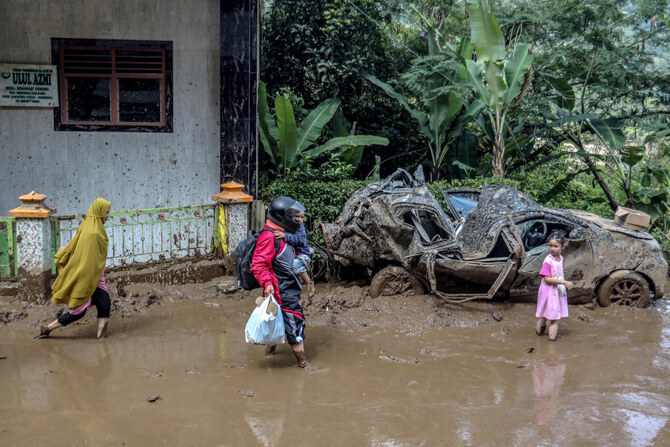
Indonesian rescuers search for missing in buried cars and bus after landslide in Sumatra

At least five cars, one bus, and one truck were trapped at the base of a cliff following the landslide. (AFP/FILE)
Short Url
Updated 29 November 2024
Follow

Indonesian rescuers search for missing in buried cars and bus after landslide in Sumatra

  • The death toll from one landslide on Wednesday on a hilly interprovince road rose to nine from seven
  • Flash floods hit the provincial city of Medan on Friday although waters have receded in some areas

JAKARTA: Indonesian rescuers on Friday searched for survivors buried in three cars and bus at the base of a cliff after flash floods and landslides in North Sumatra province killed at least 29 people.
Torrential rain for the past week in the province has triggered flash floods and landslides in four different districts, Indonesia’s disaster agency has said.
The death toll from one landslide on Wednesday on a hilly interprovince road rose to nine from seven, Hadi Wahyudi, the spokesperson of North Sumatra police told Reuters on Friday.
At least five cars, one bus, and one truck were trapped at the base of a cliff following the landslide. On Friday, police and rescuers focused their search for missing people on three cars and one bus buried in mud.
“We still don’t know how many people who were still trapped,” Hadi said.
In other districts, landslides over the weekend killed 20 people and rescuers will keep searching for two missing people until Saturday.
Flash floods hit the provincial city of Medan on Friday although waters have receded in some areas, said Sariman Sitorus, spokesperson for the local search agency.
The floods forced a delay in votes for regional elections in some areas in Medan on Wednesday.
Extreme weather is expected in Indonesia toward the end of 2024, as the La Nina phenomenon increases rainfalls across the tropical archipelago, the country’s weather agency has warned.


US judge blocks Trump plans to end of deportation protections for South Sudanese migrants

Updated 7 sec ago
Follow

US judge blocks Trump plans to end of deportation protections for South Sudanese migrants

  • Kelley issued the order after four migrants from South Sudan along with African Communities Together, a non-profit group, sued

BOSTON: A federal judge on Tuesday blocked plans ​by US President Donald Trump’s administration to end temporary protections from deportation that had been granted to hundreds of South Sudanese nationals living in the United States.
US District Judge Angel Kelley in Boston granted an emergency request by several South Sudanese nationals and an immigrant rights group to prevent the temporary protected status they had been granted from expiring as planned after January 5.
The ruling is a temporary victory for immigrant advocates and a setback for the Trump administration’s broader effort to curtail the humanitarian program. It is the latest in a series of legal ‌challenges to the ‌administration’s moves to end similar protections for nationals from several ‌other ⁠countries, including ​Syria, Venezuela, ‌Haiti and Nicaragua.
Kelley issued the order after four migrants from South Sudan along with African Communities Together, a non-profit group, sued. The lawsuit alleged that action by the US Department of Homeland Security was unlawful and would expose them to being deported to a country facing a series of humanitarian crises.
Kelley, who was appointed by Democratic former President Joe Biden, issued an administrative stay that temporarily blocks the policy pending further litigation.
She wrote that allowing it to take effect before the courts had time ⁠to consider the case’s merits “would result in an immediate impact on the South Sudanese nationals, stripping current beneficiaries of lawful status, ‌which could imminently result in their deportation.”
Homeland Security Department spokesperson ‍Tricia McLaughlin said in a statement that the ‍judge’s ruling ignored Trump’s constitutional and statutory authority and that the temporary protected status extended to ‍South Sudanese nationals “was never intended to be a de facto asylum program.”
Conflict has ravaged South Sudan since it won independence from Sudan in 2011. Fighting has persisted in much of the country since a five-year civil war that killed an estimated 400,000 people ended in 2018. The US State Department advises citizens not ​to travel there.
The United States began designating South Sudan for temporary protected status, or TPS, in 2011.
That status is available to people whose home countries ⁠have experienced natural disasters, armed conflicts or other extraordinary events. It provides eligible migrants with work authorization and temporary protection from deportation.
About 232 South Sudanese nationals have been beneficiaries of TPS and have found refuge in the United States, and another 73 have pending applications, according to the lawsuit.
Homeland Security Secretary Kristi Noem published a notice on November 5 terminating TPS for South Sudan, saying the country no longer met the conditions for the designation.
The lawsuit argues the agency’s action violated the statute governing the TPS program, ignored the dire humanitarian conditions that remain in South Sudan, and was motivated by discrimination against migrants who are not white in violation of the US Constitution’s Fifth Amendment.
“The singular aim of this mass deportation agenda is to remove as many Black and Brown immigrants from this ‌country as quickly and as cruelly as possible,” Diana Konate, deputy executive director of policy and advocacy at African Communities Together, said in a statement.