New 10-day truce after over 110 killed in Pakistan sectarian feuding — officials

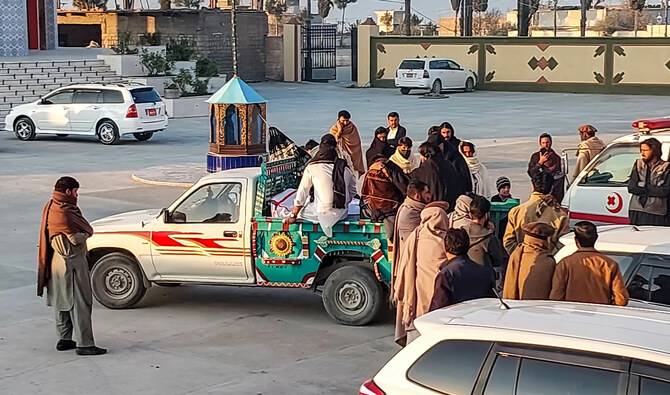
Relatives transport a dead body of a victim who was killed in sectarian attacks in Kurram district at a Shitte Muslim mosque in Parachinar, the mountainous Khyber Pakhtunkhwa province, on November 22, 2024. (AFP/File)
Short Url
Updated 28 November 2024
Follow

New 10-day truce after over 110 killed in Pakistan sectarian feuding — officials

  • Troops will be deployed at key locations in Kurram to enforce the ceasefire, compensation will be provided to victims’ families
  • The Human Rights Commission of Pakistan said 79 people had been killed between July and October in sectarian clashes

PESHAWAR: Feuding communities in northwest Pakistan on Wednesday agreed to a new 10-day ceasefire, as the death toll from a week-long spate of sectarian violence rose to 111, officials said.
“A ten-day ceasefire between the warring parties in Kurram has come into effect as of today,” the office of the Chief Minister of Khyber Pakhtunkhwa province, where the district is located, said in a statement.
The statement caps a day of continuing hostilities, with provincial officials saying that the death toll from the latest spate of violence had climbed to 111, including 79 Shias and 32 Sunnis. Another 88 people were injured.
Pakistan is a Sunni-majority country, but Kurram district — in Khyber Pakhtunkhwa province, near the border with Afghanistan — has a large Shiite population and the communities have clashed for decades.
The provincial minister’s office added that troops will be deployed at key locations in Kurram to enforce the ceasefire and compensation will be provided to the victims’ families.
“Negotiations will continue to ensure lasting peace,” the statement said.
The latest violence began last Thursday when two separate convoys of Shiite Muslims traveling under police escort were ambushed, and at least 43 people were killed.
Provincial officials brokered a seven-day truce this weekend but it did not hold.
Police have regularly struggled to control violence in Kurram, which was part of the semi-autonomous Federally Administered Tribal Areas until it was merged with Khyber Pakhtunkhwa in 2018.
Last month at least 16 people, including three women and two children, were killed in a sectarian clash in Kurram.
The Human Rights Commission of Pakistan said 79 people had been killed between July and October in sectarian clashes.


Pakistan finance chief says country leveraging AI to boost tax compliance, revenu

Updated 6 sec ago
Follow

Pakistan finance chief says country leveraging AI to boost tax compliance, revenu

  • Aurangzeb says AI-driven systems are cutting leakages, discretionary intervention in tax administration
  • He tells a national workshop the government must focus on applied AI, not technology for its own sake

KARACHI: Pakistan is deploying artificial intelligence-driven systems to strengthen tax compliance and enforcement as part of a broader reform push, Finance Minister Muhammad Aurangzeb said on Tuesday, adding the country must focus on applied AI solutions.

He was speaking during a panel discussion at the National Artificial Intelligence Workshop in the capital, as Pakistan undertakes sweeping fiscal and structural reforms under a $7 billion International Monetary Fund loan program aimed at stabilizing the economy and boosting revenue collection.

The government has pledged to widen the tax base, curb leakages and digitize administration, with technology playing a central role in its tax transformation agenda.

“AI-enabled systems are playing an increasingly important role in strengthening compliance, enforcement, and decision-making,” Aurangzeb said, according to a statement released by the finance division.

“The Government’s ongoing tax transformation, anchored in reforms to people, processes, and technology, is leveraging AI-led CRM [Customer Relationship Management] systems, AI-led production monitoring, risk-based compliance tools, and faceless customer processes to enhance transparency, reduce leakages, and improve revenue outcomes,” he added.

The finance minister said the focus for a country like Pakistan must remain on applied AI solutions that deliver measurable gains in efficiency, transparency and productivity, rather than on adopting technology for its own sake.

Reducing discretionary human intervention through technology was central to curbing inefficiencies and corruption, he said, adding that AI-led systems had generated tangible fiscal gains that would not have been achievable through manual processes alone.

Aurangzeb said investing in human capital and skills development was essential to enable Pakistan’s youth to participate in higher-value segments of the global technology ecosystem, noting that technologies such as blockchain and data analytics could support productivity-led growth.

He maintained artificial intelligence offered opportunities in revenue mobilization, public service delivery and climate and population management, adding that realizing those gains would require clear policy direction, institutional readiness and a coordinated, whole-of-government approach.