

Qatari ambassador discusses bilateral investment and ties with Sindh governor

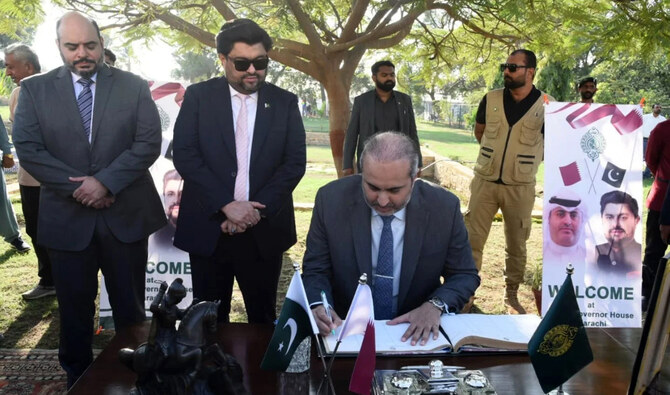
Ambassador of the State of Qatar, Ali Mubarak Ali Essa Al-Khater, writes in the guestbook at the Governor’s House following a meeting with Sindh Governor Kamran Tesori in Karachi, Pakistan, on November 27, 2024. (Photo Courtesy: Sindh Governer House)
Short Url
Updated 27 November 2024
Follow

Qatari ambassador discusses bilateral investment and ties with Sindh governor

  • Qatari envoy expressed interest in large-scale investments in Pakistan, particularly Karachi, says Sindh Governor
  • PM Shehbaz Sharif last month visited Qatar to boost foreign trade, investment to stabilize $350 billion economy

KARACHI: Qatar’s Ambassador to Pakistan Ali Mubarak Ali Essa Al-Khater met Sindh Governor Kamran Tessori on Wednesday to discuss ways to increase bilateral investment and foster stronger ties between the two countries, the Governor House said. 

Pakistan’s Prime Minister Shehbaz Sharif last month visited Qatar as he sought to bolster economic cooperation amid the country’s efforts to boost foreign investment and stabilize its frail $350 billion economy.

Islamabad and Doha have attempted to forge closer business ties over the past few months, with a Qatar Investment Authority (QIA) team also expected to visit Pakistan this month to set up an information technology (IT) park. 

Al-Khater called on Tessori at the Governor House in Karachi where the two held a detailed meeting to discuss investment and other matters. 

“The meeting focused on matters of mutual interest and fostering stronger bilateral ties,” the Governor House said. “During the visit, the Ambassador praised the Governor’s initiative and expressed Qatar’s desire to strengthen relations further with Pakistan, particularly in economic collaboration.”

Tessori spoke to reporters after the meeting, acknowledging that Qatar had always supported Pakistan. He added that Pakistanis harbored “immense affection for Qatar.”

“He shared that the Ambassador conveyed Qatar’s keen interest in large-scale investments in Pakistan, particularly in Karachi,” the statement said. 

Tessori highlighted that Qatar was interested in government-to-government investments and joint ventures with Pakistani businesses. 

The Sindh governor said Al-Khater assured him of local Qatari investors’ readiness to invest in Pakistan. 

“I will provide detailed insights into sectors that can yield immediate results for investments, ensuring that this partnership benefits both nations significantly,” Tessori said.

He emphasized that Qatar’s interest is particularly crucial given Pakistan’s current economic challenges. 

“We are committed to providing a conducive environment and guarantees for Qatari investors to achieve substantial returns,” Tessori said.  

Pakistan’s desire to forge closer economic ties with allies come amid its attempts to increase trade and foreign investment after the country narrowly escaped a default last year by securing a last-gasp $3 billion financial assistance package from the International Monetary Fund (IMF).


Pakistan’s deputy PM discusses ways to boost economic, trade ties with Iran

Updated 02 January 2026
Follow

Pakistan’s deputy PM discusses ways to boost economic, trade ties with Iran

  • Both countries agreed in August to increase bilateral trade to $10 billion by 2028
  • Pakistan and Iran have been working to stabilize relations after strained security ties

ISLAMABAD: Pakistan’s Deputy Prime Minister Ishaq Dar presided over a meeting to discuss economic and trade cooperation with Iran, the foreign office said on Friday, as the neighboring countries seek to expand ties.

The development took place during an inter-ministerial meeting on Pakistan-Iran bilateral relations chaired by Dar in Islamabad. Pakistan and Iran have been working to stabilize ties following a period of strained security relations.

Both countries have been working to enhance bilateral trade, setting up border markets and exploring barter trade to circumvent banking and currency restrictions. Sanctions and foreign exchange shortages remain key hurdles for Iran, making these alternative systems central to its trade strategy with Pakistan.

“The meeting reviewed ongoing cooperation across a range of sectors and discussed ways to further enhance economic and trade ties,” the foreign office said in a statement.

“The DPM/FM reaffirmed Pakistan’s commitment to deepening engagement with Iran in key priority areas.”

In December, the foreign ministers of Iran and Pakistan vowed to strengthen bilateral cooperation in trade and connectivity while working for regional peace.

Iranian President Dr. Masoud Pezeshkian also visited Pakistan in August, during which both countries signed agreements to increase bilateral trade to $10 billion by 2028.