

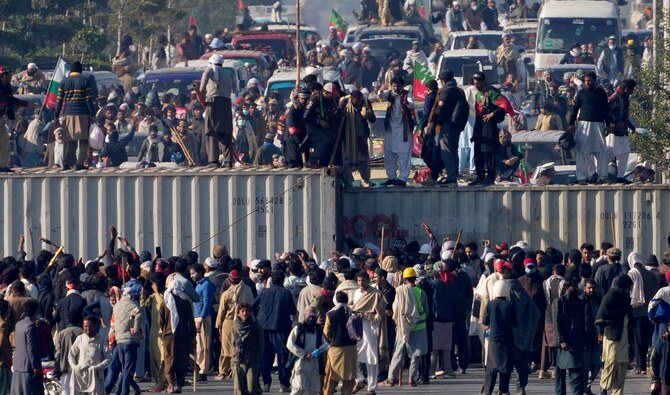

ISLAMABAD: Pakistan police said Wednesday they had arrested nearly 1,000 protesters who marched on the capital demanding the release of jailed ex-prime minister Imran Khan, after crowds were evicted from the city center in a sweeping security crackdown.
Khan has been jailed since August 2023, sidelined by dozens of legal cases he claims were confected to prevent his comeback in elections this year marred by rigging allegations.
Since the February vote, his Pakistan Tehreek-e-Insaf (PTI) party has defied a government crackdown with regular rallies, but Tuesday’s gathering was by far the largest to grip the capital since the poll.
More than 10,000 protesters surged into the city on the weekend, defying a ban on public gatherings and a lockdown to skirmish with 20,000 security forces enlisted to turn them back.
The government said at least one police officer was slain in unrest on Monday, while four state paramilitary personnel were also reported killed when protesters ran them over in a vehicle on Tuesday.
The crowds aimed to occupy a public square outside parliament and the prime minister’s house.
Overnight, security forces fired tear gas and rubber bullets at protesters wielding sticks and slingshots, as roadblocks were set ablaze.
By early Wednesday, AFP staff saw the main thoroughfare toward Islamabad’s government enclave cleared of crowds, and security forces in riot gear being bussed away from the area.
Islamabad Police Inspector General Ali Nasir Rizvi said 954 protesters had been arrested between Sunday and Tuesday, when the crowds came within one mile (1.6 kilometers) of the government enclave.
“610 of those arrests were made only on Tuesday alone,” he said.
Interior Minister Mohsin Naqvi said in a statement that security forces had “bravely repulsed the protesters.”
Khan had issued a call from his cell outside Islamabad on Tuesday evening, telling more people to join the crowds.
“All Pakistanis participating in the protest must remain peaceful, stay united, and stand firm until our demands are met,” he said in a social media statement released by his party, who often meet him in jail.
Prime Minister Shehbaz Sharif called the protests “extremism.” Since Sunday, his ministers held regular press conferences in central Islamabad vowing no mercy for the oncoming marchers.
But as they retreated from the capital, there were growing calls for reconciliation to prevent future flare-ups impacting regular citizens in the country of 240 million.
The Human Rights Commission of Pakistan said in a statement that Khan and Sharif’s parties should “immediately enter a purposeful political dialogue.”
“It is high time that they agree on a peaceful way forward instead of whipping up the emotions of their respective political workers and bringing the country to a standstill,” the organization said.
Michael Kugelman, South Asia Institute director at The Wilson Center, said on social media platform X that “Pakistan’s protests had no winners.”
Anger toward the establishment has increased over the crackdown, he said, while at the same time, PTI was forced to retreat.
“Pakistan on the whole is burdened by a worsening confrontation,” he said.
Khan, a charismatic 72-year-old former cricket star, served as premier from 2018 to 2022 and is the lodestar of PTI.
But in his absence, the protests were led partially by his wife, Bushra Bibi, who was also jailed this year but released last month.
Sharif’s government has come under increasing criticism for deploying heavy-handed measures to quash PTI rallies.
Mobile Internet was cut across Islamabad, schools shut on Monday remained closed on Wednesday, and roadblocks prevented thousands of workers from reaching their jobs.
Amnesty International said that “as protesters enter the capital, law enforcement officials have used unlawful and excessive force.”
Khan was ousted by a no-confidence vote after falling out with the kingmaking military establishment, which analysts say engineers the rise and fall of Pakistan’s politicians.
But as opposition leader, he led an unprecedented campaign of defiance, with street protests boiling over into unrest that the government cited as the reason for its crackdown.
PTI won more seats than any other party in this year’s election, but a coalition of parties considered more pliable to military influence shut them out of power.


