QUETTA: Sarfraz Bugti, the chief minister of Balochistan, on Monday asked opponents of a planned military operation against separatists in the insurgency-plagued southwestern province to suggest another solution to a surge in militant attacks, saying the armed campaign would target “terrorists and their camps.”
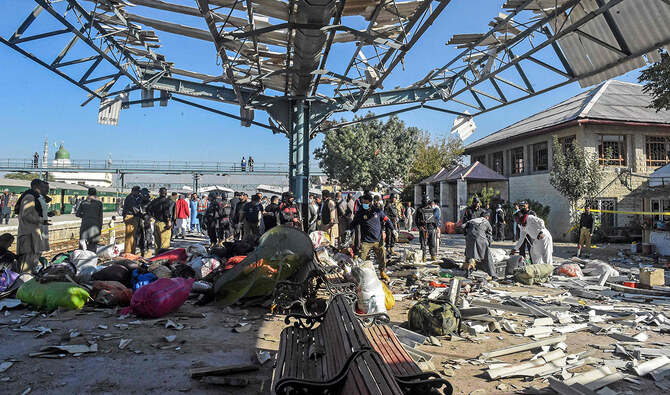
The province has seen a rise in deadly attacks that have targeted both citizens and security forces in recent months, including a series of coordinated assaults in August in which over 50 people were killed and a suicide bombing last month that targeted Pakistani army troops at a railway station, killing 27, including 19 soldiers, who were in civilian clothing.
Last Tuesday, the federal government announced that it would launch a “comprehensive” military operation to stem the rising tide of separatist militancy, though many political parties, civil rights groups and citizens have questioned the chances of the armed campaign’s success in the vast province.
“Obviously, this will be a targeted operation and the operation will be against those who are committing this terrorism, there will be operations against the terrorist camps,” Bugti said in response to questions by reporters.
“My question to all political parties is that if any other solution is seen emerging against this terrorism, then the government and the state of Pakistan are ready for this solution. These nationalist parties should tell us that solution … If any other political party knows any other solution, I ask them to tell the government.”
The statement from the prime minister’s office last week announcing the launch of the operation did not give any details, including which security forces would take part, whether the campaign would be limited to ground operations or could involve the air force, when it would be launched and in which parts of the vast, remote Balochistan province. It also did not mention if the plan would be a joint effort with Beijing, since Balochistan is home to key Chinese Belt and Road projects, and there has been a rise in attacks on Chinese nationals and interests in the region.
Pakistan’s military already has a huge presence in Balochistan, which borders Afghanistan and Iran and is home to a decades-long separatist insurgency by militants fighting for a separate homeland to win a larger share of benefits from the resource-rich province. The government and military deny they are exploiting the province’s mineral wealth or ignoring its economic development.
The military has long run intelligence-based operations against insurgent groups, the most prominent being the Baloch Liberation Army (BLA), which has escalated attacks in recent months on the military and nationals from longtime ally China.
The region hosts the Gwadar Port, built by China as part of the China-Pakistan Economic Corridor (CPEC), a $65 billion investment in President Xi Jinping’s Belt and Road infrastructure initiative to expand China’s global reach.
In addition to the recent attacks, the BLA also claimed a suicide bombing last month outside the international airport in the southern port city of Karachi that killed two Chinese engineers.
Ethnic Baloch separatists have launched several insurgencies in Balochistan since the birth of Pakistan in 1947, including from 1948-50, 1958–60, 1962–63 and 1973–1977. An ongoing low-level insurgency began in 2003. The army has launched several military campaigns in response, including as early as 1948 in the state of Kalat and a five-year-long operation in the 70s under Prime Minister Zulfiqar Ali Bhutto.
“Many political governments have come and gone in Balochistan but the operation has continued,” Sardar Akhter Jan Mengal, head of the Balochistan National Party (BNP) and a prominent Baloch nationalist leader in the province, told Arab News last week. “No one can resolve Balochistan’s political issue with military operations.”
Indeed, political leaders and independent analysts have for years urged the government to take a holistic approach to resolving Balochistan’s problems, which they say stems from decades of economic deprivation and political disenfranchisement. The province, which comprises 44 percent of Pakistan’s total land mass, is its most backward by almost all economic and social indicators.
Rich in land and mineral wealth, most parts of the region often lack even the rudiments of modern life. For instance, though home to Reko Diq, one of the world’s largest undeveloped copper and gold deposits, and the site of major Chinese investment projects, the province lacks employment opportunities and basic facilities like Internet, health and education.
Balochistan is also the least represented in Pakistan’s parliament, where legislative seats are allocated to provinces according to their population. Balochistan has a population of only 14.89 million people in a country of over 240 million and is hence allocated only 16 National Assembly seats. Punjab, with a much smaller land area but a population of 127.68 million, gets 141 seats.


![]()

‘Give us another solution,’ Balochistan CM asks opponents of military operation against separatists
Short Url
https://arab.news/p4b7h
‘Give us another solution,’ Balochistan CM asks opponents of military operation against separatists
- Government has announced operation but not shared details of scale, scope, whether it will be joint effort with China
- Analysts say military solutions will not work in Balochistan, plagued by low-level separatist insurgency since decades
Latest updates


© 2026 SAUDI RESEARCH & PUBLISHING COMPANY, All Rights Reserved And subject to Terms of Use Agreement.