Russia security chief meets Taliban officials in Kabul

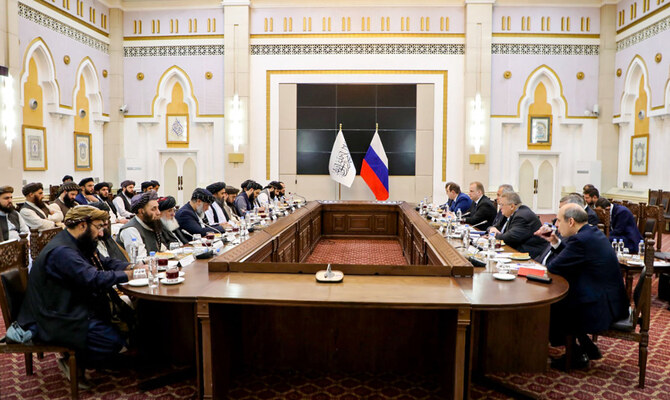
This handout photograph taken on November 25, 2024 and released by the Taliban deputy prime minister for economic affairs office shows Afghanistan's delegation (L) headed by their deputy prime minister for Economic Affairs Abdul Ghani Baradar attending a bilateral meeting with the Russian delegation headed by the secretary of Russia's Security Council Sergei Shoigu at the Chahar Chinar Palace in Kabul. (AFP)
Short Url
Updated 26 November 2024
Follow

Russia security chief meets Taliban officials in Kabul

  • Shoigu, the secretary of Russia’s Security Council, met an Afghan cohort in Kabul headed by Deputy Prime Minister for Economic Affairs Abdul Ghani Baradar

KABUL: Top Russian security official Sergei Shoigu visited Afghan government officials on Monday, assuring them Moscow will soon remove the Taliban from its list of banned organizations, Kabul said.
Since the Taliban surged back to power in 2021 visits by foreign officials have been infrequent because no nation has yet formally recognized the government of the former insurgent group.
Taliban government curbs on women have made them pariahs in many Western nations but Kabul is making increasing diplomatic overtures to its regional neighbors, emphasising economic and security cooperation.
Shoigu, the secretary of Russia’s Security Council, met an Afghan cohort in Kabul headed by Deputy Prime Minister for Economic Affairs Abdul Ghani Baradar.
He “expressed Russia’s interest in increasing the level of bilateral cooperation with Afghanistan,” Baradar’s office said in a statement released on social media site X.
“He also announced that, to expand political and economic relations between the two countries, the Islamic Emirate’s name would soon be removed from Russia’s blacklist.”
The Islamic Emirate is the name the Taliban government uses to refer to itself.
Russian news agencies quoted Shoigu as saying he wanted “constructive” ties with Kabul, without saying if he had floated Moscow removing the Taliban from its list of banned groups.
“I confirm the readiness to build a constructive political dialogue between our countries, including in order to give momentum to the process of the internal Afghan settlement,” Shoigu said, according to the RIA Novosti news agency.
He also said Russian companies plan to take part in projects in Afghanistan on extracting natural resources.
Analysts say Moscow may be eying cooperation with Kabul to counter the threat from Islamic State Khorasan (IS-K) — the Afghan-based branch of the Sunni militant group.
In March, more than 140 people were killed when IS-K gunmen attacked a Moscow concert hall.
Taliban authorities have repeatedly said security is their top domestic priority and have pledged militants staging foreign attacks will be ousted from Afghanistan.
“The Taliban certainly are our allies in the fight against terrorism,” Russia’s ambassador to Afghanistan, Dmitry Zhirnov, said in July.
“They are working to eradicate terrorist cells.”


Human rights situation in Colombia is backsliding, UN warns as nation heads into elections

Updated 2 sec ago
Follow

Human rights situation in Colombia is backsliding, UN warns as nation heads into elections

The annual report on Colombia’s human rights situation highlights a surge in attacks on rural communities by rebel groups and drug traffickers
Murders of human rights defenders increased by 9 percent last year

BOGOTA: Colombia is at risk of “reverting to the serious human rights situation” it faced before a peace deal with the nation’s largest rebel group improved security conditions, the United Nations warned Thursday, adding that an uptick of violence in rural areas could also “undermine” the nation’s upcoming elections.
The annual report on Colombia’s human rights situation highlights a surge in attacks on rural communities by rebel groups and drug traffickers as they fight over territory abandoned by the Revolutionary Armed Forces of Colombia following their 2016 peace deal with Colombia’s government.
According to the report, the number of people displaced by violence in Colombia increased by 85 percent in 2025 from the year before, with approximately 94,000 people forced to flee their homes.
Murders of human rights defenders increased by 9 percent last year alongside a 12 percent increase in the number of lockdowns imposed by armed groups on rural communities. During the lockdowns, villagers are banned from hunting or tending to their farms. Schools and businesses are also forced to shut down in small towns, disrupting the livelihoods of civilians.
“This report is an early warning,” said Scott Campbell, the Colombia representative for the United Nations High Commissioner for Human Rights. “There are a number of indicators that we are trying to draw attention to in order to prevent further degradation” of the human rights situation in Colombia.
While human rights violations in Colombia are not as numerous as they were at the height of the nation’s conflict with the FARC rebels — when an average of 300,000 people were displaced by violence each year — the report says that Colombia’s government has to take firmer actions to protect civilians from illegal groups.
One problem that persists is the forced recruitment of children by rebel groups that now use social media platforms to lure kids into their ranks.
Although the UN confirmed 150 cases of forced recruitment in 2025, the report notes this is likely an undercount, because many families are afraid to denounce these cases for fear of retaliation.
The administration of left-wing President Gustavo Petro, a former member of Colombia’s M-19 guerrilla group, has tried to reduce violence in Colombia by staging peace negotiations with the nation’s remaining rebel groups under a strategy known as “total peace.”
But often, the report notes, ceasefires between the Colombian government and rebel groups have failed to reduce attacks on civilians.
“We think it is very important that the government push for remedies to that,” Campbell said.
As Colombia prepares for upcoming elections, the report warns of a risky environment for political candidates. Last year alone, there were 18 murders of political leaders in Colombia and 126 attacks against them.
In June, conservative presidential hopeful Miguel Uribe was shot in the head during a rally in Bogota, marking the first attack against a Colombian presidential candidate in three decades. Uribe died from his injuries two months later.
“Violence and conflict, including the emergence of pre-electoral violence, have generated greater risks for the free and safe exercise of certain civil and political rights” the report said.
On March 8, Colombia will elect a new Senate and House of Representatives, with candidates competing to fill more than 300 congressional seats.
That will be followed up by a presidential election in May, in which at least half a dozen candidates are expected to run.
To improve the human rights situation in Colombia, the report said that the next administration must focus on the full implementation of the 2016 peace pact with FARC rebels.
While some parts of the deal have been implemented — including the FARC’s disarmament and the creation of a transitional justice system — others remain unfulfilled.
One of those is the creation of an agrarian jurisdiction to resolve conflicts over land. Schemes that could lure farmers away from growing coca, the base ingredient for cocaine, also require further implementation.
“It’s crucially important at this juncture ahead of elections to make sure that the current government and the future government take concrete actions to make sure that Colombia moves forward,” Campbell said.
He added that the 2016 peace deal provides a “road map” to a “Colombia of sustainable peace and respect for human rights.”