

Trumps names two Arab Americans for his Cabinet

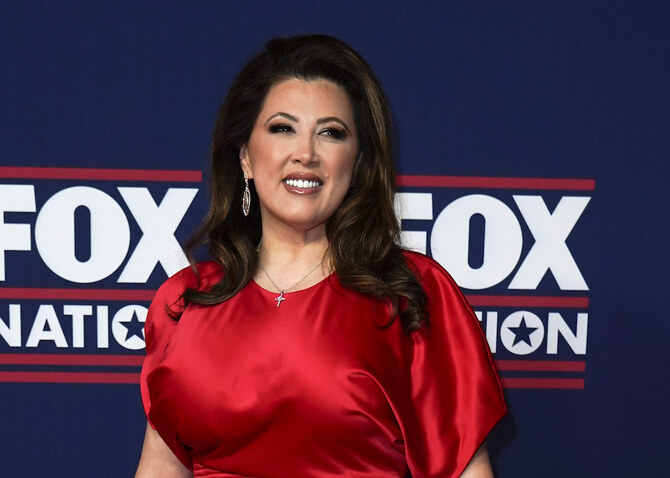
President-elect Donald Trump nominated Dr. Janette Nesheiwat to be US surgeon general . (AP)
Short Url
Updated 24 November 2024
Follow

Trumps names two Arab Americans for his Cabinet

  • President-elect Donald Trump nominated Dr. Janette Nesheiwat to be US surgeon general
  • He also nominated Dr. Marty Makary as head of the US Food and Drug Administration

CHICAGO: President-elect Donald Trump has named two Arab Americans to serve in his Cabinet once he is sworn into office in January.

Trump nominated Dr. Janette Nesheiwat to be US surgeon general and Dr. Marty Makary as head of the US Food and Drug Administration.

The appointments were applauded by Dr. Bishara Bahbah, chairman of Arab Americans for Trump, who helped the former president to win nearly half of the Arab American vote in the Nov. 5 election against US Vice President Kamala Harris.

“We are delighted with President Trump’s nomination of the first two Arab Americans to be part of his administration,” Bahbah said in a message to Arab News on Saturday.

“This is a testament to the hard work of Arab Americans for Trump and recognition of President Donald J. Trump of the role Arab Americans played in his election as the 47th president of the United States. AAFT looks forward to additional Arab American appointments in President Trump’s administration, particularly in the political field.”

Dr. Makary is a British American surgeon of Lebanese background. He is a public policy researcher at Johns Hopkins University serving as a professor at the Johns Hopkins School of Medicine and a professor, by courtesy, at the Johns Hopkins Carey Business School.

His current research focuses on the underlying causes of disease, public policy, health care costs, and relationship-based medicine. Dr. Makary previously served in leadership at the World Health Organization patient safety program and has been elected to the National Academy of Medicine.

Clinically, Dr. Makary is the chief of Islet Transplant Surgery at Johns Hopkins. He is the recipient of the Nobility in Science Award from the National Pancreas Foundation and has been a visiting professor at more than 25 medical schools. He has published more than 250 peer-reviewed scientific articles and has served on several editorial boards. He is the author of two New York Times bestselling books, “Unaccountable” and “The Price We Pay.”

Dr. Makary is also an anti-vaxxer who refused vaccination for COVID-19, a view shared by many of President-elect Trump’s conservative and Republican supporters.

Dr. Nesheiwat is a double board-certified medical doctor described on her website as “bringing a refreshingly no-nonsense attitude to the latest medical news, breaking down everything you need to know to keep you — and your family — healthy at all times.” She is also the author of “Beyond the Stethoscope: Miracles in Medicine.”

A graduate of the University of Arkansas for Medical Sciences, UAMS, Dr. Nesheiwat has been “shaped by her faith and her upbringing.”

Born in Carmel, New York, she is the daughter of Christian Jordanian immigrants and one of five children raised by her widowed mother, Hayat Nesheiwat. Her siblings are Julia Nesheiwat, Jaclyn Stapp, Dina Nesheiwat and Daniel Nesheiwat.


African Union rejects ‘any recognition of Somaliland’ after Israel declaration

A man holds a flag of Somaliland in front of the Hargeisa War Memorial monument in Hargeisa on November 7, 2024. (AFP)
Updated 45 min 5 sec ago
Follow

African Union rejects ‘any recognition of Somaliland’ after Israel declaration

  • Egypt’s foreign ministry said its top diplomat had spoken with his counterparts from Turkiye, Somalia and Djibouti, who together condemned the move and emphasized “their full support for the unity, sovereignty and territorial integrity of Somalia”
  • Israel repeatedly hit targets in Yemen after the Gaza war broke out in October 2023, in response to Houthi attacks on Israel that the rebels said were in solidarity with Palestinians in the Gaza Strip

NAIROBI: The African Union on Friday said it “rejects any recognition of Somaliland” after Israel declared it viewed the breakaway Somali territory as a sovereign state.
In a statement issued by its head, Mahamoud Ali Youssouf, the AU called for African borders to be respected and said: “Any attempt to undermine the unity, sovereignty, and territorial integrity of Somalia... risks setting a dangerous precedent with far-reaching implications for peace and stability across the continent.”
The chief of the pan-African body, which counts Somalia as a member, said he “firmly rejects any initiative or action aimed at recognizing Somaliland as an independent entity” and stating that Somaliland “remains an integral part of the Federal Republic of Somalia.”

While, Somalia reacted angrily on Friday after Israel formally recognized its northern region of Somaliland as an “independent and sovereign state” — the first country to do so.
Somaliland, which declared independence from Somalia in 1991, has for decades pushed for international recognition, which has been the key priority for president Abdirahman Mohamed Abdullahi since he took office last year.
But a Somali foreign ministry statement warned that the decision was “deliberate attack” on its sovereignty that would undermine peace in the region. Several other countries also condemned Israel’s decision.
Israeli Prime Minister Benjamin Netanyahu’s office said he announced “the official recognition of the Republic of Somaliland as an independent and sovereign state,” making Israel the first country to do so.
“The declaration is in the spirit of the Abraham Accords,” Netanyahu’s office said, referring to several agreements between Israel and Arab countries brokered by US President Donald Trump during his first presidency to normalize ties with Israel.
It said Netanyahu had invited Abdullahi to visit.
Hailing Israel’s decision, Abdullahi said in a post on X that it marked the beginning of a “strategic partnership.”
“This is a historic moment as we warmly welcome” he said, affirming “Somaliland’s readiness to join the Abraham Accords,” he added.
In Hargeisa, the capital of Somaliland, crowds of people took to the streets to celebrate, many carrying the flag of the breakaway state, said sources.

- ‘Illegitimate actions’ -

Somalia’s foreign ministry said: “Illegitimate actions of this nature seriously undermine regional peace and stability, exacerbate political and security tensions, in the Horn of Africa, the Red Sea and Gulf of Aden, the Middle East and the wider region.”
Turkiye, a close ally of Somalia, also condemned the move.
“This initiative by Israel, which aligns with its expansionist policy... constitutes overt interference in Somalia’s domestic affairs,” it said in a foreign ministry statement.
Egypt’s foreign ministry said its top diplomat had spoken with his counterparts from Turkiye, Somalia and Djibouti, who together condemned the move and emphasized “their full support for the unity, sovereignty and territorial integrity of Somalia.”
In video showing Netanyahu speaking to Abdullahi by telephone, the Israeli leader said: “I want you to know that I am signing now as we speak Israel’s official recognition of the Somaliland,” adding that the new relationship would offer economic opportunities.
“I am very, very happy and I am very proud of this day and I want to wish you and the people of Somaliland the very, very best,” he said.
Netanyahu also said that he would communicate to Trump Abdullahi’s “willingness and desire to join the Abraham accords.”
A self-proclaimed republic, Somaliland enjoys a strategic position on the Gulf of Aden, has its own money, passports and army. But since its unilateral declaration of independence in 1991, it has grappled with decades of isolation.

- Strategic -

Analysts say matters of strategy were behind Israel’s drive to recognize Somaliland.
“Israel requires allies in the Red Sea region for many strategic reasons, among them the possibility of a future campaign against the Houthis,” said the Institute for National Security Studies in a paper last month, referring to Yemen’s Iran-backed rebels.
“Somaliland is an ideal candidate for such cooperation as it could offer Israel potential access to an operational area close to the conflict zone,” it said, adding there were also economic motives.
Israel repeatedly hit targets in Yemen after the Gaza war broke out in October 2023, in response to Houthi attacks on Israel that the rebels said were in solidarity with Palestinians in the Gaza Strip.
The Houthis have halted their attacks since a fragile truce began in Gaza in October.
Somaliland’s lack of international recognition has hampered access to foreign loans, aid and investment, and the territory remains deeply impoverished.
A deal between landlocked Ethiopia and Somaliland last year to lease a stretch of coastline for a port and military base enraged Somalia.
Israel has been trying to bolster relations with countries in the Middle East and Africa.
Historic agreements struck late in Trump’s first term in 2020 saw several countries including Muslim-majority United Arab Emirates and Morocco normalize relations with Israel, but wars that have stoked Arab anger, particularly in Gaza, have hampered recent efforts.