Haider tank, Shahpar fighter drone in spotlight as Pakistan’s top defense expo concludes 

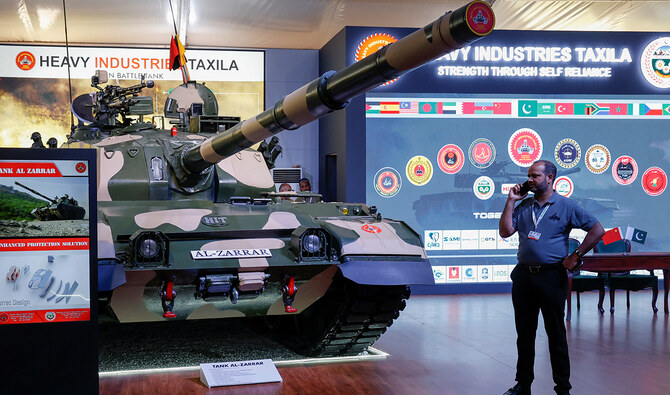
A visitor uses his mobile phone while visiting the stall of the AL-Zarrar tank on display during the International Defense Exhibition and Seminar “IDEAS 2024” in Karachi on November 21, 2024. (REUTERS)
Short Url
Updated 22 November 2024
Follow

Haider tank, Shahpar fighter drone in spotlight as Pakistan’s top defense expo concludes 

  • Exhibition hosted over 550 exhibitors and 350 civil and military officials from 55 countries
  • IDEAS has been held biennially since 2000 and grown into a key event for defense sector

ISLAMABAD: Pakistan’s top defense exhibition IDEAS 2024 will conclude today, Friday, with the locally manufactured third-generation Haider tank and Shahpar fighter drone among the South Asian nation’s main showpieces. 
IDEAS has been held biennially since 2000 and has since grown into a key event for the Pakistani defense sector. This year’s show, running from Nov.19-Nov. 22 in Karachi, hosted over 550 exhibitors, including 340 international defense companies, and more than 350 civil and military officials from 55 countries.
On the first day of the expo, Pakistan launched the Haider tank, locally produced at the Heavy Industry Taxila in collaboration with local and international technology partners. The tank has auto-tracking, a remote-control weapons system and a 470-kilometer cruising range.
The Shahpar-III drone capable of flying at 35,000 feet and carrying heavy weapons such as bombs, cruise missiles and torpedoes, was also launched at the exhibition. 
“I had no prior knowledge about these products, but upon visiting, I was astonished to discover such a top-class range of items being exported abroad,” Muhammad Mohsin, a visitor, told media.
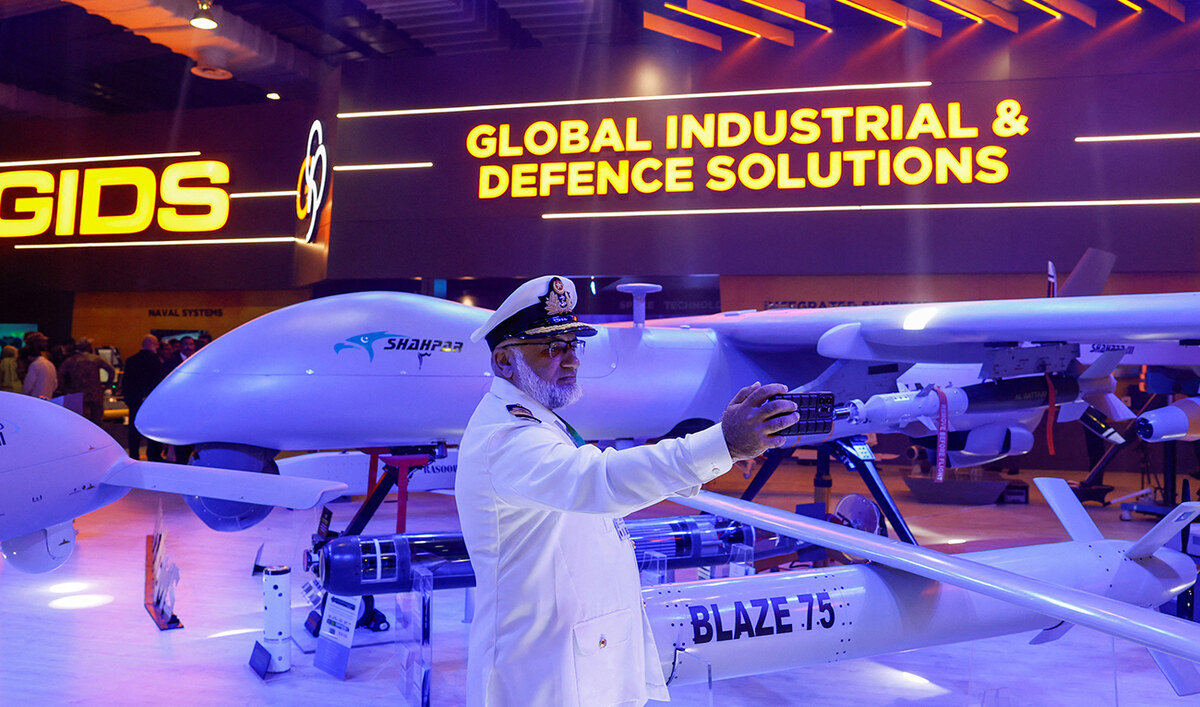


A member of Pakistan armed forces takes a selfie with Global Industrial & Defense Solutions (GIDS) Shahpar, unmanned combat aerial vehicle (UCAV) during the International Defense Exhibition and Seminar “IDEAS 2024” in Karachi on November 21, 2024. (REUTERS)

“These products, manufactured in Sialkot, Gujranwala, and Karachi, truly showcase exceptional craftsmanship. It is imperative that these remarkable offerings gain greater recognition in international markets.”
Mohsin said he was unaware that Pakistan was exporting a “top-class range of items” in the defense sector until he attended this year’s IDEAS.
The Shahpar-III is a successor to the Shahpar-II drone, which could fly up to 20 hours at a maximum altitude of 23,000 feet, according to Global Industrial Defense Solutions (GIDS), a state-owned Pakistani defense conglomerate that has developed the drones. The Shahpar-III can fly up to 35,000 feet for 24 hours and carry a payload of up to 500 kilograms.
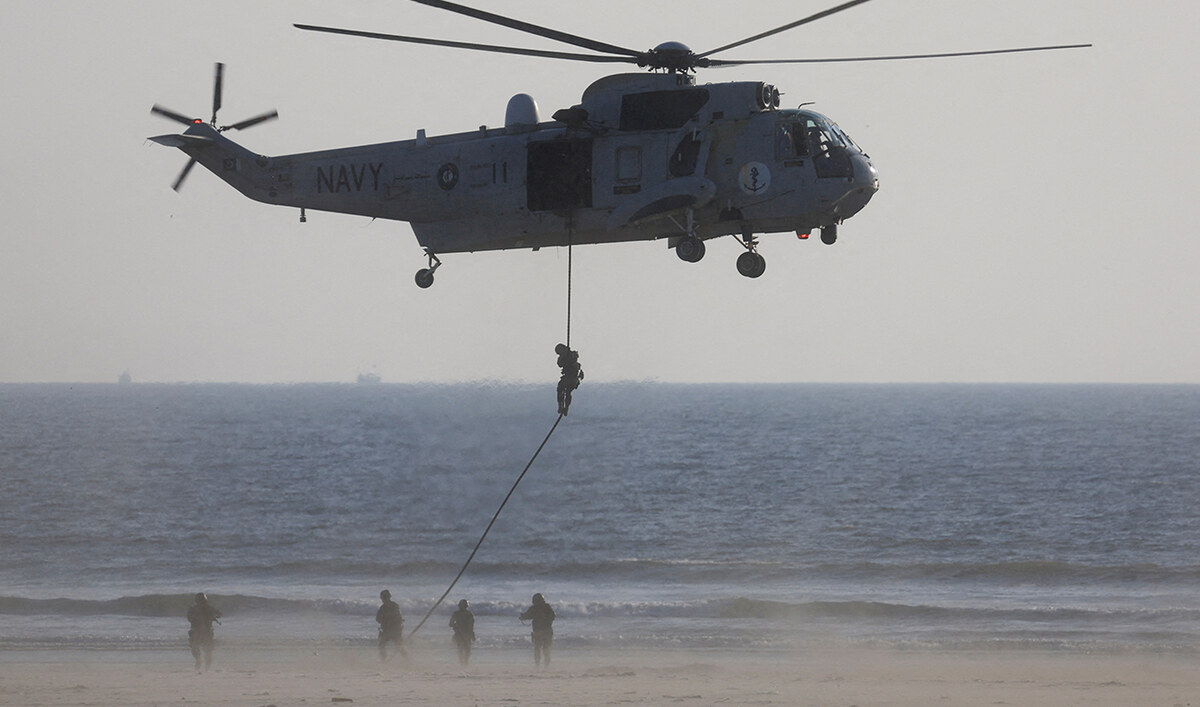


Members of the Pakistan Navy special force conduct a counter-terrorism demo during the International Defense Exhibition and Seminar “IDEAS 2024” in Karachi on November 21, 2024. (REUTERS)

GIDS, which exports its products to 14 countries including Saudi Arabia and the United Arab Emirates, introduced Shahpar-II in 2021.
“This [Shahpar-III] has a more strategic value to an armed force in comparison to Shahpar-II,” Asad Kamal, Chief Executive Officer of GIDS, told Arab News, adding that the drone would soon be inducted into the Pakistan Air Force.
“Shahpar-III is a natural step up when you’re making UAVs drones.”
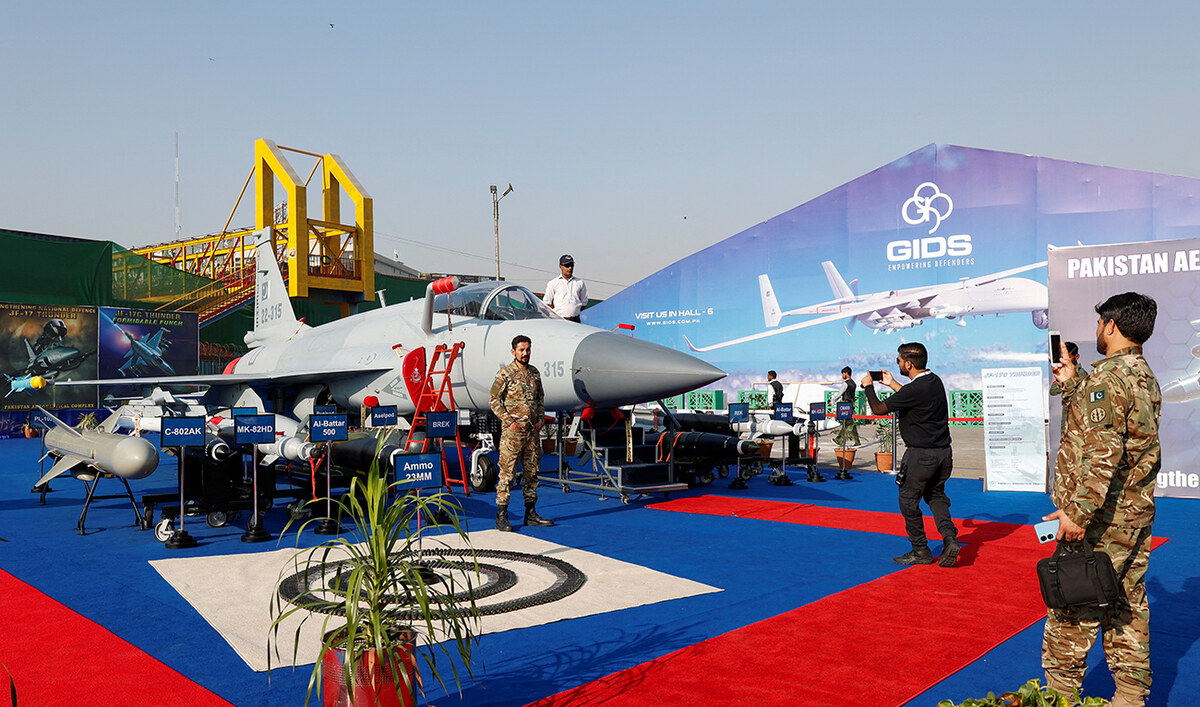


Officials and people take pictures with a JF17 Thunder fighter jet during the International Defense Exhibition and Seminar “IDEAS 2024” in Karachi on November 21, 2024. (REUTERS)

Kamal said the drone could see targets at night and “take out on the enemy” with heavy weapons. 
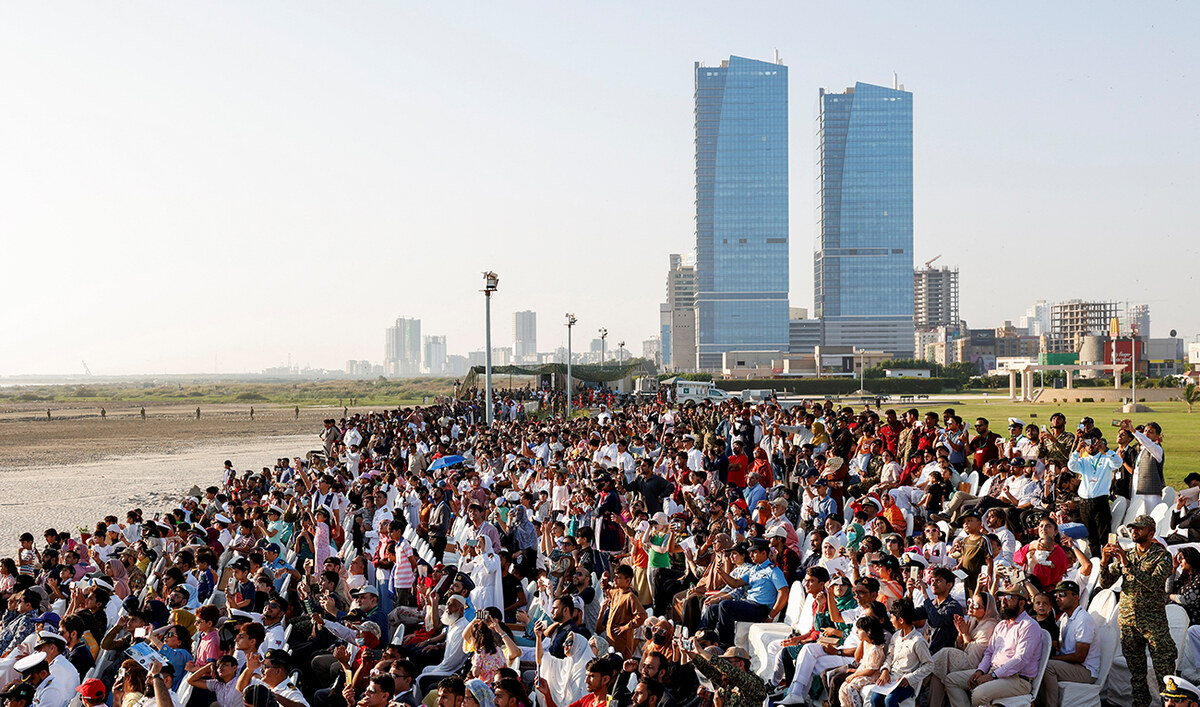


Members of Pakistan armed forces and their families look at a counter-terrorism demo during the International Defense Exhibition and Seminar “IDEAS 2024” in Karachi on November 21, 2024. (REUTERS)
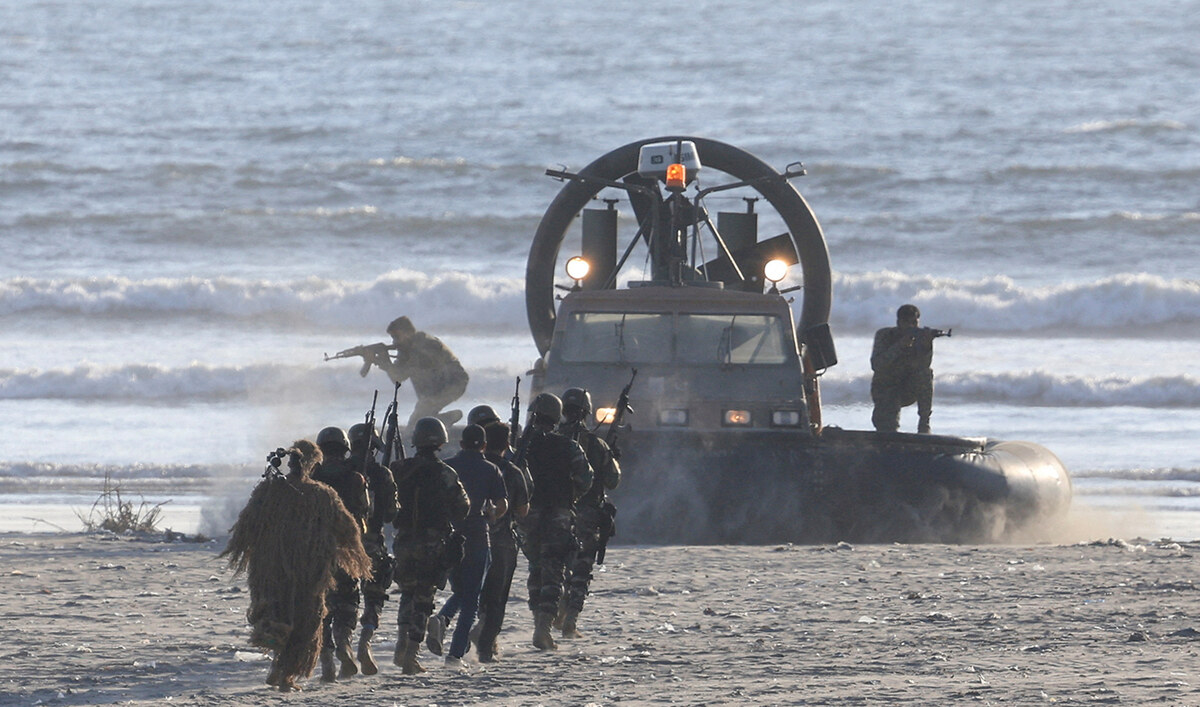


Members of the Pakistan Navy special force conduct a counter-terrorism demo during the International Defense Exhibition and Seminar “IDEAS 2024” in Karachi on November 21, 2024. (REUTERS)

“That means that from your own borders, you can launch a cruise missile from an unpiloted plane,” he added. “That cruise missile has a range of 250 kilometers. So, it can give any force a lot of firepower value by having this sort of a weapon in its arsenal.”
With inputs from AFP


Pakistan says responding to Afghan ‘offensive operations’ after border fire as tensions escalate

Updated 26 February 2026
Follow

Pakistan says responding to Afghan ‘offensive operations’ after border fire as tensions escalate

  • Afghan Taliban spokesperson says “large-scale offensive operations” launched against Pakistani military bases
  • Pakistan says Afghan forces opened “unprovoked” fire across multiple sectors along shared border

ISLAMABAD: Afghanistan’s Taliban authorities said on Thursday they had launched “large-scale offensive operations” against Pakistani military bases and installations, prompting Pakistan to say its forces were responding to what it described as unprovoked fire along the shared border.

The escalation follows Islamabad’s weekend airstrikes targeting what it said were Tehreek-e-Taliban Pakistan (TTP) and Daesh militant camps inside Afghanistan in response to a wave of recent bombings and attacks in Pakistan. Islamabad said the strikes killed over 100 militants, while Kabul said dozens of civilians were killed and condemned the attacks as a violation of its sovereignty.

In a post on social media platform X, Afghan government spokesperson Zabihullah Mujahid said Afghanistan had launched “large-scale offensive operations” in response to repeated violations by the Pakistani military.


Pakistan’s Ministry of Information said Afghan forces had initiated hostilities along multiple points of the frontier.

“Afghan Taliban regime unprovoked action along the Pakistan–Afghanistan border given an immediate, and effective response,” the ministry said in a statement.

The statement said Pakistani forces were targeting Taliban positions in the Chitral, Khyber, Mohmand, Kurram and Bajaur sectors, claiming heavy Afghan casualties and the destruction of multiple posts and equipment. It added that Pakistan would take all necessary measures to safeguard its territorial integrity and the security of its citizens.


Separately, security officials said Pakistani forces had carried out counterattacks in several border sectors.

“Pakistan’s security forces are giving a befitting reply to the unprovoked Afghan aggression with full force,” a security official said, declining to be named. 

“The Pakistani security forces’ counter-attack destroyed Taliban’s hideouts and the Khawarij fled,” they added, referring to TTP militants. 

The claims from both sides could not be independently verified.

Cross-border violence has intensified in recent weeks, with Pakistan blaming a surge in suicide bombings and militant attacks on militants it says are based in Afghanistan. Kabul denies providing safe havens to anti-Pakistan militant groups.

The clashes mark the third major escalation between the neighbors in less than a year. Similar Pakistani strikes last year triggered weeklong clashes before Qatar, Türkiye and other regional actors mediated a ceasefire in October.

The 2,600-kilometer (1,600-mile) frontier, a key trade and transit corridor linking Pakistan to landlocked Afghanistan and onward to Central Asia, has faced repeated closures amid tensions, disrupting commerce and humanitarian movement. Trade between the two nations has remained closed since October 2025.