

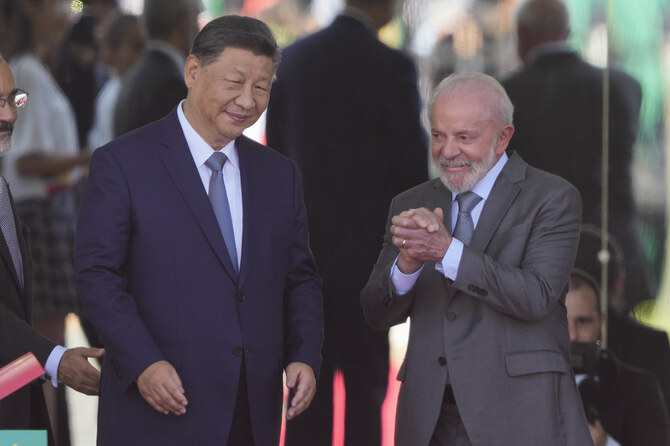
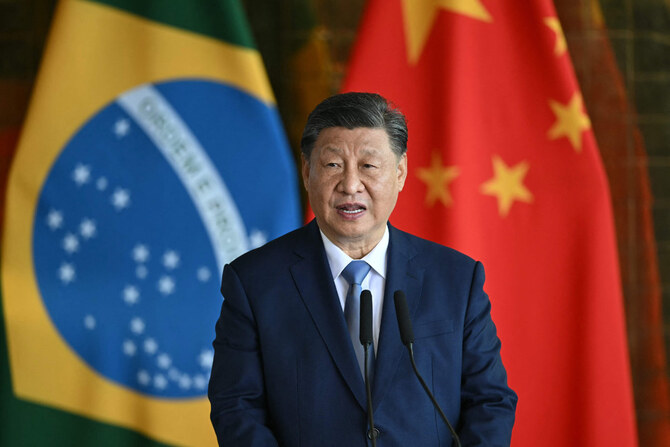

BRASILIA: Chinese leader Xi Jinping urged “more voices” to end the Ukraine war and a ceasefire in Gaza, as he conducted a state visit to Brazil’s capital, Chinese state media said.
Brazilian President Luiz Inacio Lula da Silva echoed those points as he met with Xi in a red-carpet welcome in Brasilia, and stressed a joint roadmap for peace in Ukraine that they are proposing.
“In a world plagued by armed conflicts and political strife, China and Brazil put peace, diplomacy and dialogue first,” Lula said.
Xi said he wanted to see “more voices committed to peace to pave the way for a political solution to the Ukraine crisis,” the Chinese state news agency Xinhua reported.
He also called for “a ceasefire and an end to the war at an early date” in Gaza, the agency said.
On Ukraine, the China-Brazil roadmap for mediating peace has been endorsed by Russia — which is China’s ally — but rejected by Kyiv and its Western backers.
The Chinese president’s appeal for a halt to fighting in Gaza — where Israel is pressing an offensive against Hamas — echoed one he and the other G20 leaders made during a summit held Monday and Tuesday in Rio.
That summit’s joint statement called for a “comprehensive” ceasefire in both Gaza and Lebanon, where Israel is also waging an offensive against the Iran-backed Hezbollah group.
On Wednesday, the UN Security Council held a vote on a resolution calling for “an immediate, unconditional and permanent ceasefire” in Gaza, but it was vetoed by Israel’s ally the United States.
Shrinking US influence
Xi’s state visit to Brasilia showcased closer relations between the biggest economies in Asia and Latin America, which analysts said also reflected shrinking US influence.
The two leaders signed 35 cooperation accords on areas including agriculture, trade, technology and environmental protection.
Xi said China-Brazil relations “are at their best in history” and the two countries are now “reliable friends,” according to Xinhua.
Lula said he believed the growing Brazil-China ties “will exceed all expectations and pave the way for a new phase of bilateral relations.”
He added that he looked forward to welcoming Xi to Brazil again next July for a BRICS summit.
The Chinese leader figured prominently at the G20 summit, and at an APEC one held last week in Peru — in contrast with outgoing US President Joe Biden, who cut a spectral figure.
Fellow leaders looked past Biden, politically, to the coming US presidency of Donald Trump, which starts January 20.
“Xi Jinping is clearly looking to fill the vacuum that will come following the election of Trump, who does not value multilateralism,” Oliver Stuenkel, an international relations expert at Brazil’s Getulio Vargas Foundation think tank, told AFP.
Brazil's balancing act
China is Brazil’s biggest trading partner, with two-way commerce exceeding $160 billion last year.
The South American agricultural power sends mainly soybeans and other primary commodities to China, while the Asian giant sells Brazil semiconductors, telephones, vehicles and medicines.
Since returning to power in early 2023, Lula has sought to balance efforts to improve ties with both China and the United States.
A visit to Beijing this year by Vice President Geraldo Alckmin was seen as paving the way for Brazil to potentially join China’s Belt and Road Initiative to stimulate trade — a central pillar of Xi’s bid to expand China’s clout overseas.
But there was no announcement in that direction during Xi’s visit. Instead both leaders spoke of finding “synergies” between that Chinese program and Brazil’s own infrastructure development program.
South American nations that have signed up to Beijing’s initiative include Argentina, Chile, Bolivia, Ecuador, Peru, and Venezuela.
One of the accords signed Wednesday was on Brazil opening its market to a Chinese satellite company, SpaceSail, that competes with Starlink, founded and run by South African-born US billionaire Elon Musk, which already covers remote Brazilian regions.
Musk has a turbulent history with Brazil, whose courts forced his social media platform X to comply with national laws against disinformation.


