ISSAQUAH, Wash: A major storm swept across the U.S. Northwest battering the region with strong winds and rain, causing widespread power outages, closing schools and downing trees that killed at least two people.
The Weather Prediction Center issued excessive rainfall risks through Friday and hurricane-force wind warnings were in effect as the strongest atmospheric river — a large plume of moisture — that California and the Pacific Northwest has seen this season overwhelmed the region. The storm system that hit starting Tuesday is considered a “ bomb cyclone,” which occurs when a cyclone intensifies rapidly.
In California, the weather service extended a flood watch into Saturday for areas north of San Francisco. Up to 16 inches of rain (40 cm) was forecast in northern California and southwestern Oregon through Friday. Dangerous flash flooding, rock slides and debris flows were possible, officials warned.
A winter storm watch was in place for the northern Sierra Nevada above 3,500 feet (1,066 meters), where 15 inches (28 cm) of snow was possible over two days. Wind gusts could top 75 mph (120 kph) in mountain areas, forecasters said.
Heavy, wet snow was expected to continue along the Cascades and in parts of far northern California. Forecasters warned of blizzard and whiteout conditions and near impossible travel at pass level due to accumulation rates of 2 to 3 inches (5 to 7.6 centimeters) per hour and wind gusts of up to 65 mph (105 kph).
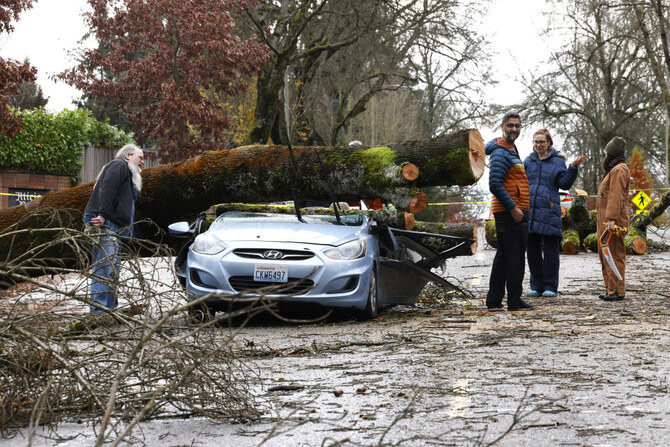
Falling trees struck homes and littered roads across western Washington. In Lynnwood, a woman died Tuesday night when a large tree fell on a homeless encampment, South County Fire said in a statement. In Bellevue, east of Seattle, a tree fell onto a home, killing a woman Tuesday night, fire officials said.
Tracy Meloy of Issaquah, Washington, felt well-prepared for the storm Tuesday afternoon, with dinner prepped and lanterns ready. But then she spent the night listening to wind-whipped debris hit the outside of her home, including a particularly loud “thump” around 9 p.m. On Wednesday morning she ventured outside to survey the damage to her neighborhood about 17 miles (27 kilometers) east of Seattle.
“Now that I’m standing here in front of the house, I can tell it’s the tree that was across the street,” Meloy said. The tree pulled down the power lines in front of her home. Limbs, leaves and other plants were strewn all over the road.
“It looks like a forest floor instead of a street,” she said.
The number of power outage reports in Washington fluctuated wildly Tuesday evening, but steadily declined to about 460,000 by Wednesday afternoon, according to poweroutage.us. More than a dozen schools were closed in Seattle alone.
About 2,800 customers were reported to be without power Wednesday in Oregon, 38,000 in California and 10,000 around Carson City and Reno, Nevada. Three Reno schools were closed and semi-trucks were prohibited on the main highway between the two cities due to high winds. All chairlifts were shut down at the Mt. Rose Ski Resort near Lake Tahoe.
The first significant snow of the season in the Dakotas and Minnesota led to accidents and slippery roadways. The weather service said up to 16 inches (40 cm) of snow could fall in the Turtle Mountains of North Dakota, and Minot could get up to 8 inches (20 cm) of snow. Winds were expected to be problematic in parts of Montana and Nebraska, with gusts up to 60 mph (97 kph), the weather service said.
Officials briefly advised no travel throughout northern North Dakota due to the wintry weather. State troopers in northern Minnesota responded to several accidents, including tractor-trailers that jackknifed on Interstate 94 after the roadway became slippery from snow and ice. The storm was contributing to high wind conditions in Juneau, Alaska, where gusts of up to 60 mph (96 kph) were expected.
The weather service warned people on the West Coast about the danger of trees during high winds, posting on X, “Stay safe by avoiding exterior rooms and windows and by using caution when driving.”
Southbound Interstate 5 was closed for an 11-mile (18-kilometer) stretch from Ashland, Oregon, to the border with California on Wednesday morning due to extreme winter weather conditions in northern California, according to the Oregon Department of Transportation. It was expected to be a long-term closure, the department said.
The weather service issued a flood watch for parts of southwestern Oregon through Friday evening, while rough winds and seas halted a ferry route in northwestern Washington between Port Townsend and Coupeville for part of the day.
Robert and Lisa Haynes, of Issaquah, Washington, surveyed the damage in their neighborhood Wednesday. Fallen branches or trees blocked driveways and roads, and they were stuck at home.
“It's like a snow day,” Robert Haynes said, “but with no snow.”


![]()

‘Bomb cyclone’ kills 2 and knocks out power to over half a million homes across the Northwest US
Short Url
https://arab.news/bcavf
‘Bomb cyclone’ kills 2 and knocks out power to over half a million homes across the Northwest US
Latest updates


© 2026 SAUDI RESEARCH & PUBLISHING COMPANY, All Rights Reserved And subject to Terms of Use Agreement.