WASHINGTON: President Joe Biden has been notably quiet since the Democrats’ gut-wrenching defeat at the polls.
After warning voters for years that a Donald Trump win would be calamitous for American democracy, Biden has gone largely silent on his concerns about what lays ahead for America and he has yet to substantively reflect on why Democrats were decisively defeated up and down the ballot.
His only public discussion of the outcome of the election came in a roughly six-minute speech in the Rose Garden two days after the election, when he urged people to “see each other not as adversaries but as fellow Americans” and to “bring down the temperature.” Since then, there’s been hardly a public peep — including over the course of Biden’s six-day visit to South America that concluded on Tuesday evening. His only public comments during the trip came during brief remarks before meetings with government officials.
At a delicate moment in the US — and for the world — Biden’s silence may be leaving a vacuum. But his public reticence has also underscored a new reality: America and the rest of the world is already moving on.
“His race is over. His day is done,” said David Axelrod, who served as a senior adviser in the Obama-Biden White House. “It’s up to a new generation of leaders to chart the path forward, as I’m sure they will.”
Edward Frantz, a historian at the University of Indianapolis, said Biden’s relative silence in the aftermath of the Republican win is in some ways understandable. Still, he argued, there’s good reason for Biden to be more active in trying to shape the narrative during his final months in office.
“The last time a president left office so irrelevant or rejected by the populace was Jimmy Carter,” said Frantz, referring to the last one-term Democrat in the White House. “History has allowed for the great rehabilitation of Carter, in part, because of all he did in his post-presidency. At 82, I’m not sure Biden has the luxury of time. The longer he waits, the longer he can’t find something to say, he risks ceding shaping his legacy at least in how he’s seen in the near term.”
Biden’s allies say the president — like Democrats writ large — is privately processing the election defeat, stressing that it’s barely been two weeks since Trump’s win. Biden hasn’t been vocally introspective about his role in the loss, and still has a lot to unpack, they said.
Biden, in his speech after the election, said: “Campaigns are contests of competing visions. The country chooses one or the other. We accept the choice the country made. I’ve said many times you can’t love your country only when you win. You can’t love your neighbor only when you agree.”
Biden’s aides say the president’s insistence on following electoral traditions — ensuring an orderly transition and inviting Trump to the White House — is especially important because Trump flouted them four years ago, when he actively tried to overturn the results of the election he lost and helped incite a mob that rioted at the US Capitol.
But that doesn’t mean Biden isn’t privately stewing over the results even as he doesn’t say much in public.
During his six-day visit to Peru and Brazil for meetings with global leaders, Biden declined to hold a news conference — typically a set piece for American presidents during such travel. Biden already was far less likely to hold news conferences than his contemporaries, but his staff often points to off-the-cuff moments when he answers questions from reporters who travel everywhere with him. In this case, he’s yet to engage even in an impromptu Q&A on the election or other matters.
And notably this week, Biden left it to allies Emmanuel Macron of France and Justin Trudeau of Canada to offer public explanations of his critical decision to loosen restrictions on Ukraine’s use of longer-range American weapons in its war with Russia.
Biden, for whom Ukraine has been a major focal point of his presidency, had long been concerned about escalation should the US relax restrictions, and was cognizant of how Moscow might respond had he seemed to be thumping his chest at President Vladimir Putin. But Ukraine has also been a touchy subject because of Trump, who has claimed he’d end the war immediately and has long espoused admiration for Putin.
The GOP victory — Trump won both the popular vote and Electoral College count, and Republicans won control of Congress — comes as the president and Vice President Kamala Harris have both sounded dire alarms over what a Trump presidency might mean. Harris called Trump a fascist. Biden told Americans the very foundation of the nation was at stake, and he said world leaders, too, were concerned.
“Every international meeting I attend,” Biden said after a trip in September to Germany, “they pull me aside — one leader after the other, quietly — and say, ‘Joe, he can’t win. My democracy is at stake.’”
His voice rising, Biden then asked if “America walks away, who leads the world? Who? Name me a country.”
Perhaps the most important moment of his time in South America was a bilateral meeting with Chinese President Xi Jinping on the sidelines of the Asia-Pacific Economic Cooperation summit in Peru. His public comments at the start of that meeting were notably more backward looking than Xi’s, the leader of America’s most powerful geopolitical competitor.
“I’m very proud of the progress we’ve both made together,” said Biden, fondly recalling a visit near the Tibetan plateau with Xi years ago. He added, “We haven’t always agreed, but our conversations have always been candid and always been frank. We have never kidded one another. We’ve been level with one another. And I think that’s vital.”
Xi, by contrast, looked past Biden in his remarks and sought to send a clear message to Trump.
“China is ready to work with the new US administration to maintain communication, expand cooperation, and manage differences so as to strive for a steady transition of the China-US relationship for the benefit of the two peoples,” Xi said, while urging American leadership to make a “wise choice” as it manages the relationship.
The president also seemed in no mood to engage with reporters throughout his time in South America. Since Election Day, he’s only briefly acknowledged media questions twice.
In one of those exchanges, he responded to a question from an Israeli reporter about whether he believed he could get a ceasefire deal in Gaza done before he leaves office with a sarcastic reply: “Do you think you can keep from getting hit in the head by a camera behind you?”
The terse answers and silence haven’t stopped reporters from trying to engage him.
Over the course of his time in South America, he ignored questions about his decisions on providing anti-personnel mines to Ukraine, reflections on the election, and even why he’s not answering questions from the press.
As he got ready to board Air Force One in Rio de Janeiro on Tuesday to make his way home, one reporter even tried endearing herself to the president by pointing to Biden’s 82nd birthday on Wednesday.
“Mr. President, happy early birthday! For your birthday, will you talk to us, sir?” the reporter said. “As a gift to the press will you please talk to us? Mr. President! President Biden, please! We haven’t heard from you all trip!”
Biden got on the plane without answering.


![]()

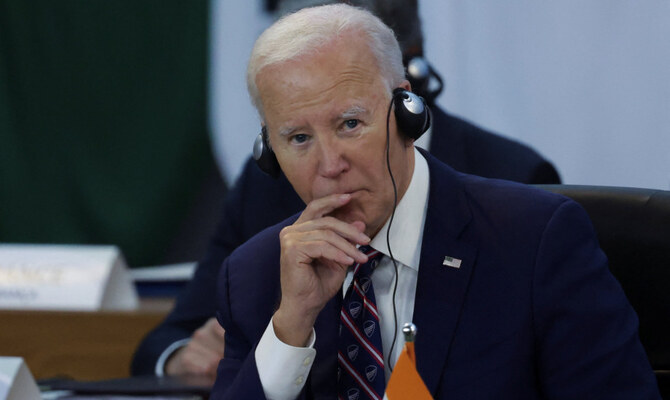
Biden has become notably quiet after the 2024 election and Democrats’ loss
Short Url
https://arab.news/g89kt
Biden has become notably quiet after the 2024 election and Democrats’ loss
- During his six-day visit to Peru and Brazil for meetings with global leaders, Biden declined to hold a news conference — typically a set piece for American presidents during such travel


Latest updates


© 2026 SAUDI RESEARCH & PUBLISHING COMPANY, All Rights Reserved And subject to Terms of Use Agreement.