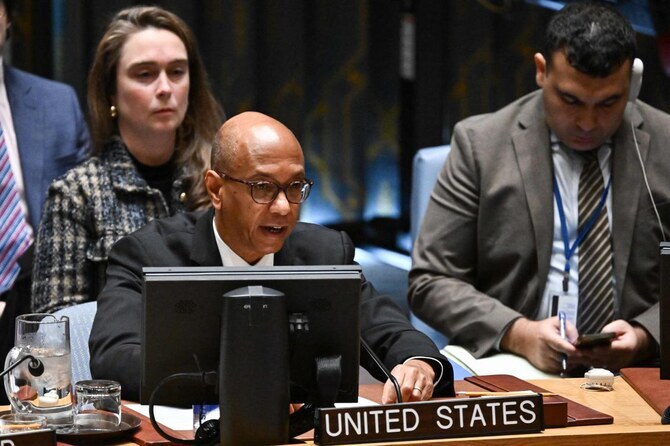

NEW YORK CITY: The US on Wednesday used the power of veto it holds as one of the five permanent member of the UN Security Council to block a resolution demanding “an immediate, unconditional and permanent ceasefire” in Gaza and “the immediate and unconditional release of all hostages.”
The resolution was put forward by the 10 elected, non-permanent members of the council. The US was the only one of the 15 members not to vote in favor of it.
The text of the resolution also called for the “safe and unhindered entry of humanitarian assistance at scale” to Gaza, including besieged areas in the north of the territory, and denounced any attempt to deliberately starve the population there.
More than 44,000 Palestinians have been killed since Israel’s war in Gaza began in October last year, and the UN says that in excess of 70 percent of the verified deaths were among women and children. More than 130,000 people have been injured. The UN believes these figures to be an underestimate, given that scores of bodies are thought to be buried under the rubble of destroyed or damaged buildings.
The war has also displaced almost the entire population of the enclave, resulting in a humanitarian catastrophe.
On Monday, the UN’s Special Committee to Investigate Israeli Practices presented a report to the General Assembly in which it said the methods of warfare employed by Israel in Gaza, including the use of starvation as a weapon, the mass civilian casualties and the life-threatening conditions deliberately inflicted on Palestinians, are consistent with the characteristics of genocide.
After the Security Council failed to adopt the resolution on Wednesday, Majed Bamya, the Palestinian deputy ambassador to the UN, told its members that they were witnessing an attempt “to annihilate a nation” and yet the “very tools designed to respond (to this are) not being used.”
He added: “Maybe for some we have the wrong nationality, the wrong faith, the wrong skin color, but we are humans and we should be treated as such.
“Is there a UN Charter for Israel that is different from the charter you all have? Is there an international law for them? An international law for us? Do they have the right to kill and the only right we have is to die?
“What more can (Israel) do for this council to act under Chapter 7? Or will this council be the last place on earth that cannot recognize a threat to peace when they see it?”
Chapter 7 of the UN Charter relates to action that can be taken by member states in response to threats to peace and acts of aggression.
Israel’s ambassador to the UN, Danny Danon, told council members: “Today, a shameful attempt to abandon our kidnapped men and women by the UN was prevented. Thanks to the US, we stood firm with our position that there will be no ceasefire without the release of the hostages. We will continue in this struggle until everyone returns home.”
Robert Wood, the deputy US ambassador, said that an unconditional ceasefire would mean acceptance by the Security Council of Hamas remaining in power in Gaza.
“The United States will never accept this,” he added. “Rather than adopting a resolution that emboldens Hamas, let’s instead demand Hamas implement Resolution 2735 without further condition or delay.
“Let’s continue to ensure Israel facilitates additional humanitarian aid into Gaza, and let's work to bring a durable end to the suffering and misery of Hamas’ many victims."
Security Council Resolution 2735, which was adopted in June, calls on Hamas to accept a proposed hostage and ceasefire agreement with Israel.
British envoy Barbara Woodward, whose country holds the rotating presidency of the council this month, expressed regret over the failure of the council to adopt the resolution but vowed to “keep striving, alongside our partners, to bring this war to a close.”
She said: “The deterioration of the humanitarian situation in Gaza is catastrophic and unacceptable. All of Gaza is at risk of famine, and in some areas this is likely to be imminent. Yet the aid reaching civilians remains entirely insufficient to mitigate this unfolding disaster.
“The unthinkable hardship that civilians are already facing in Gaza is set to get even worse as winter approaches.”
Woodward urged Israeli authorities to take “urgent action to alleviate this crisis. International humanitarian law must be respected by all sides.”
China’s ambassador to the UN, Fu Cong, said that even with the imminent threat of famine in Gaza, “the United States always seems to be able to find a justification to defend Israel.” It is a stance that represents a distortion of international humanitarian law, he added.
“People keep learning something new they never knew before was possible, and how low one can stoop. No wonder people feel angry,” said Fu.
“People’s indignation also stems from the fact that the continued supply of weapons from the US (to Israel) has become a decisive factor in the war lasting so long, causing so many casualties and so much destruction.”
He added: “All hostages must be released. An immediate and unconditional ceasefire must be established. Both are important factors. There should be no conditionality. They cannot be linked to each other because facts have shown that Israel’s military operations in Gaza have long exceeded the scope of rescuing hostages.
“Insistence on setting a precondition for ceasefire is tantamount to giving the green light to continuing the war and condoning the continued killing.”
The Algerian ambassador, Amar Bendjama, told the council after the vote: “Today’s message is clear.
“To the Israeli occupying power: You may continue your genocide and collective punishment of the Palestinian people with complete impunity. In this chamber, you enjoy immunity.
“To the Palestinian people: While the majority of the world stands in solidarity with your plight, tragically, others remain indifferent to your suffering.”
Nicolas de Riviere, France’s permanent representative to the UN, lamented the latest failure by the council to help bring an end to the war.
“France voted in favor of this resolution and deeply regrets that the (Security Council) remains unable to speak with one voice on the situation in the Middle East.”
The Russian envoy, Vassily Nebenzia, directly addressed his US counterpart and accused him of being responsible for the deaths “of tens of thousands of innocent civilians (and) the suffering of hostages and illegally detained Palestinians.”
He added: “It was very interesting to hear the American representative today, in the wake of the vote, say that the resolution does not contain provisions on the release of hostages. Well, it does contain such a provision. Perhaps the US representative should read through the resolution before voting against it.”