

Pakistan court grants ex-PM Khan bail in new state gifts case, orders release — party

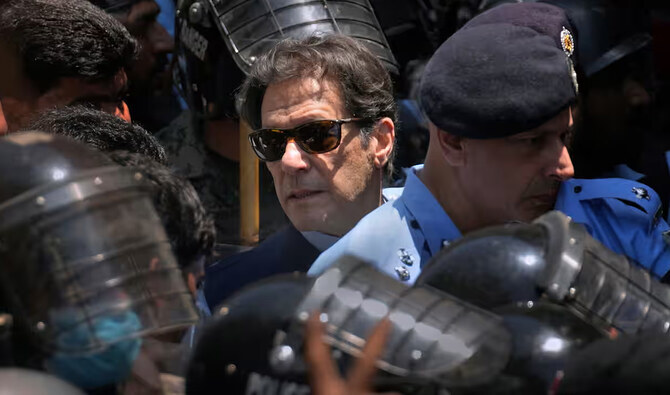
Police cammandos escort former Pakistan's Prime Minister Imran Khan (C) as he arrives at the high court in Islamabad on May 12, 2023. (AFP/File)
Short Url
Updated 20 November 2024
Follow

Pakistan court grants ex-PM Khan bail in new state gifts case, orders release — party

  • Khan and his wife are accused of undervaluing jewelry set and later buying it from state repository at lesser price
  • Unlikely Khan will be released as he is under arrest in cases relating to riots by his alleged supporters in May last year

ISLAMABAD: The Islamabad High Court (IHC) on Wednesday granted bail to former prime minister Imran Khan and ordered his release in a case involving gifts acquired from a state repository, his Pakistan Tehreek-e-Insaf (PTI) party said. 

The reference, popularly called the new Toshakhana case, was filed in July and involves a jewelry set worth over €380,000 gifted to the former first lady by a foreign dignitary when Khan was prime minister from 2018-2022. The couple is accused of undervaluing the gift and buying it at a lesser price from the state repository.

Khan’s wife, who was also under arrest in the case, got bail from the IHC last month. 

Before the new case was filed, the ex-premier, who has been in jail since last August, was convicted in four cases. Two of the cases have since been suspended, including an original one relating to state gifts, while he was acquitted in the remaining two.

“Former prime minister of Pakistan Imran Khan, currently jailed, has been granted bail in the Toshakhana 2 case,” the PTI said in a message shared with media. “Islamabad High Court has ordered his release.”

“This was the last government’s case [against Khan], all previous prosecutions have lost steam and collapsed,” Khan’s lawyer Salman Safdar told reporters outside the court after the IHC delivered its verdict.

However, it is unlikely that Khan will be released after the IHC order as he is also under arrest in a number of cases related to riots in May 2023 in which his alleged supporters ransacked government and military buildings after Khan’s brief arrest in a separate case. 

Khan’s convictions earlier this year prevented him from contesting the Feb. 8 election. The former prime minister and his party alleges the cases are politically motivated cases and a ploy by the caretaker government, Pakistan’s electoral watchdog, the powerful military and his political rivals, led by the Pakistan Muslim League-Nawaz (PML-N) party, to keep Khan and his party away from elections. All three deny the allegations. 

Khan, who was ousted from office after a parliamentary vote in April 2022, has since waged an unprecedented campaign of defiance against the country’s powerful military, which is thought to be aligned with the government.

He continues to remain popular among the masses, especially the youth, with his party’s rallies drawing thousands of people. Khan’s party has held several rallies over the past few months to build public pressure to secure his release from prison.

The PTI has announced it will hold an anti-government “long march” to Pakistan’s capital on Nov. 24 to demand Khan’s release from prison, the release of the party’s jailed leaders and supporters, and independence of the judiciary, which it says was compromised after the government recently passed the 26th amendment. 

The government says the recent amendments related to the judiciary are meant to smooth out its functioning and tackle a backlog of cases. 


Pakistan’s Mahnoor Omer named among TIME’s ‘Women of the Year’ for 2026

Updated 01 March 2026
Follow

Pakistan’s Mahnoor Omer named among TIME’s ‘Women of the Year’ for 2026

  • Omer moved a Pakistani court against the so-called ‘period tax’ in Sept. 2025 which has since sparked a national debate
  • Taxes on sanitary pads in Pakistan can add up to 40 percent to retail price, UNICEF says only around 12 percent women use such products

ISLAMABAD: Pakistani women’s rights activist Mahnoor Omer, who fought against taxes on menstrual products, has been named among the TIME magazine’s ‘Women of the Year’ for 2026.

Omer’s efforts have been recognized alongside 16 activists, artists, athletes and businesswomen in the TIME’s Women of the Year 2026 list, including Olympic gold medalist Sydney McLaughlin-Levrone and Oscar-nominated filmmaker Chloe Zhao.

Dissatisfied with the efforts to educate Pakistani girls about sexual violence, Omer founded the Noor Foundation at the age of 14 and held her own workshops with village girls about everything from climate change to menstruation, according to the TIME magazine.

Two years later, a conversation with a domestic worker about the price of pads made her realize that not everyone could afford these essentials. She moved a court against the so-called “period tax” in Sept. 2025 and the case has sparked a national debate on the subject, considered a taboo by many in Pakistan, since its first hearing late last year.

“A decade and one law degree after her interest in activism was sparked, Omer, now 25, is putting her passion and expertise to work in the name of gender equity,” TIME wrote about Omer on its website.

Taxes imposed on sanitary products in Pakistan can add up to 40 percent to the retail price. UNICEF estimates just 12 percent of women in the country use commercially produced pads or tampons. The alternative, using cloth, risks health impacts including rashes and infections, and can make it impossible for girls to attend school while menstruating.

Omer’s suit, which awaits the government response, has sparked a national discussion. She says she spoke about menstruation to her father and male cousins, who thanked her for standing up for their daughters.
The 25-year-old, who is currently enrolled in a master’s degree in gender, peace, and security at the London School of Economics, sees this case as just the first of many.

“I’m not free until every woman is free,” she was quoted as saying by TIME. “I want to leave no stones unturned in terms of what I can do with the next few decades, as a lawyer for the women in my country and gender minorities in general.”