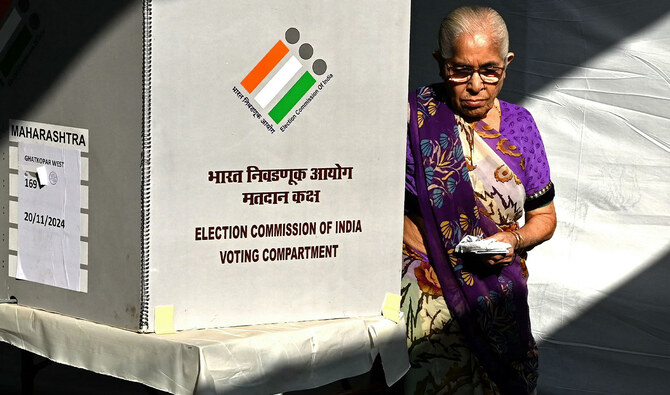
NEW DELHI: Millions of people are voting in state elections in Maharashtra, India’s western industrial hub, and the mineral-rich eastern province of Jharkhand on Wednesday, in a test of the popularity of Prime Minister Narendra Modi’s Hindu nationalist party and its regional partners.
Politically significant Maharashtra is India’s wealthiest state and home to the financial and entertainment capital, Mumbai. It is currently ruled by a coalition of Modi’s Bharatiya Janata Party and a Hindu nationalist ally. An opposition alliance, including the Congress party, is in power in eastern Jharkhand state.
Modi has held big rallies in the two states. The challenge comes barely four months after his party suffered a setback and returned to power in national elections for a third term without a parliamentary majority. He formed the government with the help of regional partners.
Modi, in a post on social platform X ahead of the state elections, wrote: “On this occasion, I appeal to all the youth and women voters to vote in large numbers.”
Nilanjan Mukhopadhyay, a political analyst who wrote a Modi biography, said a reversal in these state elections would negatively impact Modi’s leadership style.
“It will have repercussions for the BJP in coming elections in Delhi and Bihar states next year,” he said.
Votes in the two states will be counted on Saturday.
After suffering a setback in national elections, the BJP regained momentum in October as it won Haryana state elections, where pollsters had predicted an easy victory for the opposition Congress party.
Rahul Gandhi’s Congress party won a consolation victory in alliance with the regional National Conference party in local elections in India’s insurgency-wracked Jammu and Kashmir after a 10-year gap.
The BJP is trying to wrest power from the Congress party and its allies in Jharkhand, a state rich in iron ore, coal and other minerals.
The BJP’s use of slogans like “If you divide, then you will die” and “If we are united, then we are safe” to attract Hindu votes has prompted opposition parties to accuse the BJP of trying to polarize the voters along Hindu-Muslim religious lines.
Hindus constitute nearly 80 percent and Muslims 11.5 percent of Maharashtra state’s estimated 131 million people.
Mukhopadhyay saw a tendency from top BJP leaders to communalize the elections, saying, “It shows the growing desperation of the party, and it looks like their reading is they are not doing very well in Maharashtra and Jharkhand states.”
Election surveys on the eve of polling put the opposition alliance comprising the Congress party and two truncated regional groups, the Shiv Sena and the Nationalist Congress party, ahead of the BJP and its allies currently governing the state. The Congress party defeated the BJP and its allies in the June national elections by winning 30 out of 48 seats in the state. The BJP and its regional partners won 17 seats.
The Congress party and its allies hope to capitalize on the simmering disaffection with high youth unemployment, inflation and low crop prices during the BJP’s rule.
The BJP hopes to attract women voters with a scheme that provides 1,500 rupees ($18) a month to over 20 million women aged 21-65 whose annual family income is less than 250,000 ($3,010). If the Congress party is voted to power in the state, it has promised women double that amount and free transportation in government buses.


![]()

Elections in two Indian states test of Prime Minister Modi’s popularity
Short Url
https://arab.news/vgx9p
Elections in two Indian states test of Prime Minister Modi’s popularity
- Millions are voting in elections in Maharashtra, western industrial hub and mineral-rich eastern province of Jharkhand
- Election surveys on the eve of polling put the opposition alliance comprising Congress party and two others ahead of the BJP
Latest updates


© 2026 SAUDI RESEARCH & PUBLISHING COMPANY, All Rights Reserved And subject to Terms of Use Agreement.